


 Author:
I've built the retinol habit. Consistent application, pea-sized amount, dry skin, every other night, the works. My texture is smoother. The dark spots are fading. I'm four months in and it's working.
Then summer hits. Or I somehow skipped SPF twice in a row. Or perhaps I grab the cheapest sunscreen at the drugstore without checking the formula. And quietly, almost invisibly, my skin starts backsliding.
Sunscreen isn't an optional add-on to a retinol routine. It's the second half of the mechanism. Without it, you're running the engine without the oil, everything accelerates, and nothing lasts. This guide covers why retinol-treated skin has fundamentally different sun protection needs, how to choose the right sunscreen formula for specific skin state, and how AI skin analysis is making that choice faster and more accurate than ever.
Why Retinol Users Need Sunscreen More Than Anyone Else
Most people understand the headline: retinol makes skin more sun-sensitive, so wear SPF. What fewer people understand is the three-layer mechanism that makes skipping sunscreen so costly on a retinol routine specifically.
1. Retinol Accelerates Cell Turnover, and New Cells Are Defenseless
Retinol works by speeding up the skin's natural cell cycle. Normally, skin renews itself every 28–40 days. Retinol pushes that cycle faster, surfacing newer cells sooner.
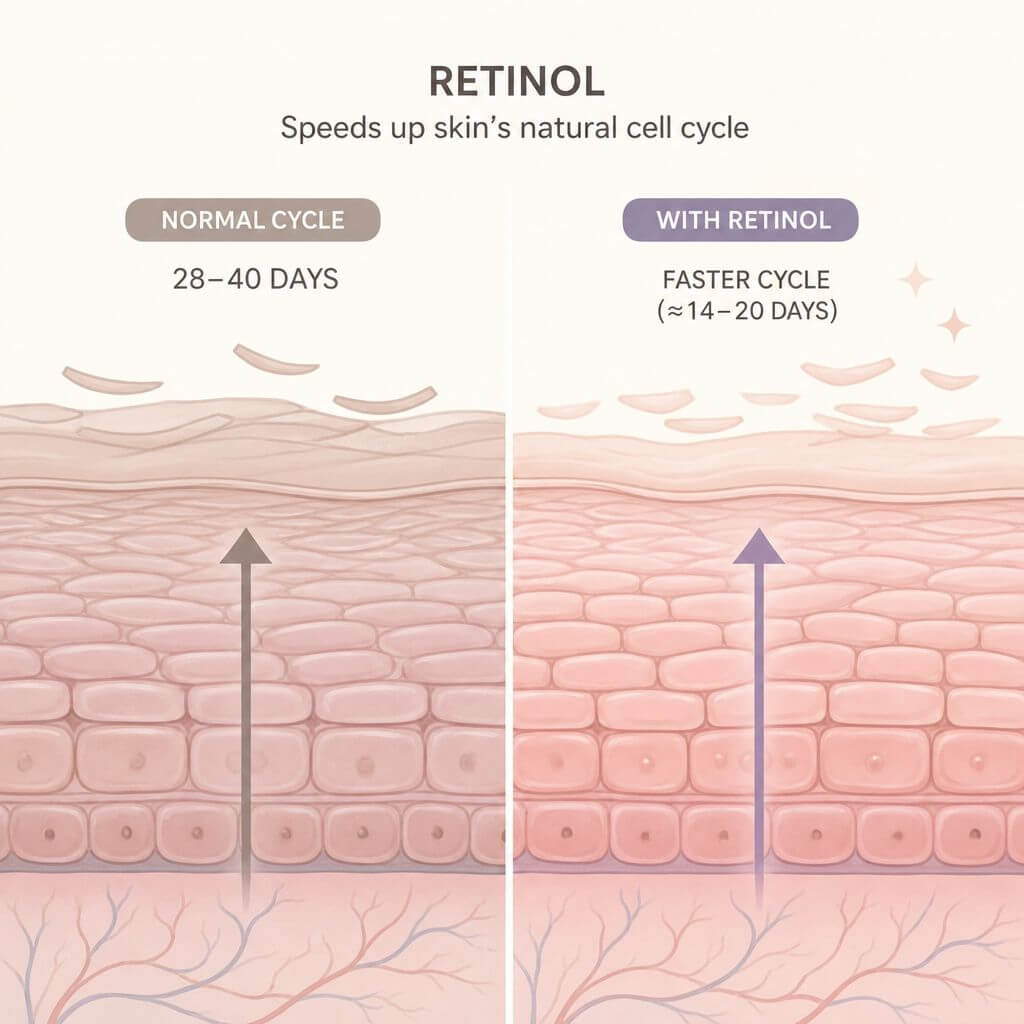
Those cells haven't had time to build the natural protective lipid barrier that mature skin cells develop. The stratum corneum, your skin's outermost layer, is effectively thinner and more UV-permeable during active retinol use.
This is the mechanism that improves texture. It's also what makes the skin so vulnerable to solar damage in the same window.
2. UV Radiation Degrades Residual Retinol Molecules
This part is almost always left out of the conversation, and it's critical. You apply retinol at night. Correct. But retinoid molecules are lipophilic, they diffuse into the lipid layers of the skin and don't simply disappear by morning.
Residual retinol remains in your skin's upper layers the following day.
Research published in the Journal of Pharmaceutical Sciences (Tashtoush, 2008) found that UV exposure can degrade tretinoin by up to 80%, meaning morning sun exposure isn't just a skin-damage event, it's actively destroying the active ingredient you invested in the night before.
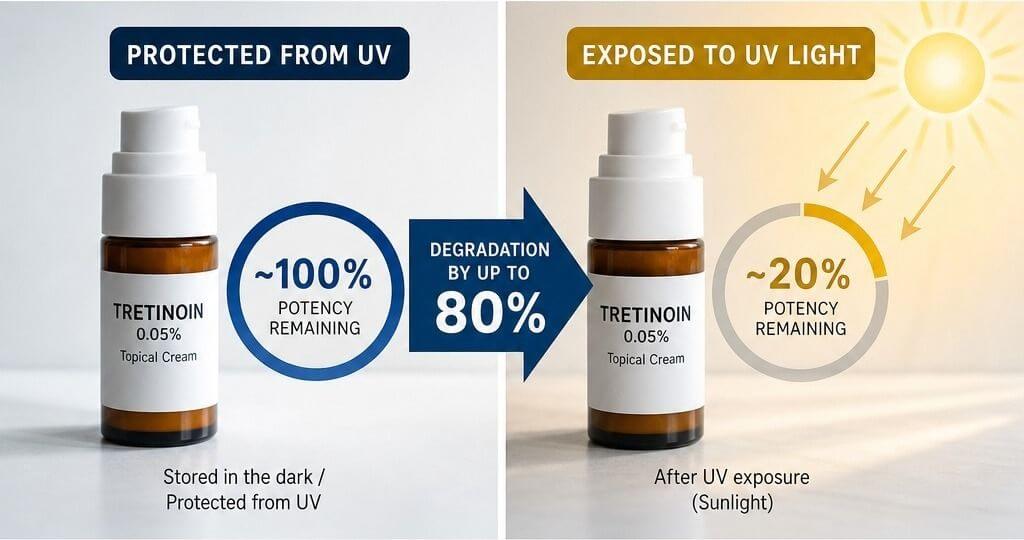
Without sunscreen, you're preserving perhaps 20% of your retinol's overnight work.
3. Retinol and UV Damage Target the Same Skin Concerns in Opposite Directions
Retinol is fighting hyperpigmentation, fine lines, and uneven texture. UV damage is creating hyperpigmentation, fine lines, and uneven texture. Every unprotected morning erases progress on the exact concerns retinol was treating.
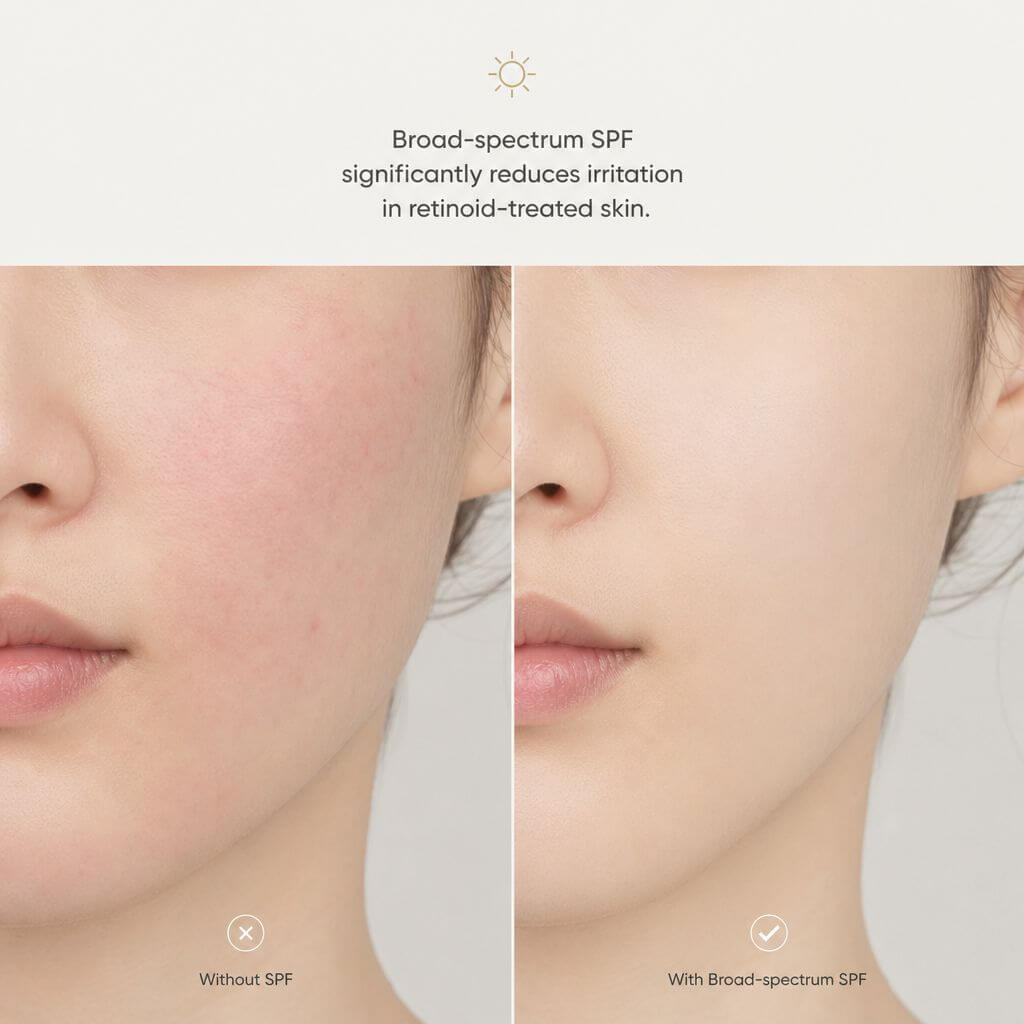
The clinical data reinforces this. A study in Photodermatology, Photoimmunology & Photomedicine found that consistent broad-spectrum SPF application significantly reduces irritation in retinoid-treated skin, meaning sunscreen doesn't just protect results, it actively improves retinol tolerability.
What SPF Do Retinol Users Actually Need?
The standard dermatologist recommendation is SPF 50 broad-spectrum for retinol users — one step above the general SPF 30 floor. Here's the reasoning:
SPF numbers assume correct application, approximately 2 mg per cm2 of skin, which for the average adult face translates to about a quarter teaspoon of sunscreen.
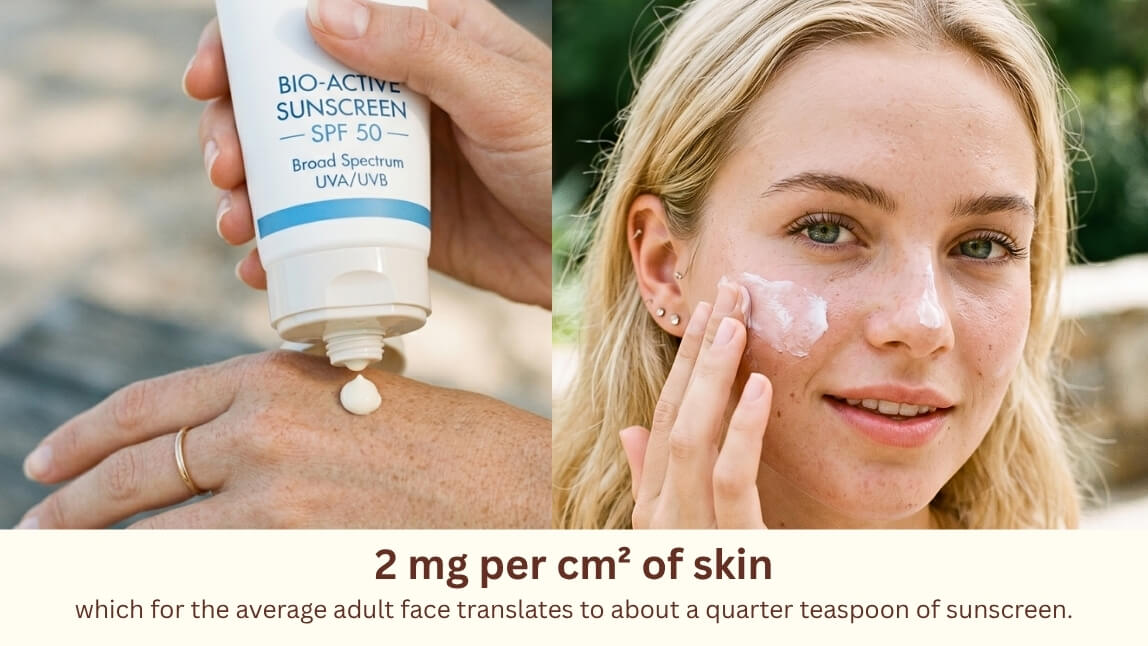
Real-world application studies consistently show people apply 25–50% of the recommended amount.
At that rate, SPF 30 delivers effective protection closer to SPF 11–15. SPF 50 under-applied lands closer to SPF 17–20. The practical gap between SPF 30 and SPF 50 closes significantly under realistic use conditions, which is why erring toward the higher number matters when your skin is already sensitized.
The second critical criterion is broad-spectrum coverage. Most sunscreens are tested and marketed primarily on UVB protection, that's what the SPF number measures. But UVA rays penetrate deeper, drive the majority of photoaging, and are responsible for much of the hyperpigmentation that retinol users are trying to correct.
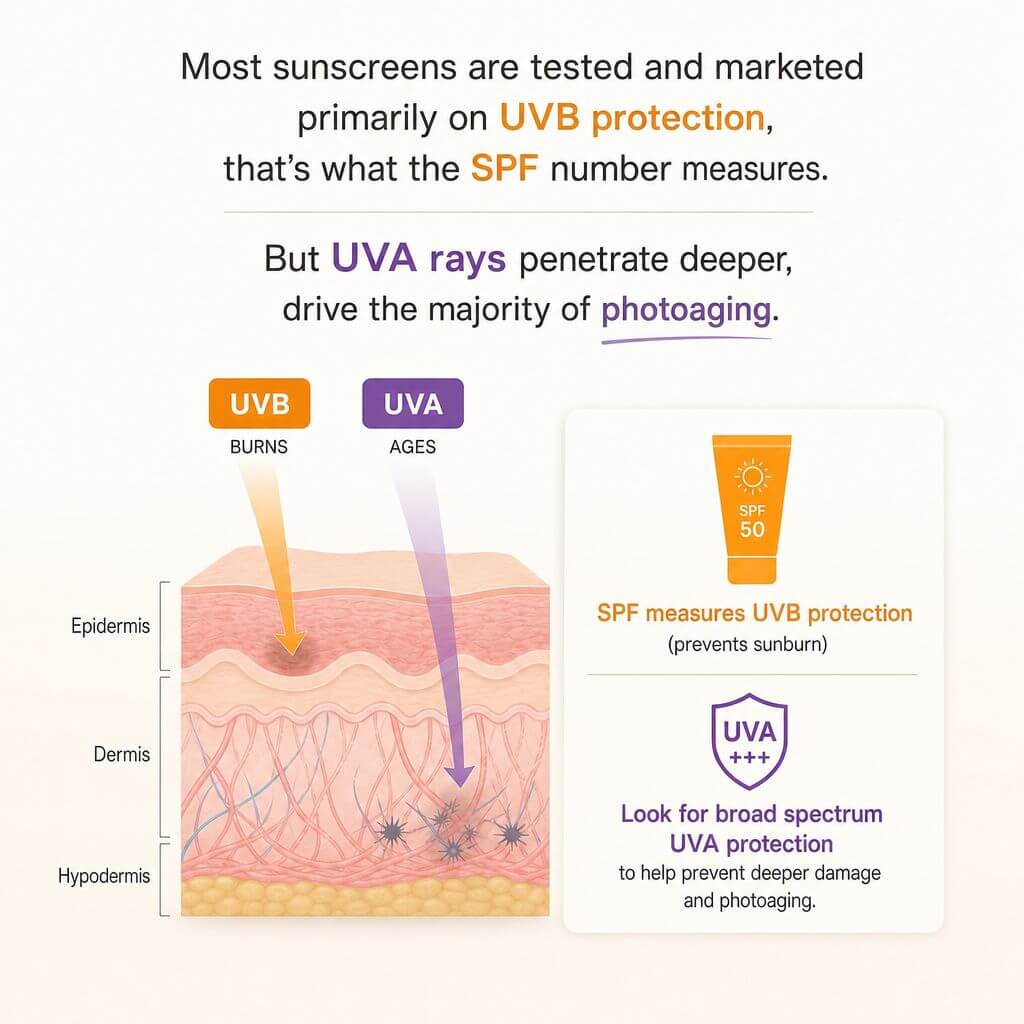
If your sunscreen isn't explicitly labeled broad-spectrum, it may be leaving UVA largely unblocked.
| SPF Level | Theoretical UVB Block | Realistic Block (50% application) | Recommendation for Retinol Users |
|---|---|---|---|
| SPF 15 | 93% | ~80% | Insufficient |
| SPF 30 | 97% | ~88% | Minimum; adequate for low exposure |
| SPF 50 | 98% | ~92% | Recommended standard |
| SPF 50+ | 98%+ | ~94%+ | Preferred for high-exposure days or post-tretinoin skin |
Mineral vs. Chemical Sunscreen: Which Is Better for Retinol Users?
Both types block UV effectively when used correctly. The choice for retinol users comes down to skin state, specifically where your skin is in the retinization process.
Mineral Sunscreen (Zinc Oxide / Titanium Dioxide)
Mineral sunscreens use zinc oxide and titanium dioxide as their active ingredients, the only two UV filters the FDA classifies as GRASE (generally recognized as safe and effective). They work at the skin surface, absorbing and dissipating UV energy as heat rather than penetrating into deeper skin layers.
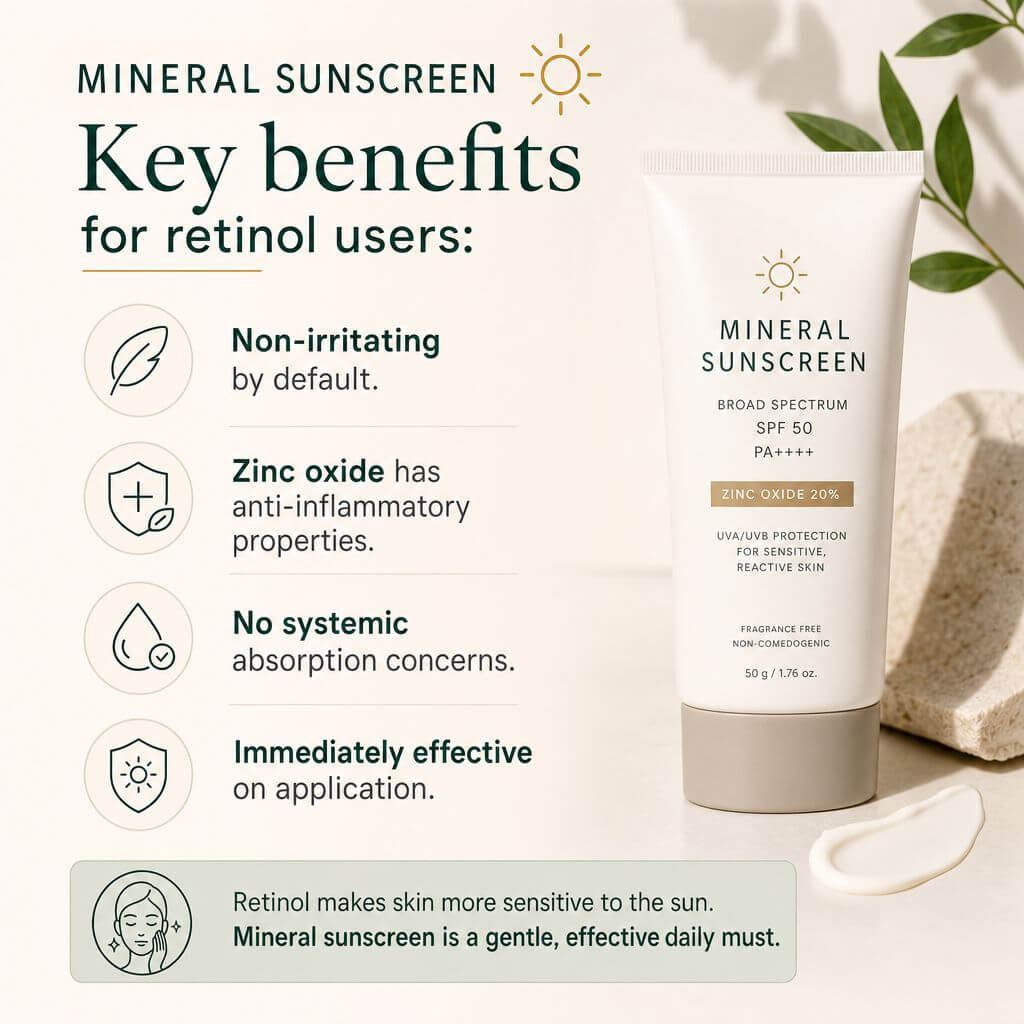
Key benefits for retinol users:
- Non-irritating by default. No chemical UV filters means no potential sensitizers for skin that's already in a reactive, cell-turnover-accelerated state.
- Zinc oxide has anti-inflammatory properties. For skin experiencing the redness and sensitivity of early retinization, this is a meaningful bonus.
- No systemic absorption concerns. A 2019–2020 FDA trial showed six common chemical UV filters appeared in plasma above the safety testing threshold after a single day of use. Mineral filters do not absorb meaningfully through intact skin.
- Immediately effective on application. No 15–20 minute wait period before UV protection activates.
The traditional downside is white cast, particularly on medium-to-deep skin tones. Modern micronized and nano-particle zinc formulas have largely addressed this, tinted mineral sunscreens with iron oxides eliminate white cast entirely and add a bonus layer of visible light protection that helps with melasma and PIH (post-inflammatory hyperpigmentation).
Chemical Sunscreen
Chemical sunscreens absorb into the skin's surface layers and convert UV radiation into heat through a chemical reaction. They feel lighter, blend invisibly, and are generally easier to layer under makeup.
For retinol users whose skin has fully adapted, typically after 3–6 months of consistent use, a well-formulated chemical sunscreen without oxybenzone is a perfectly viable daily option.
The caution: during the first 1–3 months of retinol use, when the skin barrier is most disrupted, chemical UV filters, particularly avobenzone, oxybenzone, and octocrylene, carry a higher risk of triggering irritation in sensitized skin.
If you're experiencing active redness, peeling, or tightness from retinol, switch to mineral during that window.
| Feature | Mineral (Zinc/Titanium) | Chemical |
|---|---|---|
| FDA safety classification | GRASE | Under review (12 filters) |
| Skin irritation risk | Very low | Low–moderate (skin-dependent) |
| For early retinization phase | Strongly preferred | Use with caution |
| For adapted retinol skin | Excellent | Excellent (avoid oxybenzone) |
| Finish/wearability | Improved; tinted options available | Lighter, more invisible |
| Anti-inflammatory bonus | Yes (zinc oxide) | No |
| Immediate protection | Yes | No (15–20 min needed) |
How to Apply Sunscreen When Using Retinol: The Full Morning Routine
Order matters. Here's the correct sequence, and why each step is where it is:
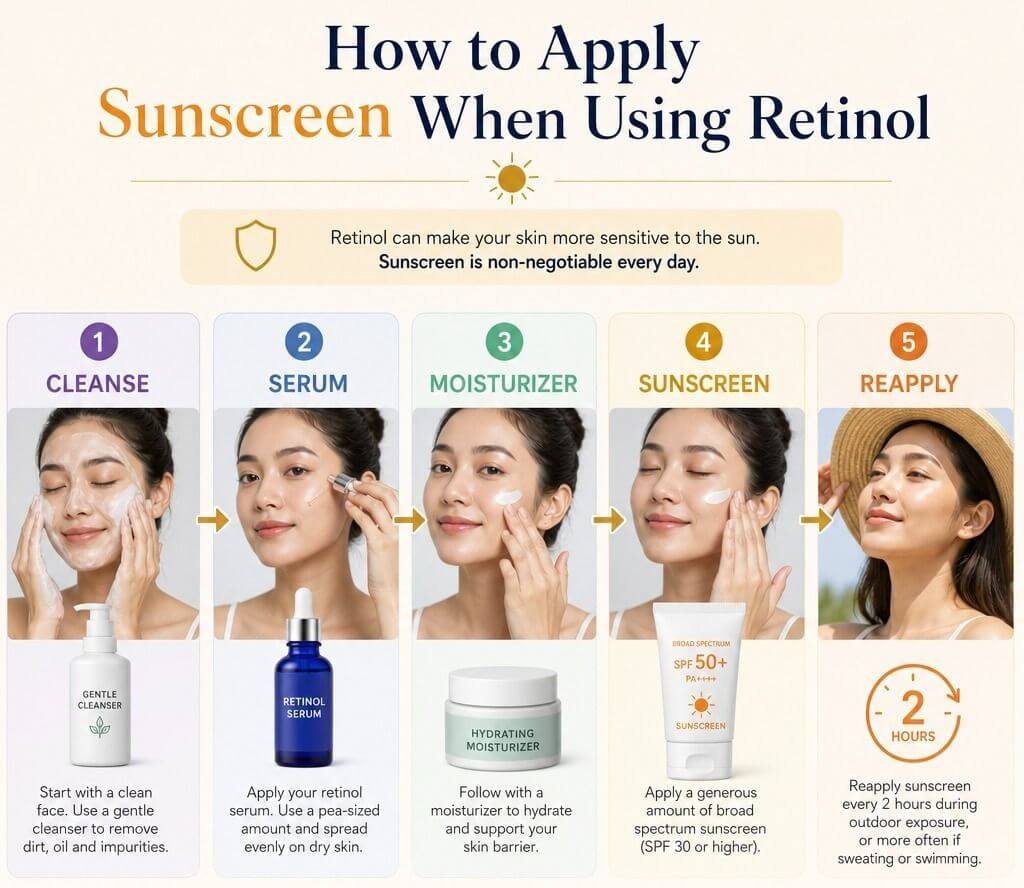
- Cleanse. Wash your face to remove any residual retinol, natural oils, and overnight products. A gentle, non-stripping cleanser. No acids or exfoliants in the morning while using retinol at night — your skin is already in an accelerated turnover state.
- Serum (if any). Antioxidant serums, vitamin C in particular, go here. Vitamin C and broad-spectrum sunscreen form a complementary combination: C neutralizes free radicals that UV generates, while SPF blocks the UV itself. Apply to dry skin, let it absorb for 30–60 seconds.
- Moisturizer. Essential. Retinol-treated skin loses moisture faster due to the accelerated cell turnover cycle. A barrier-supporting moisturizer with ceramides, hyaluronic acid, or niacinamide helps compensate. Apply before sunscreen to ensure the lipid-replenishing ingredients reach the skin directly — not filtered through a sunscreen layer on top.
- Sunscreen — last step, always. Apply a full quarter-teaspoon (about two finger-widths) to the face and neck. Do not mix sunscreen into your moisturizer, dilution reduces the UV filter concentration and compromises protection. Sunscreen is your final, outermost protective layer.
- Reapply every 2 hours during outdoor exposure. This is where most people lose protection. A morning application does not provide all-day coverage. For desk workers near windows, reapplication every 3–4 hours is a reasonable practical target. For outdoor exposure, every 2 hours is the clinical standard.
What Sunscreen Ingredients to Look For (and Avoid) on a Retinol Routine
Look For
- Zinc oxide — broad-spectrum UVA/UVB coverage, anti-inflammatory, FDA GRASE
- Titanium dioxide — strong UVB coverage, photostable, FDA GRASE
- Niacinamide — soothes redness from retinization, supports barrier function
- Ceramides — replenish the lipid barrier that retinol accelerates through
- Hyaluronic acid — compensates for the moisture disruption of active cell turnover
- Iron oxides (in tinted formulas) — block visible light, particularly relevant for melasma and post-retinol PIH
Avoid (During Active Retinization)
- Oxybenzone — highest systemic absorption rate among chemical filters; potential endocrine concerns; most irritating for sensitized skin
- Fragrances and essential oils — common contact sensitizers; retinized skin is significantly more reactive to them
- Alcohol (high on ingredient list) — disrupts the barrier further; counterproductive when retinol is already stressing barrier integrity
- AHAs or BHAs in the morning formula — doubling up on exfoliation while retinol is already accelerating turnover leads to over-exfoliation and inflammation
How AI Skin Analysis Helps Retinol Users Choose the Right Sunscreen
The "right sunscreen for retinol users" question isn't one-size-fits-all. A first-month retinol beginner with low hydration scores needs a fundamentally different formula than a two-year veteran with a stable, healthy barrier. The retinol user with active acne needs something different from the one primarily addressing photoaging. And someone with melasma needs visible light protection that a standard non-tinted SPF won't provide.
This is exactly the problem AI skin analysis solves.
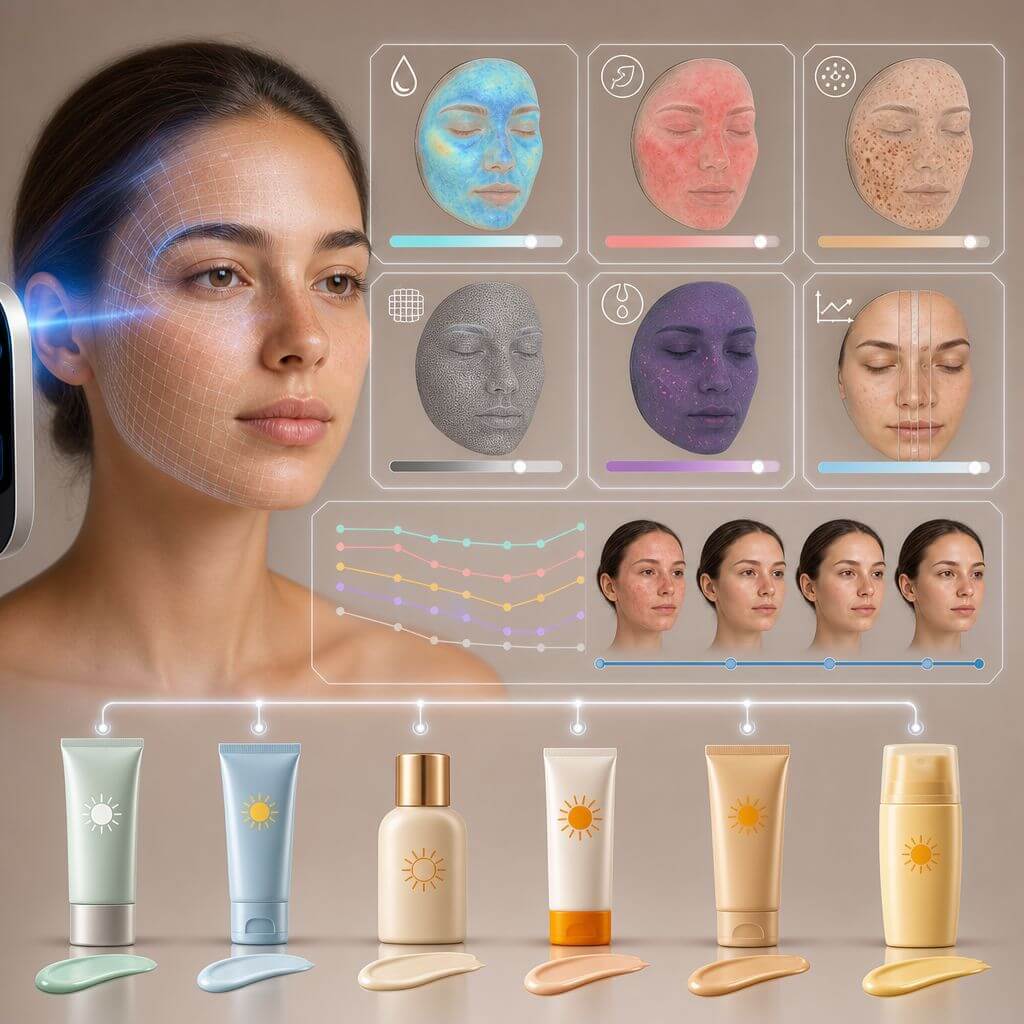
What AI Detects That Changes the Sunscreen Recommendation
- Hydration levels. Low hydration scores signal a compromised barrier, the signal to prioritize sunscreens with ceramides and hyaluronic acid, and to avoid alcohol-heavy chemical formulas.
- Redness and inflammation markers. Elevated redness during retinization indicates the skin is in a reactive state. AI can quantify this and recommend mineral-only formulas while the skin stabilizes.
- Hyperpigmentation and spot distribution. AI-detected dark spot density and location informs whether the user needs visible light blocking (iron oxides) in addition to UV protection, a tinted SPF recommendation versus a standard one.
- Texture and pore scores. Rough texture and enlarged pores can indicate whether an SPF formula with niacinamide is particularly beneficial, niacinamide both soothes retinization and refines pore appearance.
- Acne activity. Active acne changes the sunscreen formula calculus significantly. Comedogenic ingredients in SPF products can directly aggravate retinol's acne-clearing work. AI that detects and classifies acne activity flags this need for non-comedogenic, oil-free formulas.
- Progress tracking over time. AI skin scores at Week 0, Week 8, and Week 16 show whether the retinol + sunscreen combination is actually improving the target concerns — or whether a formula adjustment is needed. Without tracked data, most people have no reliable way to evaluate whether their routine is working.
Perfect Corp.'s AI Skin Analysis detects 15+ skin concerns — including hydration, redness, acne, texture, pigmentation, and wrinkles — with 95% clinical accuracy, trained on over 70,000 medical-grade images. For skincare brands, clinics, and platforms serving retinol users, this creates a direct diagnostic-to-recommendation pathway: scan the skin, read the condition, recommend the sunscreen formula that matches what the skin actually needs right now.
Learn how Perfect Corp.'s AI Skin Analysis works
Seasonal Sunscreen Adjustments for Retinol Users
Skin on a retinol routine doesn't have static sunscreen needs. Seasonal changes shift the equation in meaningful ways — and ignoring them is one of the most common reasons retinol routines plateau or produce irritation after months of working well.
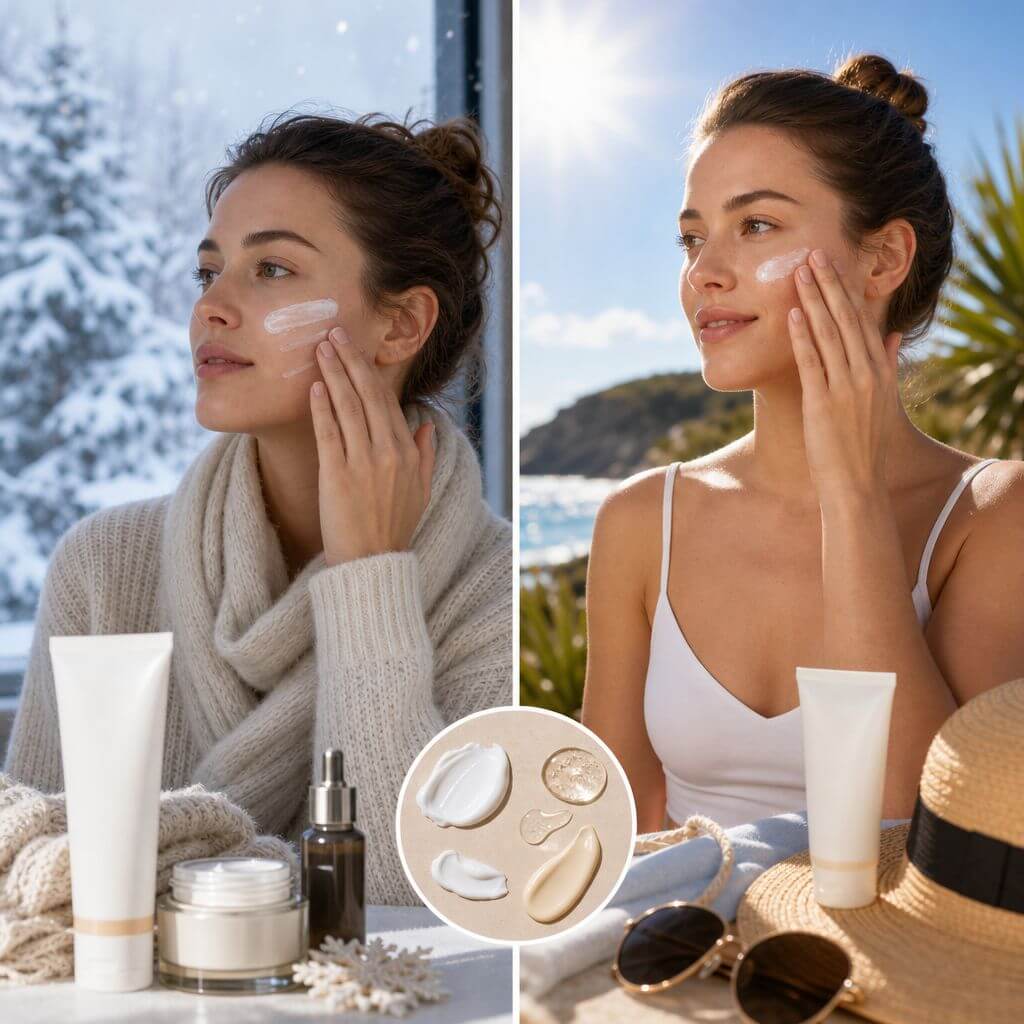
Winter
Cold weather, low humidity, and indoor heating strip moisture from the skin. Retinol is already accelerating barrier disruption. In winter, barrier reinforcement becomes the priority: SPF formulas with richer bases, higher ceramide and hyaluronic acid content.
Consider dropping retinol frequency from every night to every other night during the driest weeks, and increasing moisturizer weight before applying SPF.
Summer
Higher UV intensity, longer daylight hours, and sweating all increase the demand on SPF coverage. Reapplication frequency is the critical adjustment, most people reapply in winter roughly half as often as they should in summer. Water-resistant formulas (80-minute rating) matter more when sweating is a factor.
Iron oxide tinted sunscreens help manage the increased UV-driven pigmentation risk that comes with retinol-sensitized skin in high-UV months.
How Skincare Brands Can Use AI to Improve Sunscreen Recommendations for Retinol Users
For skincare brands and beauty platforms serving retinol users, sunscreen recommendation is a persistent conversion challenge. "Which SPF should I use with my retinol?" is one of the most common skincare questions online, and the answer varies by skin state in ways a static quiz simply can't capture.
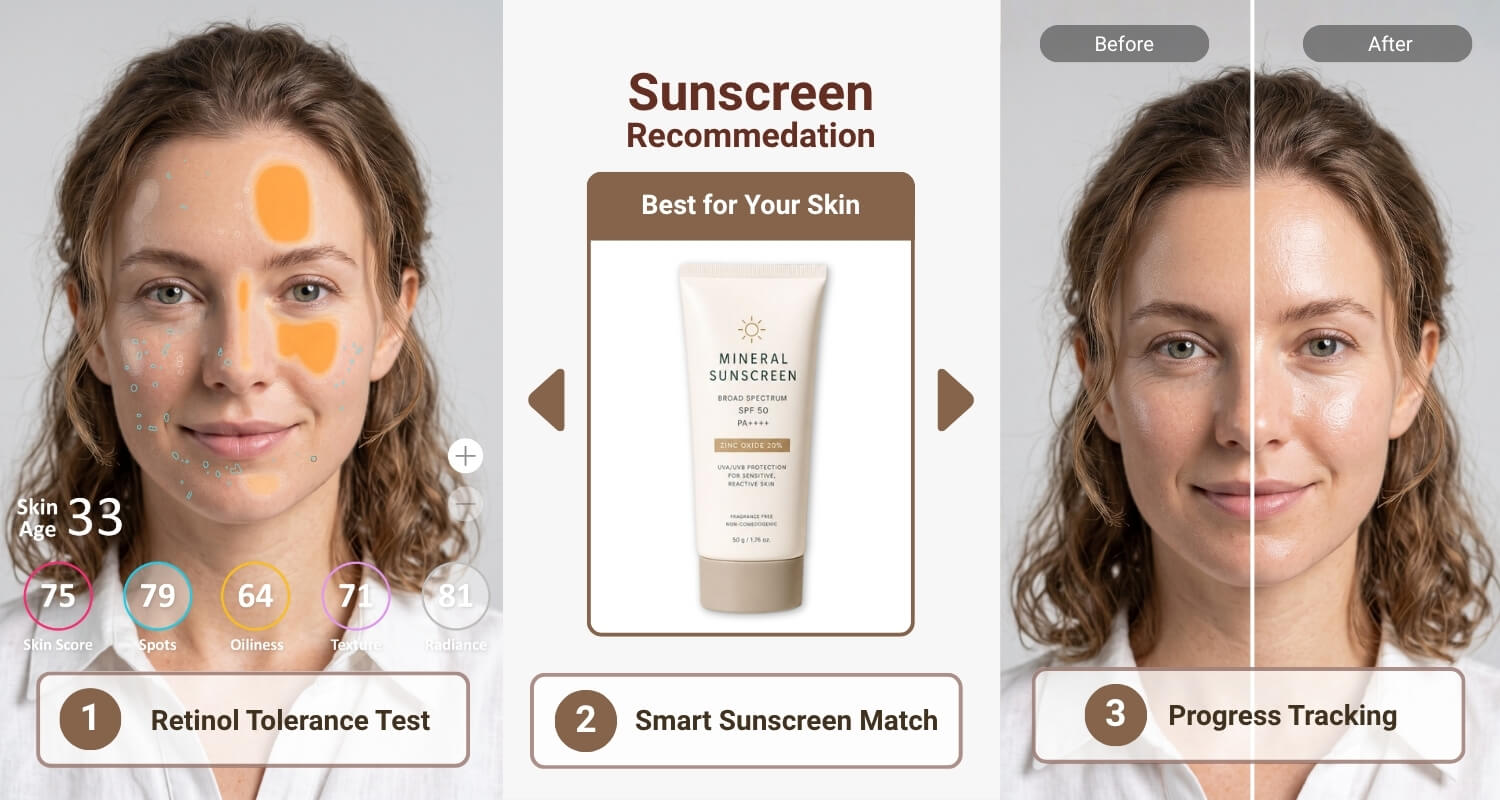
AI skin analysis creates a new category of sunscreen recommendation experience:
- Retinization stage detection. An AI that scores redness, hydration, and barrier integrity can infer where a user is in their retinol adaptation curve — and map that to the appropriate SPF formula category (mineral-only early stage vs. hybrid or chemical for adapted skin).
- Concern-matched SPF pairings. Hyperpigmentation scores → tinted mineral SPF recommendation. Acne scores → non-comedogenic, oil-free formula flags. Dry texture → ceramide-heavy SPF formulas. The AI output becomes the recommendation logic.
- Progress tracking that drives repurchase. Before-and-after skin score comparisons that show concrete improvement in hydration, redness, and pigmentation over an 8–12 week retinol + SPF routine are among the most compelling retention tools available to skincare brands. The data exists in the AI scan — it just needs to be surfaced.
- In-store and clinic consultation enhancement. AI skin analysis at point of consultation gives skincare advisors and dermatologists a shared, objective skin baseline — reducing the subjectivity in sunscreen recommendations and increasing patient confidence in the prescription.
Perfect Corp.'s AI Skin Analysis API integrates into brand websites, mobile apps, and in-clinic kiosks with a straightforward developer implementation path. Brands serving retinol users specifically can map the AI's 15+ skin concern scores directly to their SPF product catalog — turning a generic "wear SPF" instruction into a personalized, skin-state-specific sunscreen recommendation.
The Retinol + Sunscreen Routine at a Glance
| Time | Step | Key Notes |
|---|---|---|
| Morning | Gentle cleanser | No acids or exfoliants — retinol is still in the skin |
| Morning | Antioxidant serum (optional) | Vitamin C complements SPF by neutralizing free radicals |
| Morning | Moisturizer with ceramides | Always before SPF; supports retinol-stressed barrier |
| Morning | Broad-spectrum SPF 50 | Last step; quarter teaspoon for face + neck; reapply every 2 hours outdoors |
| Evening | Double cleanse (or single if no SPF buildup) | Remove SPF thoroughly before retinol application |
| Evening | Retinol | On completely dry skin; pea-sized amount; avoid eyes and lip corners |
| Evening | Moisturizer | Wait 20–30 min after retinol, or use sandwich method for sensitive skin |
Frequently Asked Questions
Do I need sunscreen if I only use retinol at night?
Yes, and the answer is firm. Retinol accelerates cell turnover, leaving newer, more UV-vulnerable cells at the surface by morning. Residual retinoid molecules remain in the skin's upper layers and are degraded by UV exposure the following day, research suggests UV can break down up to 80% of residual retinoids.
Your skin's photosensitivity from the previous night's application doesn't disappear by morning. Daily broad-spectrum SPF 50 is non-negotiable even when retinol is applied exclusively at night.
Can I use retinol and sunscreen together in the morning?
No. Retinol should not be applied in the morning. UV light destabilizes retinol, dramatically reducing its efficacy, and morning retinol application combined with sun exposure significantly amplifies irritation risk.
Your morning routine is cleanser → antioxidant serum (optional) → moisturizer → sunscreen. Retinol belongs exclusively in the evening routine, on dry skin, as the first active step.
What SPF is recommended for retinol users?
Broad-spectrum SPF 50 is the dermatologist standard for retinol users. The broad-spectrum designation ensures UVA coverage, which SPF numbers alone don't measure.
SPF 50 provides a practical buffer for the inevitable under-application that real-world use involves.
For outdoor-heavy days or retinol users in high-UV climates, SPF 50+ with water resistance offers additional protection.
Is mineral or chemical sunscreen better for retinol users?
During the first 1–3 months of retinol use, when the skin barrier is most disrupted and reactive, mineral sunscreen (zinc oxide and/or titanium dioxide) is strongly preferred.
Zinc oxide has anti-inflammatory properties that actively help the retinization phase, and mineral filters don't carry the irritation risk that some chemical filters do on sensitized skin.
Once the skin has adapted to retinol (typically 3–6 months of consistent use), a well-formulated chemical sunscreen without oxybenzone is a perfectly viable choice.
Your current skin condition, readable objectively through AI skin analysis — is the most reliable guide to which formula is appropriate right now.
How does AI help choose the right sunscreen when using retinol?
AI skin analysis scans for the specific skin signals that differentiate sunscreen needs: hydration levels (which guide formula texture and barrier ingredients), redness scores (which indicate whether mineral-only formulas are needed), hyperpigmentation distribution (which determines whether tinted iron-oxide SPF is warranted), and acne activity (which flags the need for non-comedogenic formulas).
Rather than applying a generic "use SPF 50" recommendation, AI creates a skin-state-specific sunscreen prescription, the right formula for where your skin is right now, not just a retinol user in general.
Can sunscreen improve retinol results?
Yes, directly and measurably.
A study in Photodermatology, Photoimmunology & Photomedicine found that consistent daily SPF reduces retinoid-associated skin irritation.
Beyond that, every prevented UV-damage event means your retinol's collagen-stimulating, pigmentation-clearing work isn't immediately counteracted. Over an 8–12 week retinol routine, the difference in outcomes between consistent SPF users and non-users is one of the most significant variables in the result equation, more impactful than retinol concentration differences within the same strength tier.



 English


