


 Author: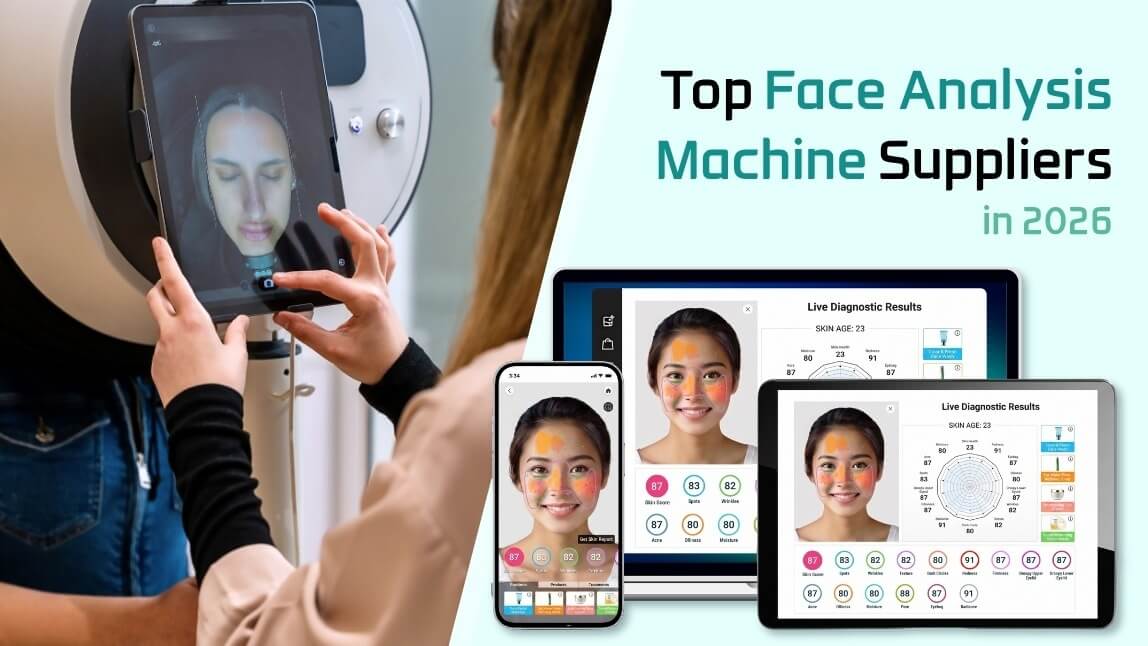
If you've Googled "face analysis machine supplier" lately, you've probably noticed something weird: half the results are 80-pound hardware boxes that look like vintage photo booths, and the other half are AI apps your customers can run from a phone. Welcome to 2026, where the "machine" is changing faster than the skin it's scanning.
Clinics, dermatology brands, beauty retailers, and even consumers are all asking the same question: who actually makes the best face analysis tech right now? This guide breaks down the top face analysis machine suppliers, what each one does well, where they fall short.
Table of Contents
- What Is a Face Analysis Machine?
- Why Are Brands Switching From Hardware to AI Software?
- Who Are the Top Face Analysis Machine Suppliers in 2026?
- How Do You Choose the Right Face Analysis Machine Supplier?
- What Features Should a 2026 Face Analyzer Have?
- How Much Does a Face Analysis Machine Cost?
- Can You Replace a Face Analysis Machine With an AI API?
- FAQ
What Is a Face Analysis Machine?
A face analysis machine is a device, or, increasingly, a piece of software, that captures high-resolution images of a person's face and runs them through computer-vision algorithms to flag skin concerns: wrinkles, pores, pigmentation, redness, UV damage, texture, sebum, hydration, and more.
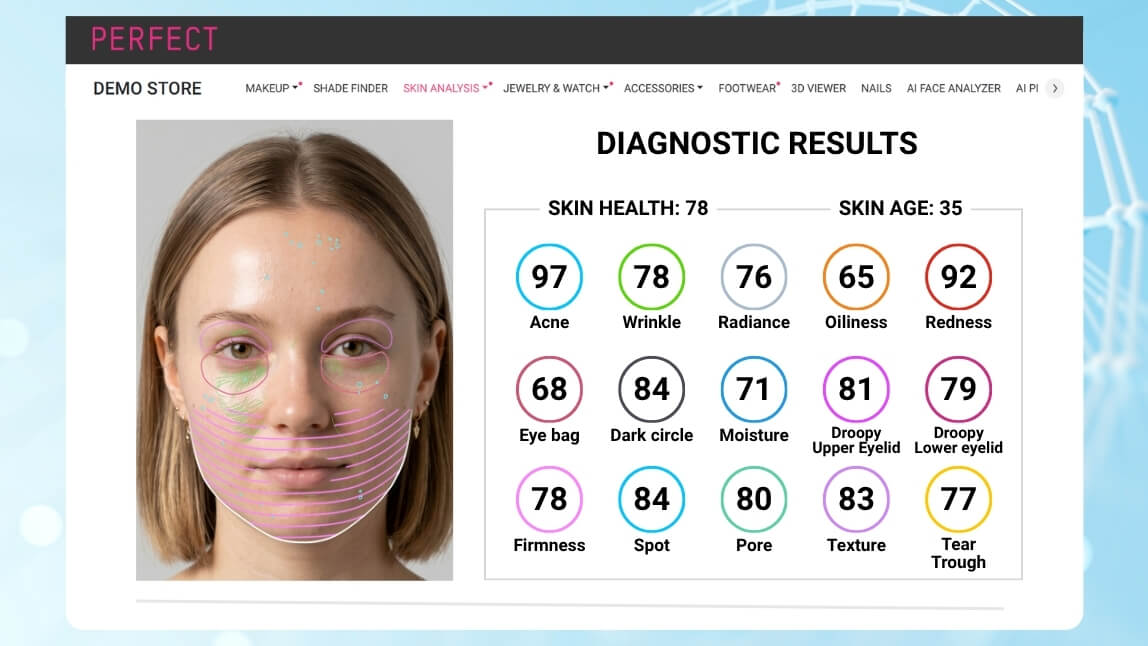
Traditional machines use multi-spectral lighting (visible light, UV, polarized, parallel-polarized) inside a controlled hood so results stay consistent. AI-driven analyzers skip the hood entirely and use deep-learning models trained on millions of facial images to deliver the same insights from a regular camera.
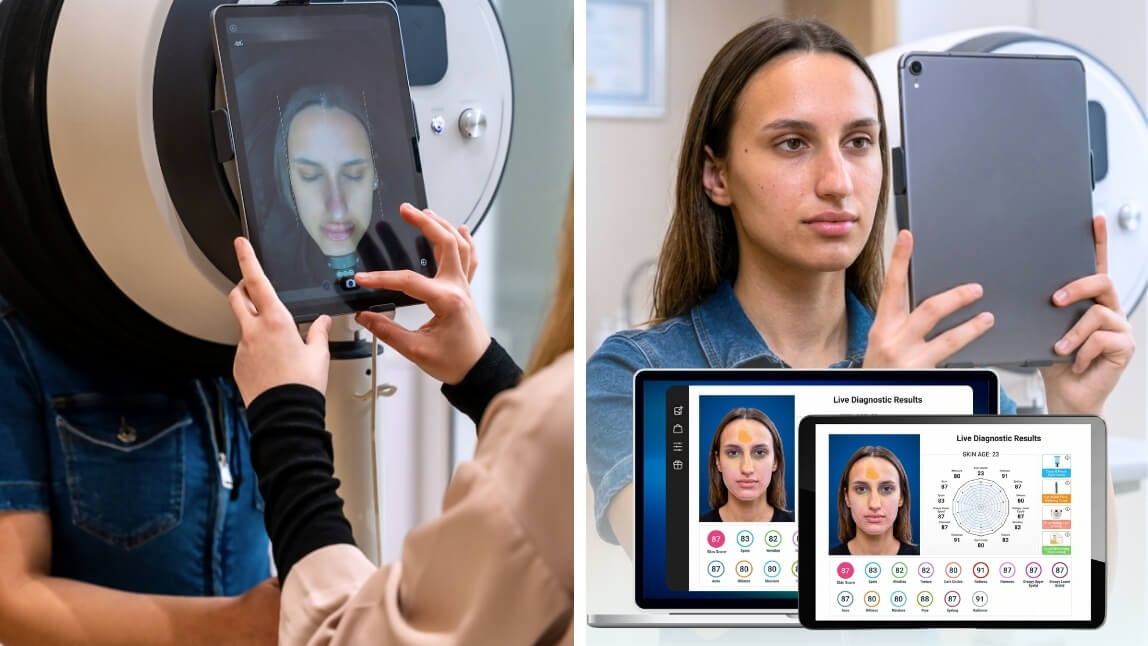
The category splits into three buckets:
- Clinical hardware — Standalone units (think VISIA, VECTRA, Observ).
- Spa/retail hardware — Compact tablet- or mirror-style devices for salons, counters, and esthetician chains.
- AI software & APIs — Cloud or on-device platforms that turn any phone, tablet, or webcam into a skin analyzer (Perfect Corp., Haut.AI, Revieve).
Why Are Brands Switching From Hardware to AI Software?
Hardware is brilliant when your clients are already inside the clinic. The trouble starts the moment you want to scale beyond one room.
A $20,000+ machine sits idle 80% of the time, can't follow shoppers home, and won't help your ecommerce team convert a TikTok visitor at 11 p.m. AI-based face analysis flips the math: one trained model can serve a flagship store, a website, a mobile app, and 200 retail counters at once.
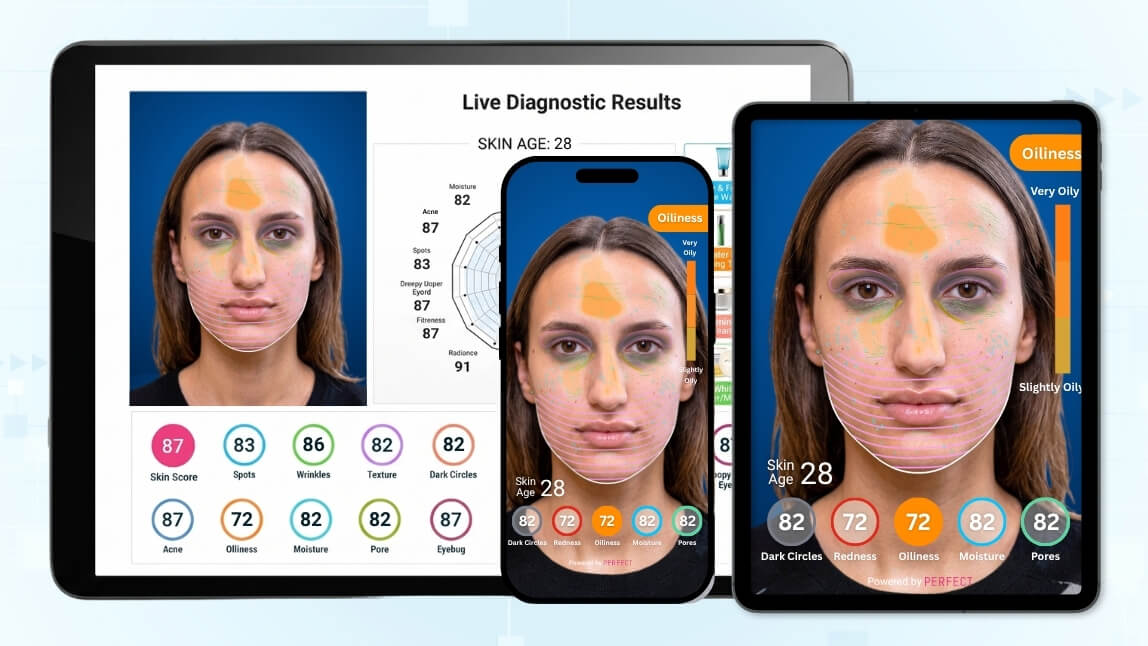
Perfect Corp.'s case studies show beauty retailers boosting Average Client Spend +47% after embedding AI skin analysis on product pages. Read more>
Who Are the Top Face Analysis Machine Suppliers in 2026?
Here's the shortlist of suppliers that consistently show up in clinic procurement decks, beauty-tech RFPs, and aesthetic conference exhibit halls this year. We split them into hardware-first and AI-first camps so you can compare apples to apples.
Top Face Analysis Machine Suppliers Comparison (2026)
| Supplier | Type | Best For | Notable Strength | Starting Price (USD) |
|---|---|---|---|---|
| Perfect Corp. | AI Software / API | Beauty brands, retailers, app developers, medspa & all | 15-attribute AI skin analysis, no hardware needed, WCM/SDK/API all supported | Subscription or customized price plan according to needs. |
| Canfield VISIA Gen8 | Clinical Hardware | Dermatology, plastic surgery | Gold-standard multi-spectral imaging | $7,000–$10,000+ |
| VECTRA 3D (Canfield) | Clinical Hardware | Plastic surgery, aesthetic simulation | 3D face modeling for procedure visualization | $500,000+ |
| Observ 520x | Clinical Hardware | Med-spas, esthetician chains | Skin-fluorescence imaging modes | $15,500–$17,990 AUD |
| Fotromed Derma Vision X | Hardware | Clinic chains, OEM/ODM buyers | Skin + Scalp 2-in-1 analyzer | $800–$3,000 |
| Zemits VeraFace | Spa/Retail Hardware | Boutique spas, esthetician studios | User-friendly UI, affordable entry | $8,270–$8,990 |
| Haut.AI | AI Software / API | Skincare R&D, brand portals | Longitudinal skin tracking | Subscription |
| Revieve | AI Software | Retail e-commerce | Routine and product recommendation engine | Subscription |
(All the info above may be updated by each brand)
1. Perfect Corp. — The AI-First Disruptor
Perfect Corp. doesn't sell you a box. It sells you an AI engine that fits in a browser tab.
The AI Face & Skin Analyzer reads 15 skin attributes: wrinkles, dark circles, pores, redness, pigmentation, oiliness, firmness, radiance, texture, and more, from a single selfie.
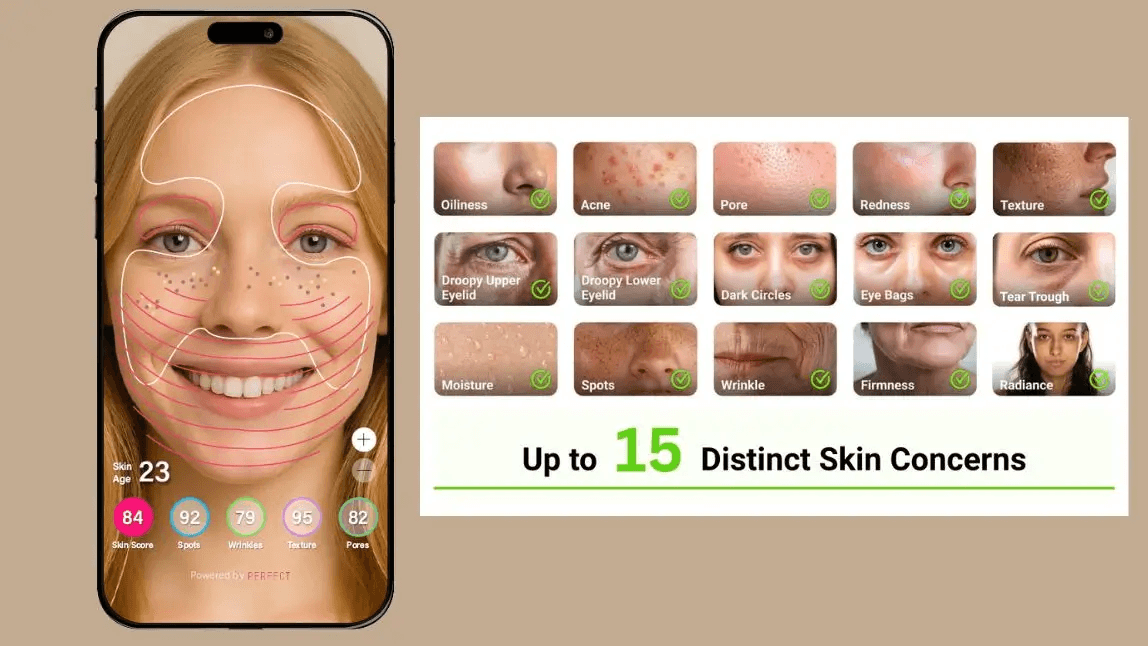
No multi-spectral hood. No physical install. It works on smartphones, tablets, in-store mirrors, and websites with one API call.
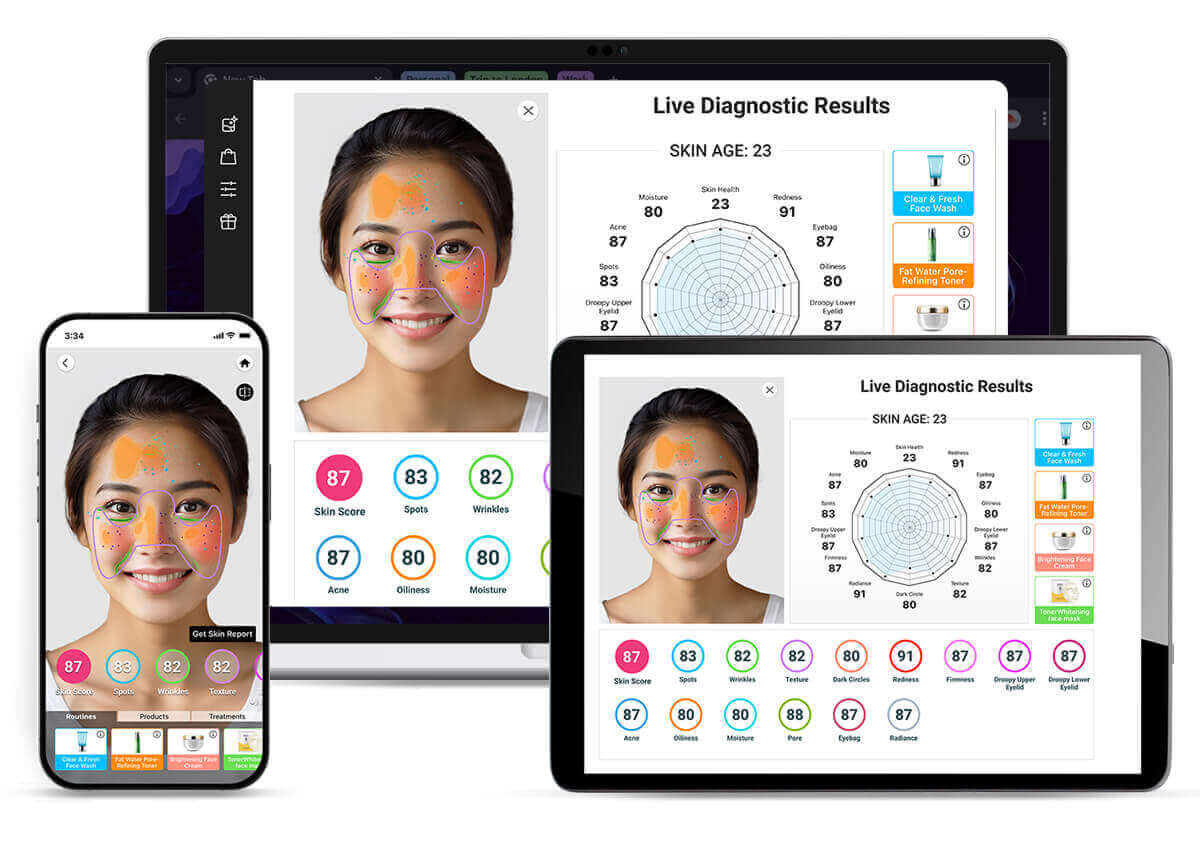
Best for: Beauty brands, retailers, and app builders who want skin analysis everywhere their customers are—not just inside one clinic room.
2. Canfield Scientific VISIA Gen8
If a dermatologist tells you they want "the VISIA," they're talking about Canfield's flagship. VISIA Gen8 uses multi-spectral imaging (RBX technology) to separate red (hemoglobin) from brown (melanin) damage.
It's expensive, and heavy, and it earns its keep at a derm or plastic-surgery practice that bills procedures off the analysis.
3. Canfield VECTRA 3D
VECTRA's 3D capture creates a facial mesh, which is why plastic surgeons love it for pre/post visualization (think rhinoplasty previews and facelift simulations). It's overkill for skincare retail, but good for procedure consultations.
Best for: Plastic surgery, reconstructive aesthetics. (For an AI alternative without the six-figure rig, see Perfect Corp.'s AI Aesthetic Simulation.)
4. Observ 520x — The Spa Favorite
Sylton's Observ uses an enclosed hood with multiple illumination modes (parallel-polarized, cross-polarized, true UV, simulated daylight) to make hidden concerns visible to the human eye. Estheticians love it for the "wow" moment during consults.
5. Fotromed Derma Vision X
A Chinese OEM/ODM-friendly supplier producing the Derma Vision X (a 2-in-1 skin and scalp analyzer) and DermaVision Plus.
6. Zemits VeraFace
An accessible, mid-priced tablet-style scanner used by boutique studios that want a clinical-looking consultation flow without a six-figure investment.
7. Haut.AI
An AI software company focused on longitudinal tracking and R&D-grade skin metrics, popular with few skincare ingredient brands or clinical trials.
8. Revieve
A digital beauty advisor platform that bundles AI face analysis with product recommendations and routine builders. Common in e-commerce conversion stacks.
How Do You Choose the Right Face Analysis Machine Supplier?
Forget brand prestige for a second. The right supplier depends on where your customer meets your brand. Use this framework:
| If your use case is… | You probably need… | Why |
|---|---|---|
| A single dermatology clinic | Skincare Pro, VISIA Gen8 or VECTRA 3D | Insurance/clinical billing values the gold standard |
| A med-spa chain (5–50 locations) | Observ or Perfect Corp. Skincare Pro | Hardware in-room, software for follow-up & home use |
| DTC skincare brand | Perfect Corp. AI Face & Skin Analyzer | Embeds anywhere, scales infinitely, no install |
| Department-store beauty counter | Tablet kiosk powered by AI API | Looks professional, costs a fraction of clinical gear |
| Mobile app / e-commerce site | Perfect Corp. SDK / API | On-device or cloud, fast time-to-market |
(All the info above may be updated by each brand)
What Features Should a 2026 Face Analyzer Have?
- Multi-attribute scoring: at minimum: wrinkles, pores, spots, redness, texture, dark circles, firmness, radiance.
- AI-driven recommendations: pairs every concern with a product or treatment match.
- Cross-device portability: works on phones, tablets, kiosks, and the web.
- Skin-tone-inclusive datasets: accuracy across Fitzpatrick I–VI.
- Real-time, sub-second analysis: slow analyzers kill conversion.
- Data privacy & compliance: GDPR, CCPA, HIPAA where applicable.
- API + SDK options: so your developers can ship faster.
Want to see all 15 attributes Perfect Corp.'s engine reads in under a second? Browse the live demo.
How Much Does a Face Analysis Machine Cost?
Hardware ranges from roughly $3,500 (entry-level spa tablet) to $40,000+ (3D clinical capture rigs).
AI software is sold on subscription or per-API-call, typically starting from $0.041/unit and scaling with traffic. The key cost difference: hardware depreciates, AI software gets smarter every release. A clinic that buys VISIA in 2026 will be running the same hardware in 2030; a brand on Perfect Corp.'s API receives model upgrades automatically.
Approximate 5-Year Total Cost of Ownership
| Solution | Hardware | Software/Service | 5-yr Estimate |
|---|---|---|---|
| VISIA Gen8 (single unit) | $10,000 | ~$3,000/yr support | ~$40,000 |
| Observ 520x | $18,000 | ~$2,000/yr | ~$28,000 |
| Perfect Corp. AI API | $0 | Volume-based | Highly variable, scales with revenue |
(All the info above may be updated by each brand)
Can You Replace a Face Analysis Machine With an AI API?
Short answer: for most beauty and retail use cases, yes. The longer answer: it depends on whether you need diagnostic output (clinical, billable, regulated) or consultative output (recommendation-driven, conversion-focused). Clinical diagnostics still benefit from controlled-lighting hardware. Everything else, from your product page to your in-store tablet, runs better on AI software because it travels with the customer.
Perfect Corp.'s AI Skin Analysis achieved 95%+ accuracy when benchmarked against dermatologist annotations across diverse skin tones, which is why brands keep replacing 80-pound machines with API calls.
FAQ
What is the best skin analysis machine for clinics?
For pure clinical diagnostics, Canfield's VISIA Gen8 has been used. For clinics that also want a digital-first patient experience (mobile follow-ups, at-home tracking, retail tie-ins), pairing clinic hardware with an AI software layer like Perfect Corp.'s AI Face Skin Analyzer delivers the strongest ROI.
How accurate are AI face analysis machines?
Leading AI analyzers benchmark at 90–96% accuracy versus dermatologist-labeled datasets across major attributes (wrinkles, pores, pigmentation). Perfect Corp.'s engine is trained on 70,000 images covering all six Fitzpatrick skin types to keep accuracy stable across skin tones.
How much does a professional face analysis machine cost?
Hardware ranges from about $3,500 for entry-level spa devices up to $40,000+ for 3D clinical systems. AI-based face analysis is sold as subscription or API usage and scales with traffic rather than location count.
Can I use a face analysis machine in retail or e-commerce?
Hardware is impractical outside a clinic. Retail and e-commerce use cases run on AI face analysis software embedded in your website, mobile app, or in-store kiosk, exactly what Perfect Corp.'s API is built for.
What is the difference between face analysis and skin diagnostic?
"Face analysis" is the umbrella term covering full-face features (symmetry, age, expression, attributes). "Skin diagnostic" is a sub-category focused on dermatological concerns like wrinkles, pores, and pigmentation. Most modern platforms, including Perfect Corp.'s, ship both in one engine.
Is a face analysis API better than a physical machine?
For brands that need to deploy at scale—across web, app, kiosks, and counters—APIs are dramatically more cost-effective and update faster. For single-location clinical diagnostics, hardware still has a role. Most growing brands use both.
Which face analysis supplier is best for beauty brands?
Perfect Corp. is the most-adopted face and skin analysis provider among global beauty brands, with deployments at Estée Lauder, Clinique, Sephora, MAC, and 600+ other retailers. Its strength is the ability to power the same AI experience across every channel without buying hardware for each location.



 English


