



Innovation Studio Inc.’s +PLUS MIRROR Creates a New Try-On Experience with Perfect Corp.’s Digital Tech
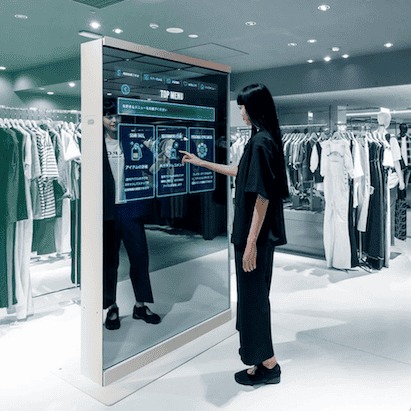
“We want people to find what truly suits them, easily and joyfully.” Born from this sentiment is Innovation Studio Inc.’s ‘+PLUS MIRROR’ Based on the concept of “Finding your true best fit,” this experiential mirror has been introduced in apparel shops nationwide, offering full-body analysis from face to body type. This service integrates Perfect Corp.’s AI Fashion Virtual Try-On API.
In this interview, we spoke with the team at Innovation Studio about the background of developing +PLUS MIRROR, how it is utilized in actual stores, and the value-added experiences generated by AI virtual try-on.
The Background Behind the Birth of +PLUS MIRROR
─ First, please tell us about the background that led to the development of +PLUS MIRROR.
Innovation Studio (IS): +PLUS MIRROR is a service that was under development as a project by our parent company, Daytona International, since before Innovation Studio was established. At Daytona International, while discussing strategies for revenue growth, a key theme was how to advance the digital utilization of physical stores, not just online channels. We placed particular emphasis on OMO (Online-Merge-Offline), specifically focusing on how to realize a purchasing experience that allows customers to move seamlessly between physical stores and online platforms. For example, we explored ways to create a bidirectional purchasing experience: creating pathways for customers who visit the store to smoothly proceed to purchase online, and conversely, creating mechanisms to encourage online customers to visit physical stores.
─ Specifically, what kind of measures were considered?
IS: First, we set a direction to provide new experiences by incorporating digital technology. Next, we focused on the issue that many existing digital services were not actually being touched or used by customers in-store. Therefore, we wondered if we could provide an experience that was casual enough for customers to enjoy and naturally want to interact with while in the store. +PLUS MIRROR was born from this idea. We aimed to build a system that is approachable for customers and careful not to diminish the value of the in-store experience.
─ I see. So, the digitization was not intended for personnel reduction.
IS: Exactly. Generally, when people hear "digital measures," they tend to think of efficiency in order to reduce staff or the replacing of humans. However, at the time, our focus was “Digital utilization that further leverages human value.” We placed importance on actually enhancing communication and the value of customer service on the sales floor. What we aimed for was a digital experience that supports communication—something that sparks conversation between staff and customers and nurtures familiarity and trust between the brand and the customer.
─ What was the reason for adopting a mirror form factor?
IS: Even as digitization advances, a mirror remains an essential entity in apparel shops. Because it is an everyday item that everyone naturally uses, we thought the fusion with digital elements would feel smooth. There is also a spatial advantage; a mirror makes the store interior look more spacious compared to installing a standard monitor. The result of this background is +PLUS MIRROR, which expands the joy of choosing through diverse diagnostic content and recommendations.
The Experience Realized by Introducing Perfect Corp.’s AI Fashion Tool
─ Please tell us about the history of introducing the AI Fashion Virtual Try-On Tool.
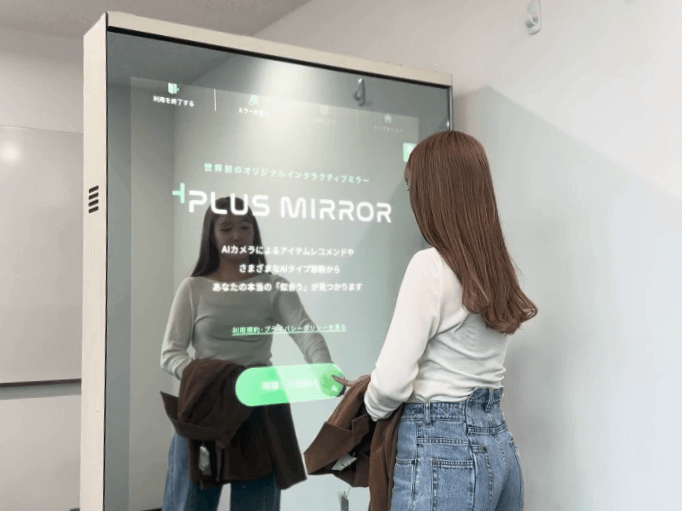
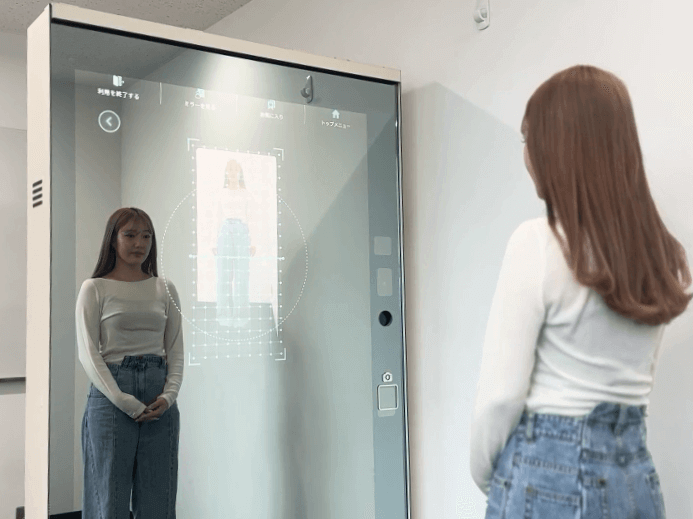
IS: With +PLUS MIRROR, we have provided various personal experiences such as Personal Color Analysis and Skeletal Body Type Diagnosis. While constantly thinking about what new experiences we can deliver to customers, many opinions arose that since we are using a mirror, we should incorporate virtual try-on. We decided to introduce AI Virtual Try-On because it has a high affinity with our existing initiatives, and we judged that it could further expand the digital experience in a natural way.
─ What points did you prioritize when introducing virtual try-on?
IS: The point we prioritized most was quality. Of course, price was a factor, but more important was the naturalness that would convince customers. If the quality is low and customers can’t imagine the look at all, it could lead to a decline in brand image. Therefore, we prioritized quality above all else.
─ Please tell us why you chose Perfect Corp.’s virtual try-on tool.
IS: We verified details such as material texture, wearing feel, and silhouette across a wide range of categories including coats, jackets, pants, skirts, and dresses. As a result, Perfect Corp.’s tool had the most natural finish with no awkwardness, so we decided to adopt it.
─ Were there any specific points you focused on regarding API utilization and design?
IS: In the design, the point we focused on most was how to reproduce a sensation close to the actual try-on experience. On top of that, we insisted on incorporating “Value-Added” experiences that are only possible with virtual try-on. For example, in a real fitting room, if you want to try different colors, you have to bring each color into the room, or call staff if you want to try another color after entering. However, with virtual try-on, you can display all colors just by scanning one product, allowing you to try them on collectively and compare them. Furthermore, the ability to try on items directly from a coordination look is also attractive. Being able to try on clothes not just from product images but also from staff styling images is an experience unique to virtual try-on. This flexible and smooth experience design was realized precisely because we utilized Perfect Corp.’s API service. Our biggest technical commitment was ensuring users can operate it intuitively while providing a broad range of try-on experiences.
Lowering the Hurdle for Entry & Experience: Designed to Naturally Invite Interaction
─ How is +PLUS MIRROR being utilized in stores?
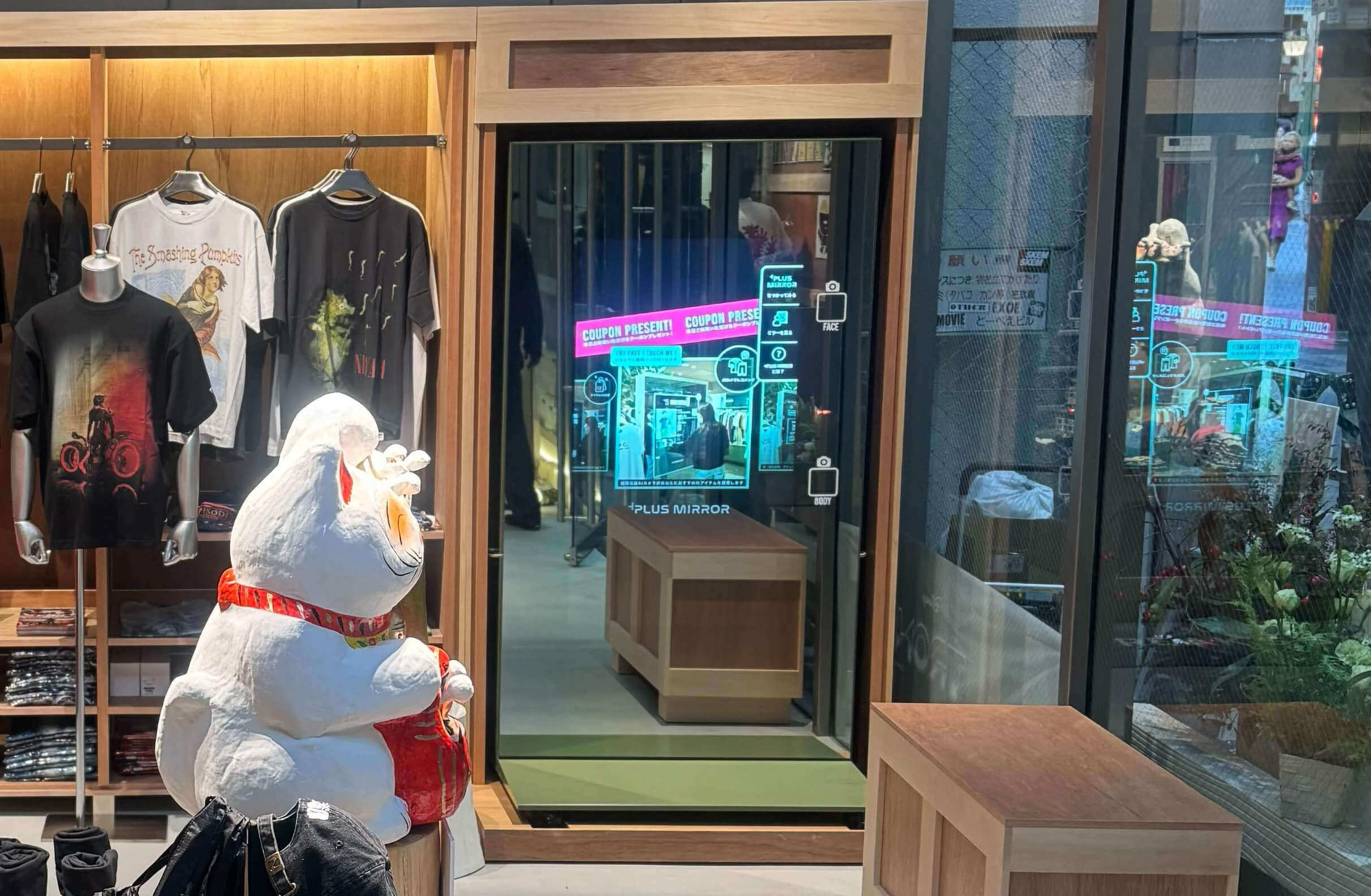
IS: While it is sometimes used during staff service, it is designed so that customers can experience it freely on their own. This is because FREAK'S STORE, where it is introduced, has a high entry rate. Since the store is always bustling with many customers, there was a concern that designing it to rely solely on staff service would place a heavy load on the staff. Therefore, we designed it to handle both staff-assisted service and self-service, ensuring customers can enjoy it casually.
─ So you have innovated ways for customers to touch it naturally?
IS: Yes. In past initiatives by other companies, we have seen many examples where monitors or mirror signage were installed, but customers rarely touched them. Therefore, with +PLUS MIRROR, we place special emphasis on designing an experience that makes customers instinctively want to touch it.
Specifically, we were thoroughly particular about UI/UX details, such as how the standby screen looks, the sound effects the moment it is operated, and the tempo of interaction. We are conscious of giving it an attractive force that makes people stop in the store and naturally want to try it. Also, the installation location is a very critical point. Analyzing reactions across multiple stores, we carefully considered the distance, angle, and flow lines so that while the mirror’s presence is visible, customers do not feel embarrassed when using it. We pursue a layout where customers do not feel self-conscious and can easily enter the experience.
Furthermore, we are particular about post-experience satisfaction. The chart summarizing diagnostic results is not completed solely digitally; we designed it to be printed on thick paper as a card you want to take home, providing a physical memento. It is sized to fit easily into a handbag, intended to ensure the in-store experience continues as a memory afterward.
─ Please tell us about the flow of the actual experience with the newly added virtual try-on function.
IS: There are broadly two methods for the experience. The first is the ‘Barcode Scan’ method. When you scan an actual product barcode, the colors and styling associated with that product are displayed on the screen. Then, by photographing your full body, your appearance wearing the item is reflected on the screen.
The second is the ‘Select from Styling’ method. You can choose a staff member of the same height from photos of staff wearing the item, or choose items to try on from the styling of in-store staff. This method was introduced to create an opportunity to communicate with staff.
A feature of both methods is that you can try on up to 5 items simultaneously in a single session.
─ Are you considering integration with EC websites?
IS: Yes. Most recently, we have enabled a function where, along with the generated virtual try-on results, product information and a link to the EC site can be set up. This serves as a mechanism for customers who did not purchase on the spot to easily purchase later on the EC site. We believe this will encourage purchases on the EC site.
Also, we are currently developing a system to allow the +PLUS MIRROR virtual try-on experience to be used directly on EC sites. This will lower the implementation hurdle, and I believe we will see adoption by clients in various industries.
Possibilities in Diverse Industries Beyond Apparel
─ You introduced +PLUS MIRROR at a trade show. Did you meet your KPIs set for this event?
IS: We set several KPIs. For example, regarding the number of leads acquired, we achieved about 120% of our plan. We are currently receiving many inquiries and conducting negotiations, continuing discussions with various companies. Since we also introduced new features at this exhibition, we achieved results in an environment different from usual. From the perspective of lead acquisition, we feel we fully achieved our goals.
─ Were there any reactions that left an impression?
IS: People from the sports industry visited our booth and gave feedback that the experiences we have provided so far are becoming stagnant. In that context, seeing +PLUS MIRROR, they proposed positive ideas, asking whether they could utilize this in a new form. It left a strong impression that as we talked, ideas for new measures and experiences were born one after another.
For example, even in environments without fitting rooms, like inside a stadium, introducing virtual try-on can provide a new experience. It was very meaningful that industries other than apparel took an interest, and we re-recognized that it can be utilized in a wide range of fields.
Lowering Adoption Hurdles by Installing a ‘Giant Smartphone’
─ How was the awareness of Virtual Try-On among those in the apparel industry?
IS: While many people know about virtual try-on itself, it seems difficult for them to visualize how to introduce it in their company or specifically how to utilize it, so we realized the hurdle for introduction is still high. Also, when hearing about a machine for virtual try-on, many people have the impression that installation and maintenance will be difficult.
─ Indeed, operations do seem like they would be difficult.
IS: That’s right. There are many companies that feel hurdles regarding the system aspect. For example, if introducing virtual try-on as a standalone unit, one must first consider the design, such as “where to install.” However, in reality, introduction is close to the sensation of installing a giant Smartphone, and there is no need to configure the machine from scratch. Functions can be added with the sensation of installing an app, and the system updates in the background, so the specifications allow for peace of mind in operation.
─ The analogy of a giant smartphone is very easy to understand! How do you support your customers through the integration?
IS: Thank you. Our service offers systematic support for companies that are anxious about such design aspects.
Since there are parts that marketing managers cannot decide alone, we can run alongside them to ensure the process proceeds smoothly from planning to implementation. Since there are many apparel companies considering incorporating virtual try-on, we want to actively support them.
The Next Area +PLUS MIRROR Targets
─ Are there any services you would be happy to see realized in the future?
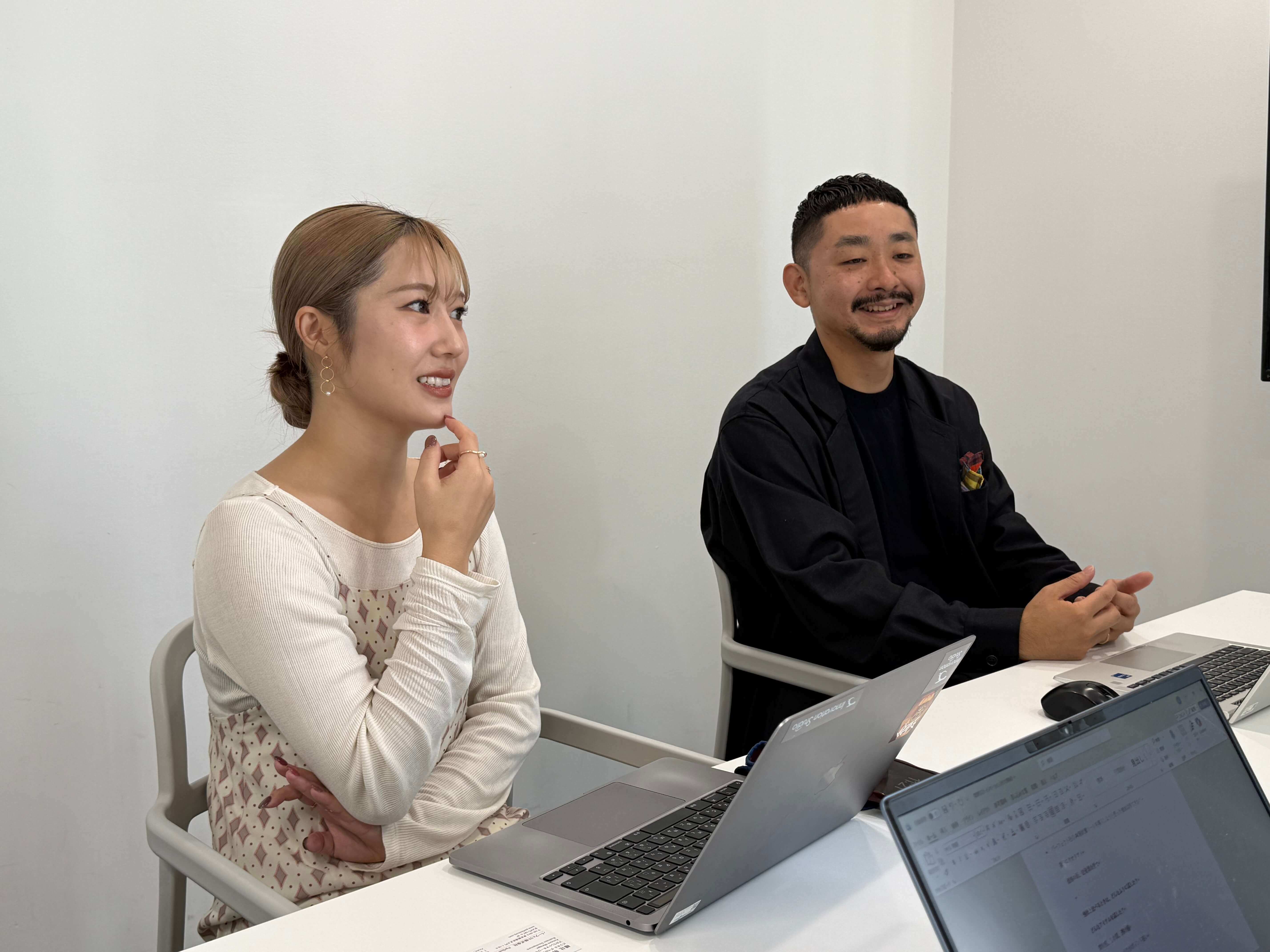
Ms.Meguro: Regarding coordination proposals by skeletal type, I feel that if the generated results reflected detailed physical characteristics like the prominence of collarbones or the shape of the pelvis, the persuasiveness and sense of conviction would be higher. I would be happy if we could build a mechanism that can incorporate the body characteristic data we possess. Also, currently, we can only output in 2D, but if we become able to input multiple images and generate them three-dimensionally, I think we can deliver an even more realistic try-on experience to customers.
Mr. Nakamura: In the sense of reproducing a try-on experience completely identical to reality, I feel that if there were a function where customers could combine individual items they selected themselves to reproduce a coordination, their satisfaction would increase further. Also, reproduction of size accuracy. I think this is a difficult area, but if we can reproduce this with high precision, I believe it will contribute significantly to differentiation from competitors.
─ Finally, please tell us about your future outlook.
IS: Until now, utilization has centered mainly on closely related industries, but going forward, we believe that a broader range of industries and companies will utilize +PLUS MIRROR and virtual try-on technology. For example, as mentioned earlier, we want to expand technology provision to fields other than apparel, such as the sports industry, entertainment industry, bridal, and fitness. Because we understand the situation on the ground, I think we can propose how to combine technologies to lead to solutions for each company’s issues.
We want to proceed with initiatives to provide value to various companies by leveraging technology, without being bound by industry or business format.
Start 30 days free trial
 English


