


 Author:
Conversational commerce is selling through a dialogue: a shopper asks questions in chat or voice, and an assistant answers, recommends products and helps complete the purchase. For beauty, a fluent chatbot is not enough. To sell foundation, serums or lipstick responsibly, an AI agent needs four things a generic large language model lacks on its own: a way to see the shopper's face and skin, grounded knowledge of your catalog, a way to show products on the shopper, and connections that let it act on a cart.
This guide breaks down those requirements so beauty brands can judge which AI shopping assistants are ready to sell, and which can only talk.
At a glance
- Conversational commerce moves product discovery, advice and checkout into a single chat.
- Beauty is a visual, personal category, so text-only answers leave the hardest question unanswered: "Will this suit me?"
- A selling-ready agent combines visual analysis, brand-grounded knowledge, virtual try-on and agent-readable integrations.
- Guardrails matter as much as features: brand data isolation, honest limits and no appearance judgments.
What Is Conversational Commerce?
Conversational commerce covers any purchase journey run through dialogue: website chat, messaging apps, voice assistants and, increasingly, general AI assistants that shop on a user's behalf. The newest form is often called agentic commerce, where an AI agent does not just answer but takes steps such as comparing products, building a cart or checking out.
The shift is already visible. In September 2025, OpenAI introduced Instant Checkout in ChatGPT along with the open-source Agentic Commerce Protocol, developed with Stripe. Adobe reported that traffic to U.S. retail sites from generative AI tools rose 693.4% year over year during the 2025 holiday season, while noting the user base remains modest, with personal care among the categories where these tools were most used.
Why Conversational Commerce Matters for Beauty Brands
Beauty shoppers rarely buy on specifications alone. They want to know whether a shade matches, whether a moisturizer suits oily skin, or how a look will read on their face. In a store, an advisor answers by looking. A conversation can replicate that consultation at scale, but only if the agent can perceive the shopper and reason about real products.
The commercial stakes are large. McKinsey estimates that agentic commerce could orchestrate up to $1 trillion in U.S. B2C retail revenue by 2030, and stresses that merchants need agent-compatible APIs and product data that agents can read.
What an AI Agent Actually Needs to Sell Beauty Products
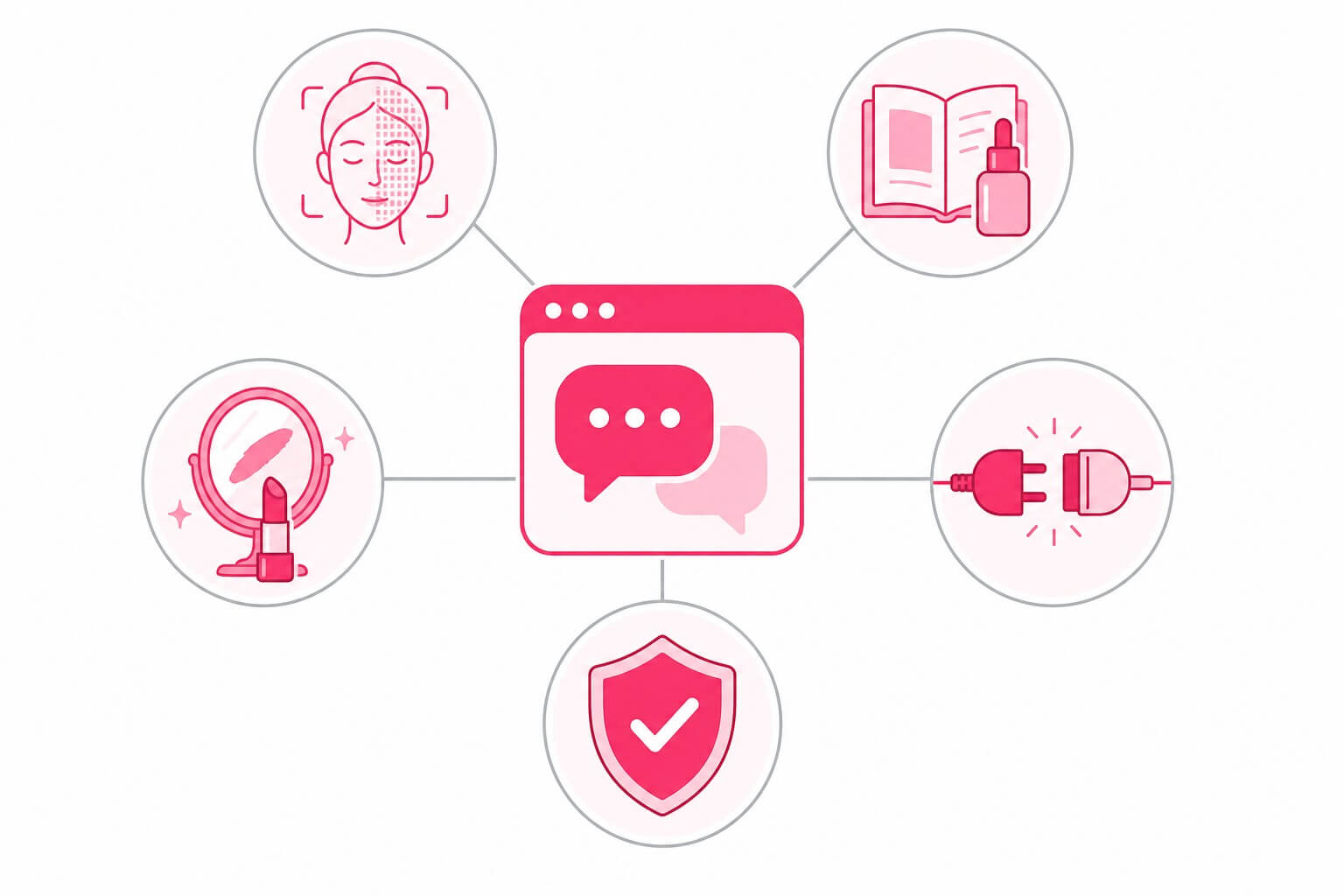
1. Visual Understanding of the Shopper
Text alone can't tell an agent that a shopper has warm undertones or visible redness. A general-purpose model can describe a selfie, but Perfect Corp's own A2A integration guide notes that a generic LLM "cannot reliably determine exact skin tone" or produce professional-grade spot and redness scoring. Purpose-built skin and face analysis gives the conversation measurable inputs instead of guesses.
2. Grounded Product and Brand Knowledge
An agent that invents ingredients or recommends discontinued SKUs damages trust fast. Selling requires answers grounded in your catalog, ingredient data and brand guidance, typically through retrieval-augmented generation (RAG), where the model looks up approved content before it responds.
3. A Way to Show, Not Just Tell
"This coral lipstick will flatter you" is a claim. A virtual try-on that renders the shade on the shopper's own face is evidence. Try-on turns a recommendation into something the shopper can judge for themselves, which is the step most text-only assistants skip.
4. Agent-Readable Integrations
Shoppers will increasingly arrive through other AI assistants, not just your site. McKinsey points to emerging standards such as Model Context Protocol (MCP), Agent2Agent (A2A), Agent Payments Protocol (AP2) and the Agentic Commerce Protocol (ACP). A beauty capability exposed through these patterns can be called by your own chatbot or by a partner's agent.
5. Guardrails and Trust
Responsible beauty agents describe and recommend; they don't rank attractiveness, diagnose conditions or promise results. Brand data should stay separated from other brands' data, and the agent should say when a question needs a professional, such as a dermatologist.
| Requirement | Generic LLM chat | Beauty-specialized agent |
|---|---|---|
| Skin and face input | Describes photos in general terms | Uses dedicated skin and face analysis |
| Product answers | Drawn from broad web training data | Grounded in the brand's catalog and guidance |
| Visual proof | Text descriptions only | Virtual try-on on the shopper's face |
| Path to purchase | Depends on the platform | Recommendations mapped to brand SKUs and cart |
How Perfect Corp Can Support Conversational Commerce
The Perfect Beauty Agent is an AI beauty advisor that can provide 24/7 conversations with personalized skincare and makeup recommendations, virtual try-on, skin analysis and AR tutorials. Brands can tune the agent's tone to their voice, and its answers draw on a RAG workflow and a knowledge base Perfect Corp describes as more than 500,000 expert insights.

Brands that already run their own assistant don't need to replace it. Through the A2A integration pattern, a host agent can hand beauty tasks such as skin analysis, product recommendation, try-on and consultation to Perfect Corp's agent, supporting a flow from analysis to recommendation, try-on and cart. Developers building on general AI assistants can also add YouCam API agent skills for skin analysis, facial consultation, makeup preview, hair advice and clothing try-on.
Build a Beauty Agent That Can Advise and Sell
Perfect Corp can help your team add skin analysis, virtual try-on and brand-grounded recommendations to the conversations your shoppers already have. Talk to our team about which deployment fits your site, app or existing AI agent.
Frequently Asked Questions
What is the difference between conversational commerce and agentic commerce?

Conversational commerce is any sale guided through dialogue. Agentic commerce is a subset where an AI agent takes actions for the shopper, such as comparing options, building a cart or completing checkout.
Can a general chatbot like ChatGPT sell my beauty products on its own?
It can discuss and surface products, but without brand-grounded data, visual skin and face analysis and try-on, its recommendations rely on general knowledge rather than your catalog and the shopper's actual features.
Do I need to replace my existing chatbot to add beauty expertise?
Not necessarily. Agent-to-agent integration lets an existing assistant delegate specialized beauty tasks to a dedicated beauty agent while keeping control of the conversation.
Is AI skin analysis in a shopping chat a medical diagnosis?
No. In a commerce setting it supports cosmetic product recommendations. Shoppers with skin health concerns should consult a dermatologist or other qualified professional.



 English


