 Author:



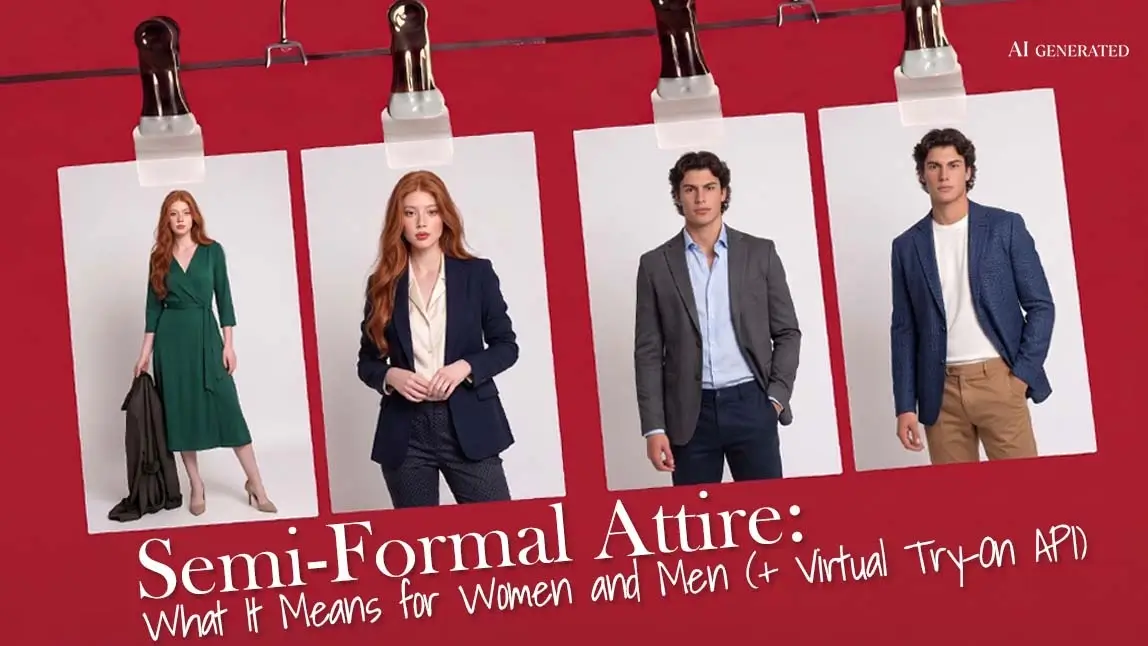
Semi-formal attire is a dress code that sits between business attire and formal evening wear. For women, it usually means a knee-length to midi dress in an elevated fabric, a dressy jumpsuit or polished separates. For men, it means a suit in navy, charcoal or gray with a dress shirt, a tie and leather dress shoes. It asks for more than your office clothes, but less than a tuxedo or a floor-length gown.
This guide explains what semi-formal means for women and men, how it changes for weddings, daytime and evening events, and what to skip. It also shows how to preview a semi-formal look on your own photo. If you sell dresses, separates or tailoring, your customers ask the same question before every event: will this look right on me? Perfect Corp.'s AI Clothes Changer API answers it by placing a garment on the shopper's own photo.
Table of Contents
- What Is Semi-Formal Attire?
- Where Semi-Formal Sits on the Dress Code Scale
- Semi-Formal Attire for Women
- Semi-Formal Attire for Men
- Semi-Formal Wedding Attire
- Semi-Formal by Time of Day and Event
- Try a Semi-Formal Look on Your Own Photo
- Virtual Try-On for Semi-Formal Separates and Tailored Layers
- Adding the AI Clothes Changer API to a Separates Catalog
- Semi-Formal Attire FAQ
- Conclusion
What Is Semi-Formal Attire?

The easiest way to understand semi-formal is by its two neighbors: it is dressier than what you would wear to the office, but a step below a formal event. In practice, that means tailored, event-ready clothes in good fabrics, without the gowns and tuxedos of black tie.
You will see "semi-formal" on wedding invitations, company dinners, award nights, graduation parties, gallery openings and holiday events. It is one of the most common dress codes, and also one of the most confusing, because the word "semi" leaves a lot of room for interpretation.
| Semi-formal at a glance | Women | Men |
|---|---|---|
| Core outfit | Knee-length, tea-length or midi dress; dressy jumpsuit; blouse with a midi skirt or tailored trousers | Suit in navy, charcoal or gray with a dress shirt |
| Fabrics | Crepe, silk, chiffon, jacquard, lace, fine knits in winter | Wool or wool blends; linen blends in hot weather |
| Finishing pieces | Pumps, block heels, dressy flats or strappy sandals; small structured bag | Tie (the default), leather oxfords, derbies or loafers, matching belt |
| Skip | Floor-length gowns, casual cotton sundresses, sneakers | Tuxedos, jeans, polos, sneakers |
Where Semi-Formal Sits on the Dress Code Scale
Semi-formal is the middle rung of the dress code ladder. Below it are business casual and business professional, which are built around office clothes. Above it are black tie optional and black tie, where gowns and tuxedos come in. Cocktail attire sits very close to semi-formal, and style guides disagree on which of the two is dressier. Our guide to how cocktail attire compares with semi-formal and black tie breaks down that difference in a full table.
Why semi-formal is so confusing
The term has shifted over time. A century ago, the tuxedo itself counted as semi-formal evening wear, because white tie was the true formal standard. As white tie faded, black tie moved up to "formal" and semi-formal came to mean a dark suit. Traditional etiquette, especially outside the US, still sometimes reads an evening "semi-formal" as black tie. If the invitation comes from a very traditional host or a formal institution, it is worth a quick check.
Semi-formal vs. business professional
The clothes can look similar, especially for men, but the intent is different. Business professional is about looking credible at work. Semi-formal is about looking dressed for an occasion. That means a little more personality: a richer tie, a pocket square, a dress in a color you would not wear to a meeting, or a fabric with some sheen.
Semi-Formal Attire for Women

Semi-formal attire for women comes down to three choices: length, fabric and silhouette. Get those right and accessories are easy.
Length
Aim for somewhere between the knee and the mid-calf. Knee-length, tea-length and midi dresses all fit the code. A mini can look too casual or too clubby, and a floor-length gown usually reads as black tie. The exception is a relaxed maxi in a light fabric, which can work for a summer daytime event.
Fabric
Fabric decides more than cut does. The same sheath dress looks semi-formal in crepe or silk and casual in cotton jersey. Good choices include crepe, silk, chiffon, lace, jacquard and brocade, plus velvet or fine wool knits in winter.
What women can wear
- A dress: sheath, wrap, A-line or fit-and-flare, in a solid color or an elegant print.
- A dressy jumpsuit: wide-leg or tailored, in crepe or another fabric with drape.
- Separates: a silk blouse with a pleated midi skirt, or a statement top with tailored wide-leg trousers.
- A suit: a well-cut pantsuit or skirt suit in a rich color, worn with a refined top.
Shoes and accessories
Pumps, slingbacks, block heels, strappy sandals and dressy flats all work. Keep jewelry to one or two focal pieces, and carry a small clutch or structured bag rather than an everyday tote. For outdoor events on grass, block heels or flats are the practical choice.
Semi-Formal Attire for Men

Semi-formal attire for men starts with a suit. If you own one well-fitting suit in navy, charcoal or mid-gray, you already have the foundation.
- Suit: navy, charcoal or gray for most events. Lighter grays, tan or blue suit daytime and warm-weather events. A subtle pattern, such as a windowpane or a faint check, is welcome.
- Shirt: a crisp dress shirt in white, light blue or a fine pattern.
- Tie: the default for semi-formal, especially at weddings and work events. A daytime or summer event may let you drop it, but bring one if you are unsure.
- Shoes: polished leather oxfords, derbies or loafers in black or brown, with dark dress socks and a matching belt.
- Optional extras: a pocket square, a dress watch or a vest for cooler months.
Can you wear a blazer instead of a suit?
At the relaxed end of semi-formal, such as a daytime party, a summer garden event or a creative industry dinner, a tailored blazer or sport coat with contrasting wool trousers is accepted. For an evening wedding or a work gala, stick with a matching suit. If you are deciding between a few suit colors or cuts, you can compare suit styles on a photo of yourself before you buy or rent.
Semi-Formal Wedding Attire

Semi-formal is one of the most popular dress codes on wedding invitations, and couples sometimes call it "dressy casual." The general rules still apply, with a few wedding-specific ones on top.
- Skip white, ivory and cream. Pale blush and champagne can also photograph as white, so check the shade in daylight.
- Let the clock and the season guide you. An afternoon ceremony suits lighter colors, florals and a lighter suit, and a reception after 6 p.m. calls for darker tones and richer fabrics. For warm-weather ceremonies, our guide to summer wedding guest dresses covers the best colors and breathable fabrics.
- Women: a knee-length, tea-length or midi dress, a dressy jumpsuit or elegant separates. Save floor-length gowns for formal and black tie weddings.
- Men: a suit and tie. You can take the jacket off once the dancing starts.
- In the wedding party? Bridesmaids follow the couple's plan, which can mean a floor-length dress even at a semi-formal wedding, so check the length and color before you order. Perfect Corp.'s bridesmaid dress virtual try-on shows how bridal shops let a whole wedding party compare styles on their own photos.
- Respect the venue. Cover your shoulders for religious ceremonies, and choose shoes that work on grass, sand or cobblestones.
If the invitation says formal or black tie optional instead, the bar moves up. Our guide to black tie wedding guest dresses covers that level. To compare guest looks for garden, beach, evening and winter weddings on your own photo, see how wedding guest dress virtual try-on works.
Getting married yourself? A semi-formal celebration gives the couple more freedom too, from a vintage-style wedding dress to a light, flowing beach wedding dress for a seaside ceremony.
Semi-Formal by Time of Day and Event

The same dress code looks different at 2 p.m. and 8 p.m. As a rule, the later the event, the darker and richer the outfit.
| Setting | Women | Men |
|---|---|---|
| Daytime (before about 6 p.m.) | Lighter colors, florals and pastels; chiffon or linen blends; sandals or block heels | Light gray, tan or blue suit; lighter tie or none in heat; brown leather shoes |
| Evening | Jewel tones, navy or black; crepe, silk or velvet; heels or dressy flats | Navy or charcoal suit, tie, black or dark brown shoes |
| Summer | Breathable midi dresses, light separates | Linen-wool or cotton suits, open weaves |
| Winter | Long sleeves, velvet, fine knits, tights with dresses | Flannel or heavier wool suits, a vest for warmth |
What semi-formal usually means at common events
| Event | What to aim for |
|---|---|
| Company dinner or awards night | The conservative end: a sheath dress or pantsuit, a dark suit with a tie |
| Holiday party | Semi-formal with a seasonal touch, like velvet or a deeper color. See our holiday party outfit ideas for looks by dress code |
| Graduation or milestone party | A daytime version: a printed midi dress or separates, a lighter suit or blazer |
| Theater, opera or gallery opening | Evening semi-formal: richer fabrics and a tie, with room for a statement piece |
What not to wear to a semi-formal event
- Jeans, unless the host explicitly says denim is welcome.
- Sneakers, flip-flops and casual sandals.
- T-shirts, polos, hoodies and anything with a large logo.
- Tuxedos and full ballgowns, which overshoot the code.
- Casual outer layers such as denim, leather or bomber jackets over your outfit.
Try a Semi-Formal Look on Your Own Photo
Because semi-formal leaves so much room, the hard part is often choosing between options: a dress or a jumpsuit, a midi or a knee length, one color or another. Virtual try-on lets you compare them on yourself. You upload a photo, choose a preset outfit or upload an image of the piece you are considering, and see it on your photo in the same pose and lighting.
These looks are actual results from Perfect Corp.'s AI clothes virtual try-on tool.
Comparisons that are worth making before a semi-formal event:
- One piece vs. separates. A dress or jumpsuit is effortless. Separates can be rewired for the next event.
- Day color vs. evening color. Check whether a lighter shade still looks dressed up enough for an evening reception.
- Wedding-safe shades. Make sure a pale dress does not read as white on camera.
For the best result, use a full-body photo in even light, standing straight in simple fitted clothes. The preview shows how the style and color look on you, and the retailer's size chart helps you pick the right size.
Online clothes try-on
Upload a photo and compare dresses, jumpsuits and separates.
Virtual Try-On for Semi-Formal Separates and Tailored Layers

Semi-formal is the dress code where separates and layers do the most work. A shopper building a look buys a blouse that has to work with a skirt, or a blazer that has to work with the shirt already in the closet. That is exactly the decision that is hard to make from a product photo alone. For fashion businesses, two use cases stand out.
Separates retailers and "complete the look"
Brands and multi-brand stores that sell blouses, skirts, tailored trousers and jumpsuits can let shoppers preview a single piece or a full pairing on their own photo. The AI Clothes Changer API works with full or partial outfits, so a shopper can check just a top, just a bottom, or the combination suggested in a "complete the look" module. Garment images can be product-only shots or photos of the piece on a model, so the images a store already has can be used.
Blazers and sport coats over the shopper's own outfit
For many men, semi-formal starts with the question "will this blazer work with what I own?" The API can preview jackets, coats and vests as an outer layer over the clothing already in the photo, so a menswear or suiting brand can show a navy sport coat over the shopper's own shirt and trousers. Our release note on outerwear try-on in AI Clothes Try-On API V4 explains how the outer category works. For complete suit looks, Perfect Corp.'s AI suit try-on page shows the business side of the same idea.
Where it fits in the shopping journey
Try-on is most useful at the moment of doubt: on the product page, next to the outfit-building module, and in dress-code collections that shoppers browse before an event. It is especially relevant when an item "looked different than expected," one of the return reasons we cover in our guide to reducing returns in fashion ecommerce. Try-on answers "will this color and cut suit me?", and size charts and fit notes on the same page answer the sizing question.
Adding the AI Clothes Changer API to a Separates Catalog
The AI Clothes Changer API is a RESTful API with Bearer authentication and JSON responses. Each request pairs a person photo with a garment, and generative AI maps the garment onto the person, adjusting for body shape, proportions and lighting.
| Step in the request | What it involves |
|---|---|
| You send a person photo | A shopper's full-body, half-body or selfie-style photo, or your own model photo |
| You send a garment | An uploaded clothing image or a predefined style, in JPG or PNG up to 10MB. Tops, bottoms, dresses and outerwear layers are all covered |
| You get back | A photorealistic try-on image URL and a result ID, with the garment shown in the photo's existing pose and angle |
| It runs on | Websites, iOS and Android apps, in-store kiosks and virtual mirrors, or your backend, using JavaScript, Java, Flutter, Python, PHP, Node.js or cURL |
No 3D garment models are required: the API works from standard product images. Perfect Corp. has developed AI and AR technology for more than a decade, and over 800 global brands have used it. The platform is ISO/IEC 27001:2022 certified, and GDPR is applied company-wide.
From prototype to launch
- Prototype. Upload a few of your own blouses, skirts and blazers to the AI Clothes API Playground and check the results on the sample model photos before writing any code.
- Build. Create an API key in the API Console, then follow the AI Clothes API reference. If your team works with a coding agent, the MCP documentation shows how to connect it.
- Launch. Plans are pay-per-use, and you can compare them on the API pricing page. For a rollout across several channels or markets, contact Perfect Corp.'s sales team.
AI Clothes API Playground
Run blouses, skirts and dresses on sample model photos.
Semi-Formal Attire FAQ
Can you wear jeans to a semi-formal event?
No. Jeans are too casual for semi-formal, even dark tailored ones. The only exception is when the host explicitly says denim is welcome. Choose dress trousers or a midi skirt instead.
Does semi-formal mean a suit and tie for men?
Usually, yes. A suit with a dress shirt and tie is the standard semi-formal outfit for men. At a daytime or summer event, the tie can sometimes go, but it is safer to wear one and remove it if no one else has.
Do you need a suit jacket for semi-formal?
Usually, yes. A matching suit is the safest choice, especially for evening weddings, galas and work dinners. For relaxed or daytime semi-formal events, a tailored blazer or sport coat with contrasting dress trousers is also acceptable. Skip the jacket entirely only if the host says the event is casual.
Can women wear pants to a semi-formal event?
Yes. A dressy jumpsuit, a well-cut pantsuit or tailored wide-leg trousers with a silk blouse all meet the semi-formal dress code, as long as the fabrics look polished.
Can you wear a long dress to a semi-formal event?
A full floor-length gown usually looks too formal. A relaxed maxi dress in a light fabric can work for a summer or daytime event, but knee-length, tea-length and midi dresses are the safest choices.
What is the difference between semi-formal and formal attire?
Formal attire, often called black tie, means tuxedos for men and floor-length evening gowns for women. Semi-formal steps down to a suit and tie and a knee-length to midi dress, jumpsuit or dressy separates.
What shoes go with semi-formal attire?
Women can wear pumps, slingbacks, block heels, strappy sandals or dressy flats. Men should wear polished leather oxfords, derbies or loafers with dark dress socks. Sneakers and casual sandals do not fit the code.
What should a female guest wear to a semi-formal wedding?
A knee-length, tea-length or midi dress in a dressy fabric such as crepe, chiffon or silk is the classic choice. A dressy jumpsuit or polished separates also work. Avoid white, ivory and cream, and choose lighter colors for a daytime ceremony and deeper tones for an evening reception.
Can you wear black to a semi-formal wedding?
Yes, especially for an evening wedding. Black is widely accepted at modern weddings. Add color or texture through accessories or fabric so the outfit feels celebratory rather than somber.
Conclusion
Semi-formal attire means dressing for an occasion without going black tie. For women, that is a knee-length to midi dress, a dressy jumpsuit or polished separates in a quality fabric. For men, it is a suit in navy, charcoal or gray with a dress shirt and tie. Read the time of day and the venue to decide how light or dark, relaxed or conservative to go, and skip white at weddings.
For fashion businesses, semi-formal is a dress code built on choices between separates, layers and colors. Letting shoppers see those choices on their own photo makes it easier to decide what to buy for a specific event.
AI Clothes Changer API
Show dresses, separates and blazers on each shopper's photo.
This article was edited and reviewed by the Perfect Corp. editorial team. Welcome to contact us or give us more suggestions.