


 Author: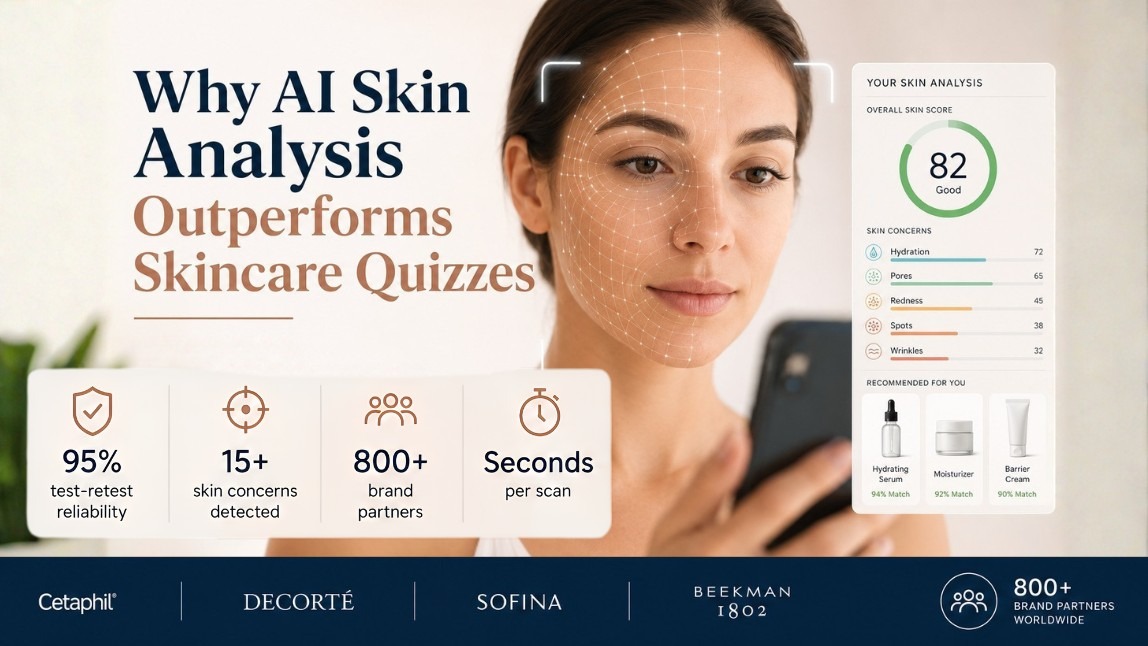
Quick answer: AI skin analysis replaces the generic skincare quiz with a selfie-based scan that reads real skin data — not self-reported guesses. Perfect Corp's AI Skin Analysis detects 15+ skin concerns and 8 skin types with a 95% test-retest reliability rate, then routes each shopper to the products in your own catalog that actually match their skin. Brands in the 800+ partner network use it to replace quizzes, cut return-driving mismatches, and turn a one-time visitor into a repeat, trackable customer — deployed as a hosted link, embed, or full API in days, not months.
| 95% test-retest reliability | 15+ skin concerns detected | 800+ brand partners | Seconds per scan |
|---|---|---|---|
| Validated across diverse skin tones and ages | Wrinkles, pores, spots, redness, hydration and more | Including Cetaphil, Decorté, SOFINA, Beekman 1802 | Selfie in, routine out |
Why the skincare quiz is quietly costing you sales
Most D2C beauty sites still lead with the same tool: a five-to-ten question quiz that asks shoppers to self-report their skin type. The problem isn't the format — it's the input. Shoppers guess at their own oiliness, their own hydration, their own "combination vs. dry." The quiz then guesses again, matching vague answers to a product. Two guesses stacked on top of each other is exactly the kind of math that produces mismatched orders, disappointed first-time buyers, and returns.
AI skin analysis swaps the guesswork for a measurement. A customer takes a selfie on the device already in their hand, and the AI reads the actual condition of their skin — texture, pores, hydration, redness, and more — instead of asking them to describe it. The recommendation that follows is grounded in data the customer can see reflected back at them, which is a very different trust signal than "you said you have combination skin."
What Perfect Corp's AI Skin Analysis actually measures
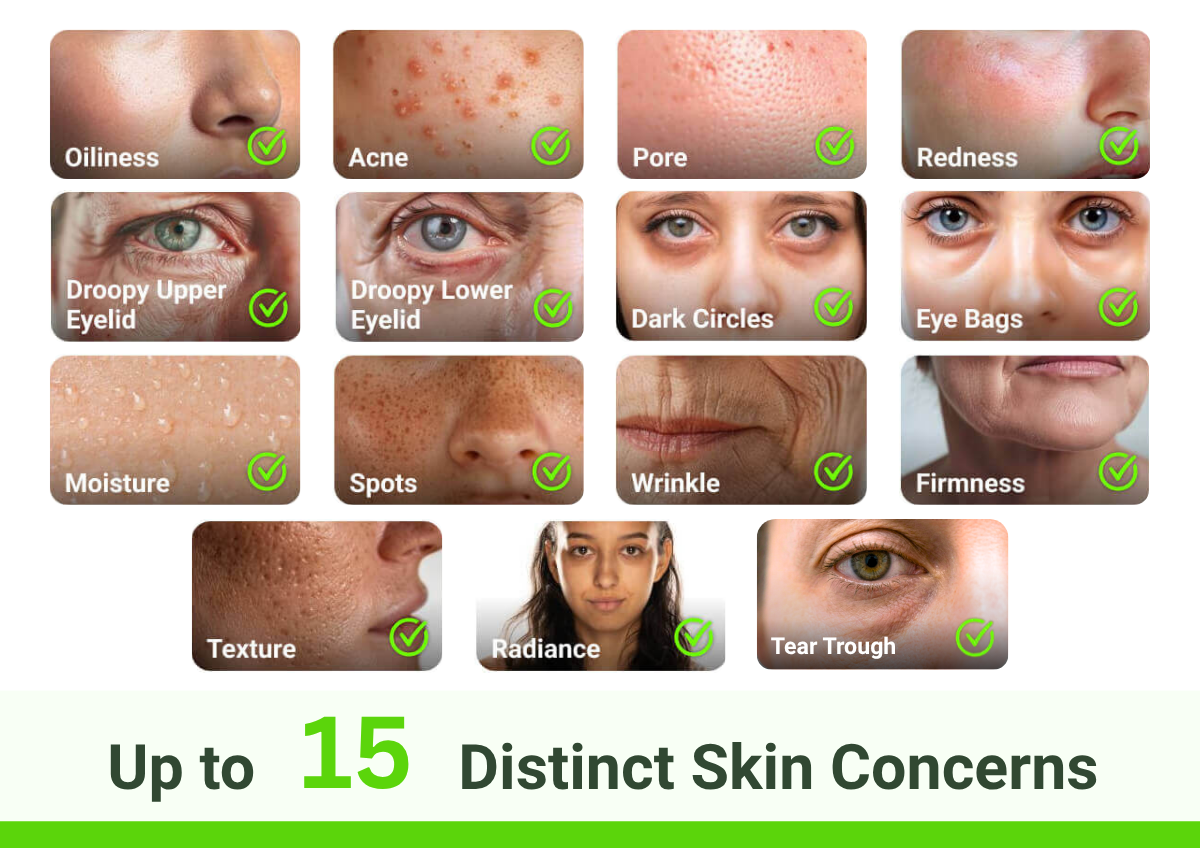
Perfect Corp's AI Skin Analysis uses 180° full-face mapping — front, left, and right profile images — to score spots, dark circles, radiance, eyebags, tear troughs, redness, pores, texture, oiliness, droopy eyelids, wrinkles, moisture, firmness, and acne, plus a skin-type classification across 8 categories (normal, oily, dry, combination, and their redness variants). The model is trained on 70,000+ medical-grade images and has shown a 95% test-retest reliability rate and over 80% correlation with physician evaluation in an independent study.
For a beauty brand, the metric alone isn't the point — the mapping is. Each detected concern needs to connect to a specific SKU in your catalog, with a clear reason attached, or the scan is just a science demo. A shopper who sees "your hydration score is low" and is then handed three products from your actual shelf, ranked by relevance, is a shopper who checks out with confidence instead of guessing again.
Add AI skin analysis to your storefront
Perfect Corp's AI Skin Analysis runs on any phone, tablet, or in-store kiosk and is trusted by 800+ beauty brands worldwide, from indie D2C labels to Cetaphil and Decorté.
How it fits into a Shopify, WooCommerce, or custom storefront
Most brands start with a self-service, no-code path: a branded skin analysis experience — your logo, your product catalog, your CTA — that drops into a product page, a collection page, or a post-purchase email as a link or embedded widget. There's no app to build and no engineering sprint required to launch.
Brands that need deeper control move to the Expert Mode API, which exposes per-pixel skin data so technical teams can build their own scoring logic on top of internal clinical testing or proprietary datasets — useful when a brand wants the AI output to align tightly with a specific product-positioning strategy rather than a generic score. Developers can explore the endpoints hands-on in Perfect Corp.'s AI API Playground before committing to a build, which shortens the usual " will this actually work for us " evaluation cycle considerably.

The business case: what actually moves when you swap a quiz for a scan
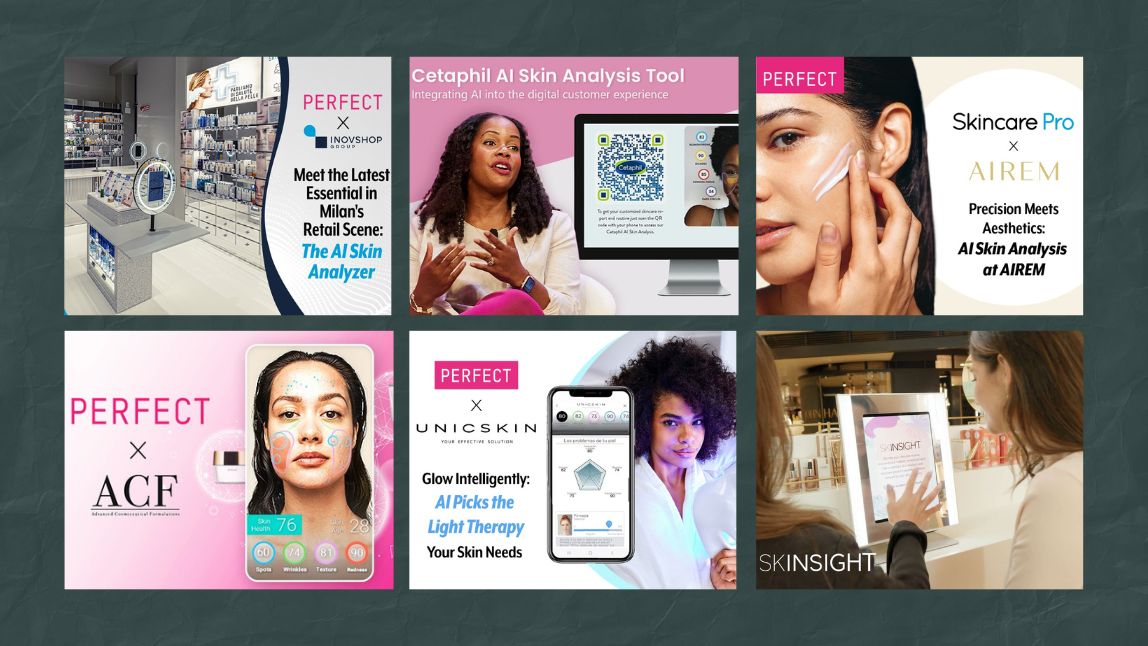
Three numbers tend to move once a scan replaces a quiz in the customer journey: session engagement, add-to-cart behavior, and return rate on recommended products. Perfect Corp's partner Beekman 1802 reported a 50% engagement lift with its AI skin experience, and Kanebo Cosmetics' COFFRET D'OR saw a 2.48x increase in time spent on page after adding AI-driven analysis to its site. Longer, more engaged sessions are the leading indicator; higher conversion and fewer mismatched returns tend to follow, because the recommendation is finally grounded in the customer's actual skin rather than a generic profile.
The underlying reason isn't mysterious. McKinsey research on personalization found 71% of consumers now expect individualized experiences and register real dissatisfaction when brands fall short of that bar. In skincare specifically, getting the recommendation wrong has a physical consequence for the customer — the wrong actives on sensitive skin isn't a minor inconvenience — so the stakes of poor personalization run higher here than in most retail categories, and the upside of getting it right runs higher too.
A scan-based approach also opens a longer runway than a one-time quiz result ever could. Because the analysis produces a trackable skin score, brands can re-engage the same customer weeks or months later to measure progress, which turns a single purchase into a tracked, repeat relationship instead of an impulse buy that never gets revisited.
What to look for when evaluating an AI skin analysis vendor in 2026
Three things separate a genuinely useful AI skin analysis tool from a marketing gimmick with a camera attached:
- Published validation, not a sticker. Look for a stated accuracy or reliability rate backed by an independent or peer-reviewed study — not just the phrase " powered by AI."
- Inclusive performance across skin tones. A model trained mostly on lighter skin will systematically under-serve darker-skinned customers, which shows up as lower conversion and higher returns in exactly the segment driving category growth.
- A real product-mapping layer. The scan result has to connect to your SKUs automatically, with a clear reasoning trail — otherwise your team is stuck hand-mapping every concern to every product, which doesn't scale past a handful of SKUs.
Perfect Corp's AI Skin Analysis is Vanta-certified GDPR- and HIPAA-compliant, which matters if your brand operates across regions with different data-privacy requirements, and gives legal teams a straightforward compliance story instead of a case-by-case negotiation.
Frequently asked questions
Do my customers need to download an app to use AI skin analysis?
No. The hosted, self-service version runs directly in a mobile browser — customers tap a link, take a selfie, and see results in seconds. Deeper integrations use an embed or API, but neither requires the shopper to install anything.
Can I add this to my Shopify or WooCommerce store without a developer?
Yes, for the self-service path. Perfect Corp's Skin Analyzer online service is built to drop into an existing storefront with a link or widget. Brands that want the analysis fully embedded in-app, or want to customize the scoring logic, typically move to the API.
How accurate is Perfect Corp's AI skin analysis?
Independent medical study puts test-retest reliability at 95%, with over 80% correlation to physician evaluation, across diverse skin tones, ages, and genders.
What does the analysis actually detect?
15+ concerns — spots, dark circles, radiance, eyebags, tear troughs, redness, pores, texture, oiliness, droopy upper and lower eyelids, wrinkles, moisture, firmness, and acne — plus classification across 8 skin types.
Is this only realistic for large, enterprise beauty brands?
No. The self-service, no-code path was built specifically so a small D2C team can launch without a development budget, while the API and Expert Mode options exist for brands that outgrow the standard tool and need custom scoring.
Is customer skin data handled securely?
Perfect Corp's AI Skin Analysis is Vanta-certified GDPR- and HIPAA-compliant, built for global skincare brands operating under multiple regional privacy regimes.
How does this compare to running a skincare quiz?
A quiz asks the customer to self-report; AI skin analysis measures. That single difference is why scan-based recommendations tend to earn more customer trust and produce fewer mismatched, return-driving purchases than a questionnaire ever can.
Bring measured personalization to your storefront
Perfect Corp's AI Skin Analysis is trusted by 800+ beauty brands — from fast-moving D2C labels to Cetaphil and Decorté — to turn selfies into product-mapped routines, in seconds, on any device.




 English


