


 Author: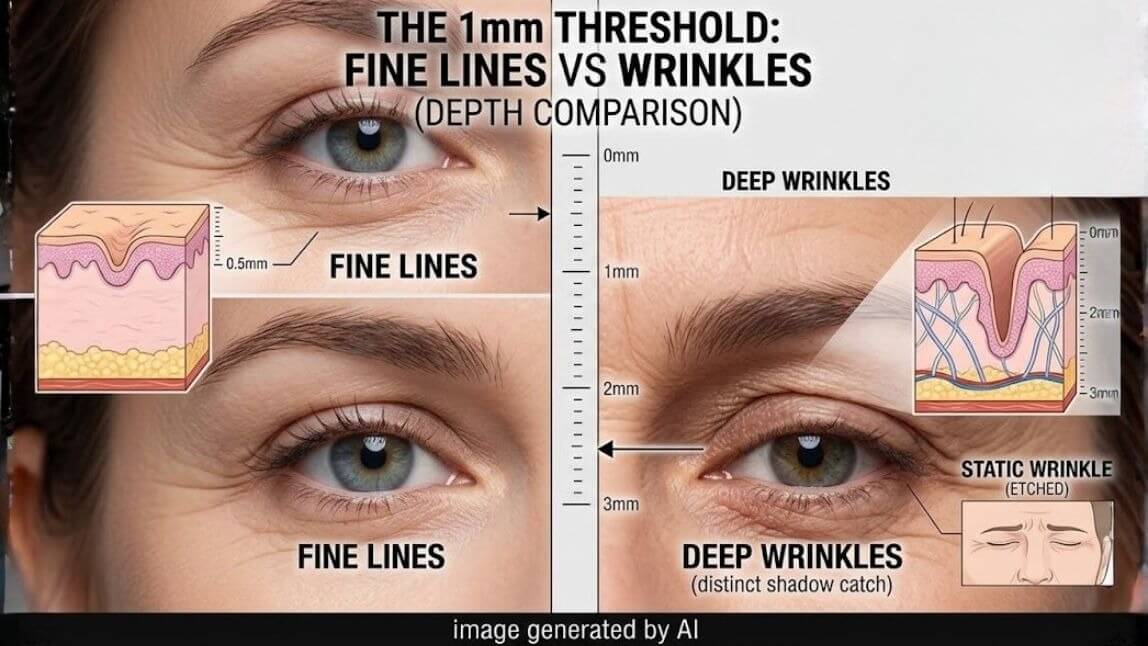
Images generated by YouCam AI
There is a reason the skincare aisle feels confusing. Fine lines and wrinkles get sold as one problem, priced as one problem, and treated as one problem, when dermatology actually separates them by a measurable threshold: depth. Anything under roughly 1mm is a fine line. Deeper than that is a wrinkle. That single number changes what will work on your face, how long it will take, and whether a cream was ever going to be enough. This guide covers the difference, where each type shows up, how AI skin analysis grades line depth, and what genuinely closes a line rather than softening it.
What this guide covers
What Is the Difference Between Fine Lines and Wrinkles?
Depth. Dermatologists generally classify a crease under about 1mm deep as a fine line, and anything deeper as a wrinkle. Fine lines sit in the upper skin layers and respond well to topical care. Wrinkles involve structural collagen loss, so they soften rather than disappear.
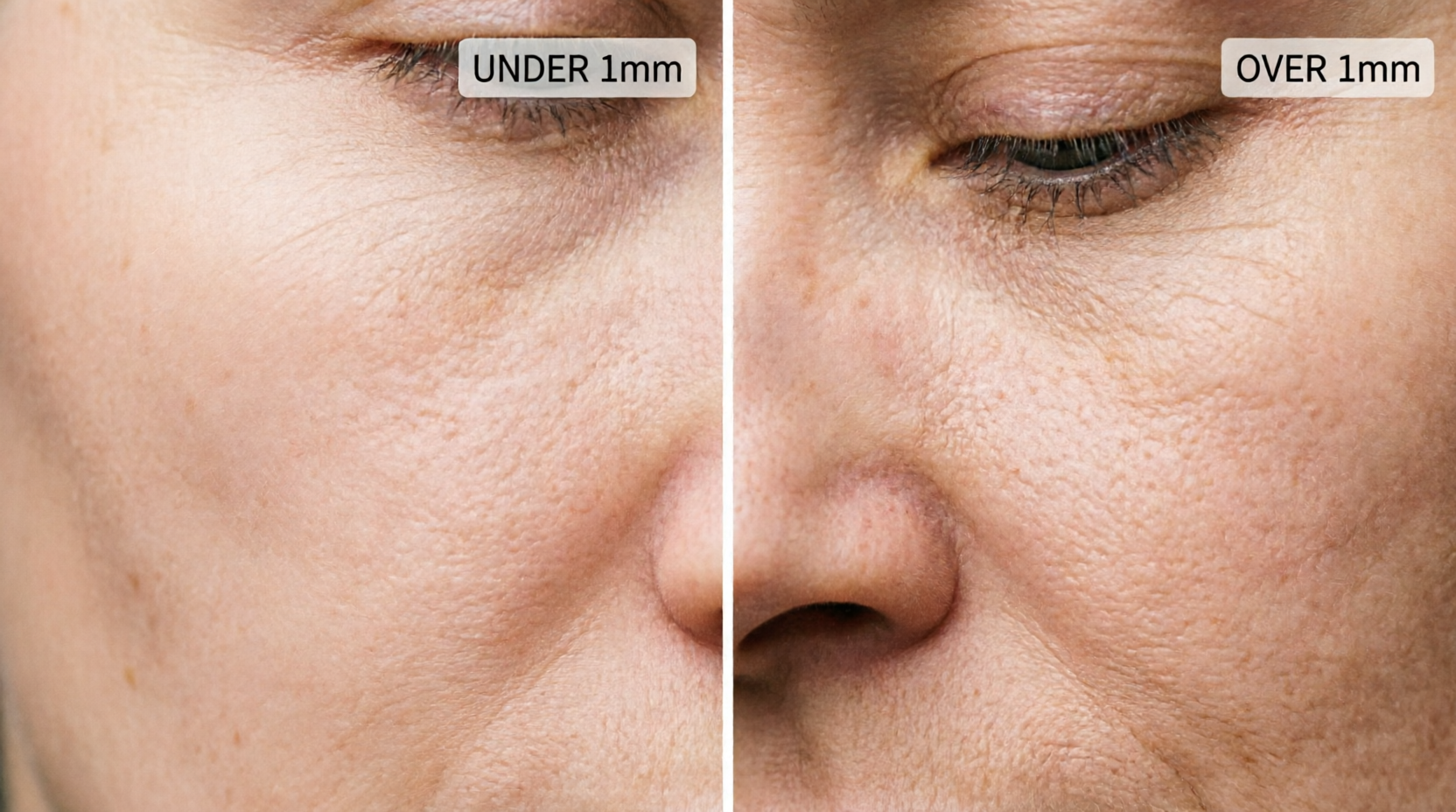
Everything else follows from that. A fine line is a surface event you can still influence with what you apply. A wrinkle is a structural event, which is why the person who has been faithfully using an expensive cream on a deep forehead crease for two years is not doing anything wrong. They are treating the wrong category.
What Are Fine Lines?
Fine lines are shallow surface creases, usually the first visible sign of aging, and they typically appear where your face moves most. They are faint, they often show up more in certain light than others, and in early stages they can look considerably better after a few days of proper hydration.
Three characteristics that identify them:
- They are shallow. Under about 1mm, sitting in the upper layers rather than the structural dermis.
- They are light dependent. Side lighting reveals them, flat frontal lighting can hide them completely.
- They respond to moisture. A dehydrated surface exaggerates fine lines, so hydration alone can visibly reduce them within days. That is not a permanent fix, it is a real effect.
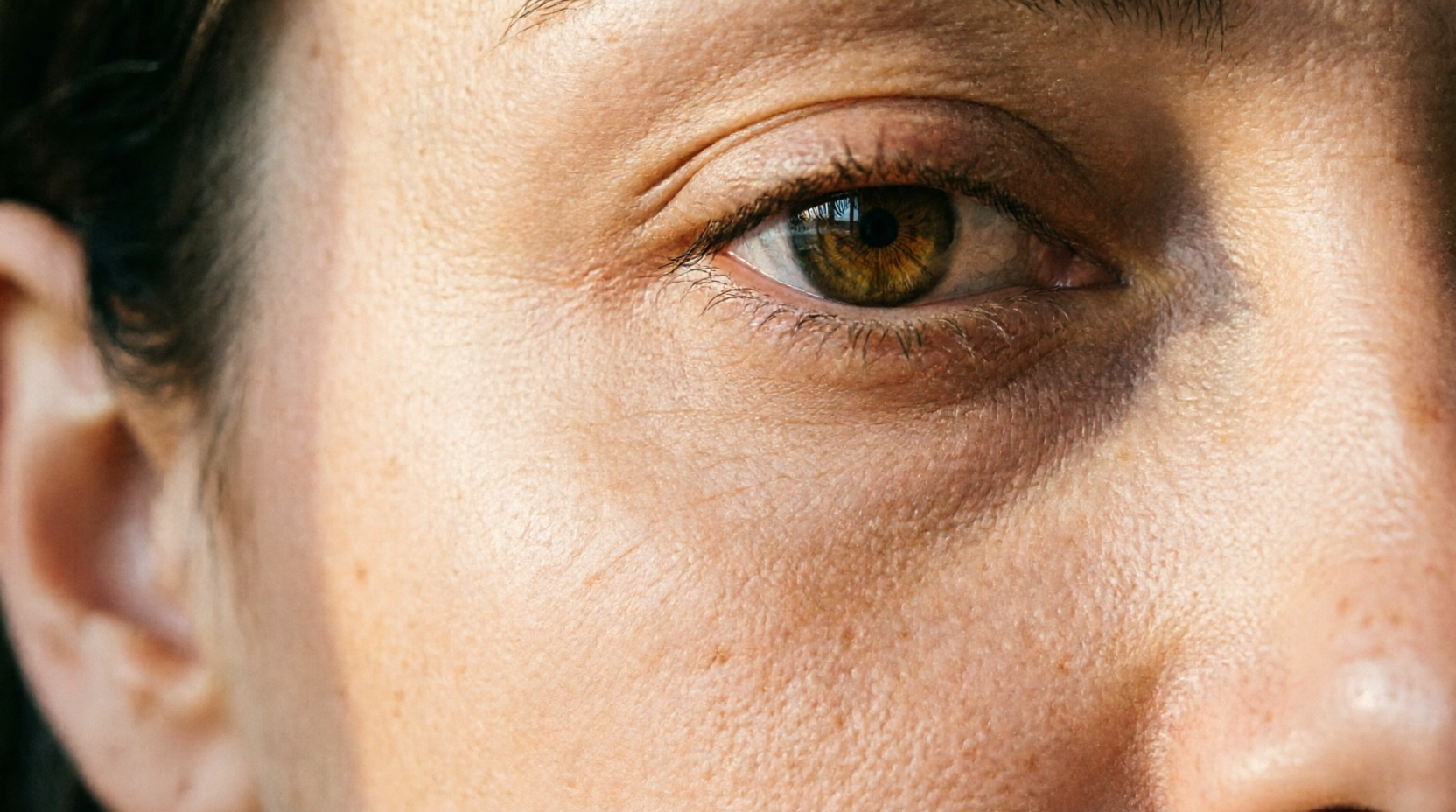
The last point is the source of endless confusion. If a product appears to erase your lines in a week, it almost certainly addressed dehydration rather than the line itself. That is genuinely useful, and it is also why the effect disappears when you stop.
What Are Wrinkles?
Wrinkles are deeper, permanent creases that persist regardless of hydration or expression. They form when collagen and elastin in the structural layer degrade to the point that the skin can no longer spring back into place, so the fold becomes the skin's new resting shape.
Identifying features:
- Visible at rest. Relax your face completely and the crease is still there.
- Depth over 1mm. It catches shadow from almost any lighting direction.
- Hydration independent. Moisturizer may soften the edges. It will not close the fold.
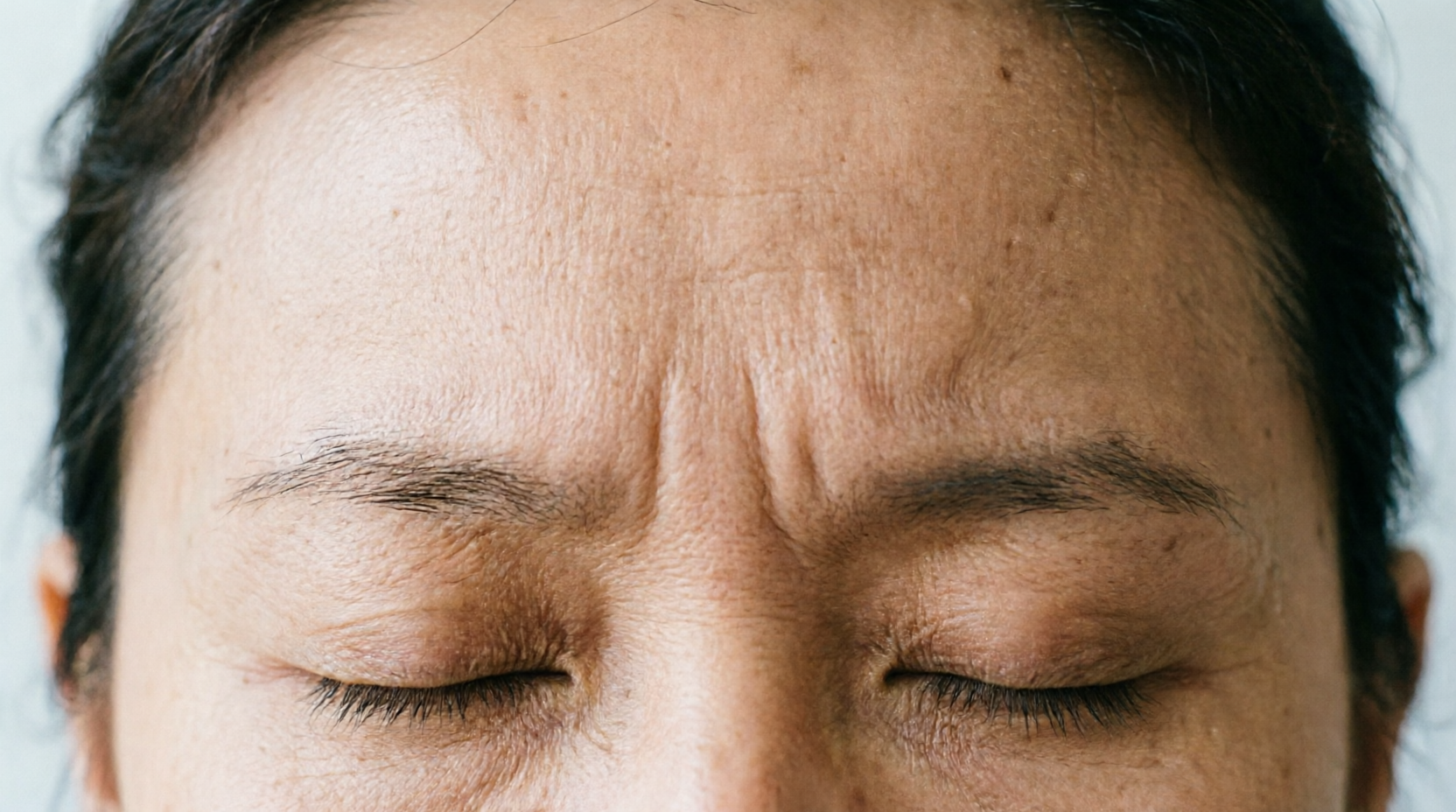
Wrinkles almost always started life as fine lines. Not every fine line becomes a wrinkle, and how many of yours make the transition is mostly a function of sun exposure, repeated expression, and time.
What Is the Difference Between Dynamic and Static Wrinkles?
This is the second distinction that decides your treatment, and it takes ten seconds to test on yourself.
| Type | When you see it | What it means | What addresses it |
| Dynamic wrinkle | Only while you are making an expression | Muscle movement, skin still has enough elasticity to recover | Prevention, sun protection, retinoids, neuromodulators for the muscle |
| Static wrinkle | At complete rest, face fully relaxed | The crease is now etched into the tissue | Resurfacing, energy based treatment, filling for deep folds |
The ten second test
Sit in front of a window, not under a ceiling light. Let your whole face go slack for a full ten seconds, including your brow and the area around your mouth, then photograph yourself at eye level. Lines still visible in that photo are static. Lines that vanished are dynamic.
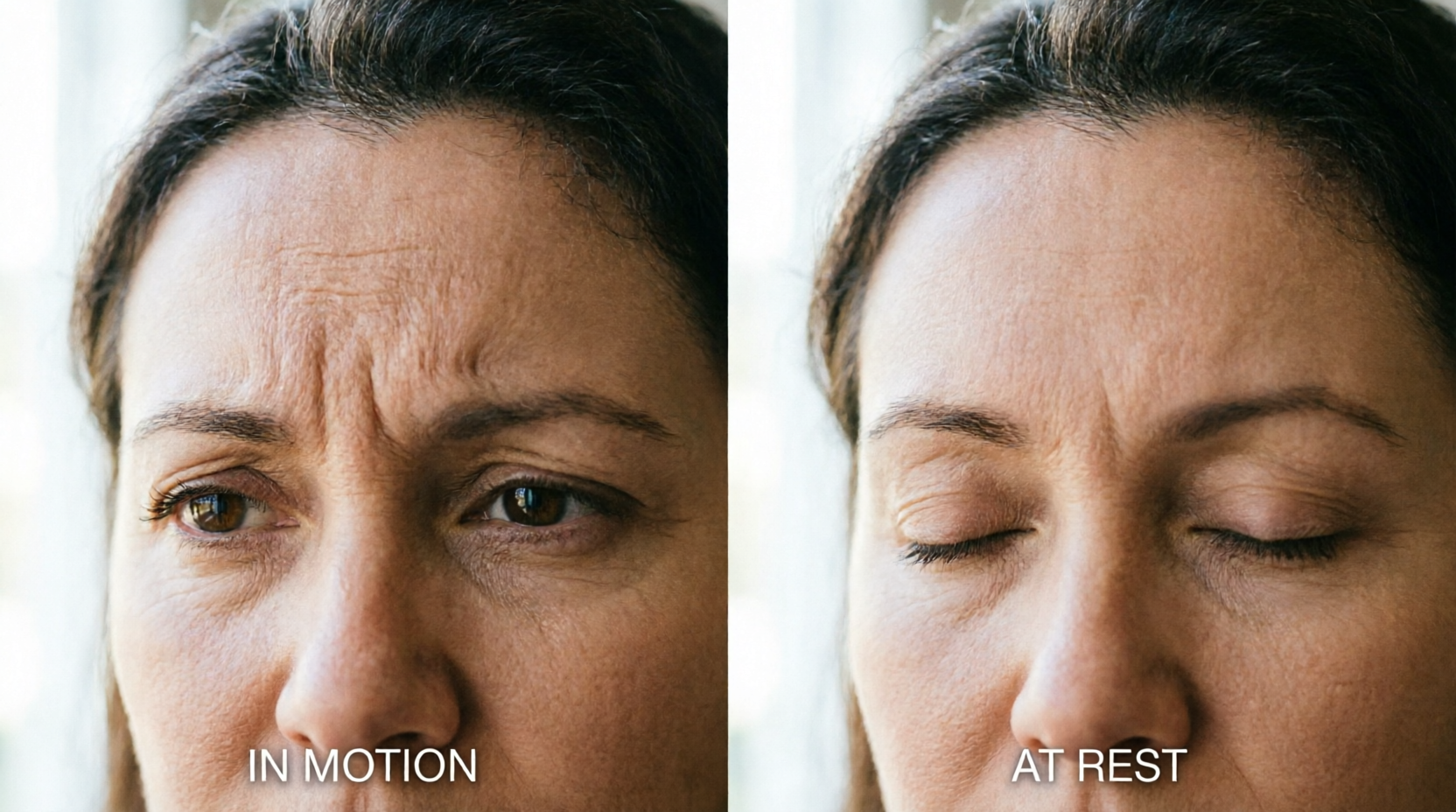
Most people skip the ten seconds, hold a faint expression without realizing, and conclude everything is static. The wait matters.
Where Do Fine Lines and Wrinkles Show Up on the Face?
Not randomly. Each zone has a characteristic pattern, and knowing the pattern tells you the cause.
| Zone | What appears there | Usual driver | Category it lands in |
| Outer eye (crow's feet) | Fine radial lines fanning outward | Squinting, smiling, thin skin, sun | Fine lines first, static wrinkles later |
| Under eye | Fine horizontal creases | Thin skin, dehydration, volume change | Usually fine lines, highly light dependent |
| Forehead | Horizontal bands | Brow raising | Dynamic early, static with repetition |
| Between the brows | Two vertical creases | Frowning and concentration | Etches into static faster than any other zone |
| Nose to mouth (cheek folds) | A deepening diagonal fold | Volume change and laxity, not just movement | Structural, rarely a pure wrinkle problem |
| Upper lip | Fine vertical lines | Sun, smoking, pursing, thin skin | Fine lines that turn static readily |
| Neck | Horizontal bands and crepey texture | Movement, thin skin, missed sunscreen | Both, and usually neglected |
| One cheek only | Vertical creases on the sleeping side | Pillow pressure overnight | Sleep lines, often reversible |
That last row deserves a moment. If your lines are noticeably worse on one side, you are probably looking at sleep creasing rather than aging, and side sleeping is the cause. It is the one line pattern with a genuinely simple fix.
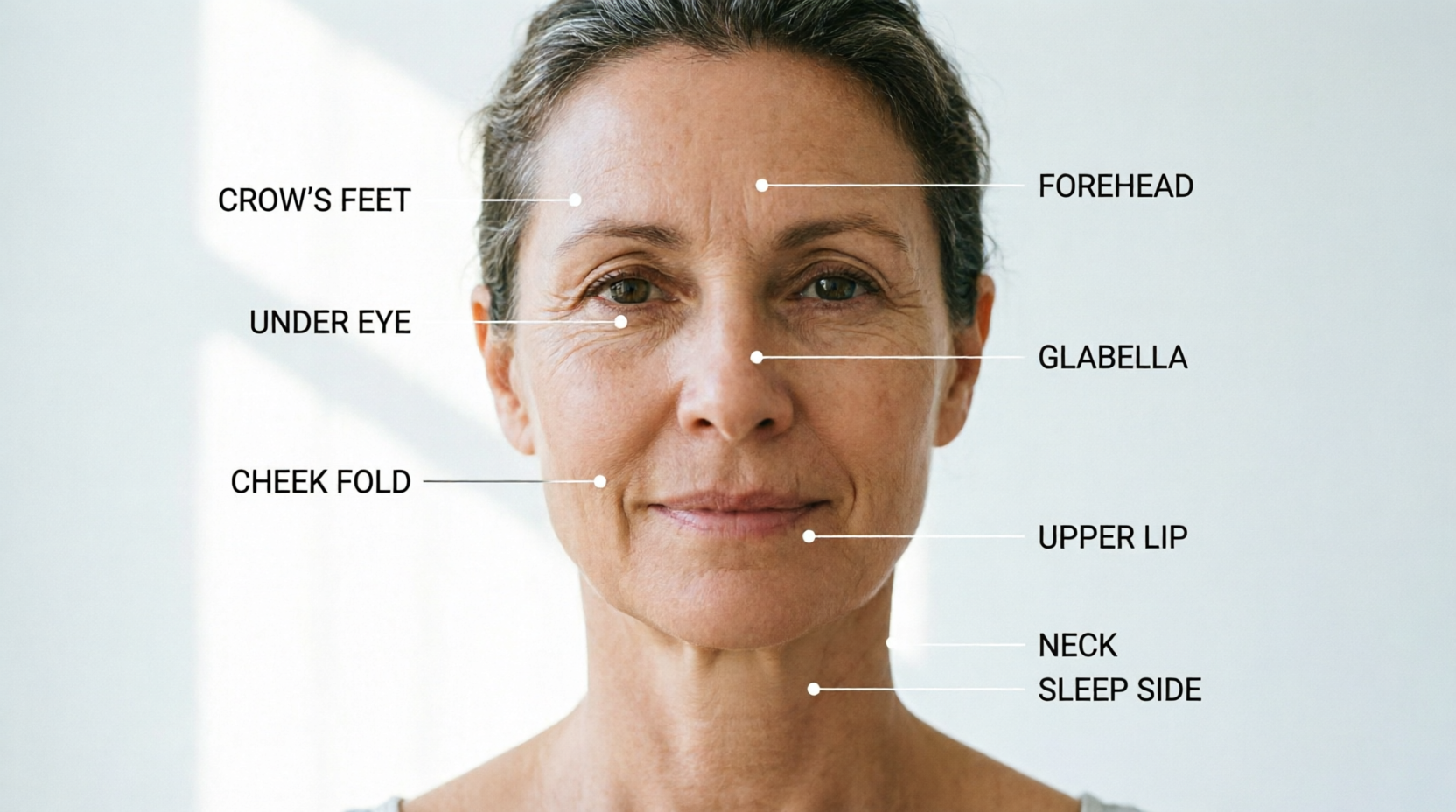
Zone also tells you something about how much age signal a line carries. Clinical research on visible aging consistently weights crow's feet and upper lip lines heavily when estimating how old a face looks, which is worth knowing when you decide where to spend your effort. Our guide to how skin age is estimated covers that weighting in more depth.
What Causes Fine Lines and Wrinkles?
Two processes, and only one of them is negotiable.
Intrinsic causes
Collagen production declines gradually from your twenties, elastin degrades, the surface renews more slowly, and fat pads shift. This is the baseline everyone rides, and it sets the earliest date a line could appear.
Extrinsic causes
This is where the difference between two people the same age gets built.
| Cause | What it does | Leverage you have |
| UV exposure | Breaks down collagen and elastin directly. Dermatology sources commonly attribute roughly 80 to 90 percent of visible skin aging to sun exposure | Very high |
| Repeated expression | Folds the same spot thousands of times until it etches | Moderate |
| Smoking | Accelerates upper lip lines and degrades surface quality | Very high |
| Dehydration | Exaggerates every existing fine line, reversibly | High, and fast |
| Sleep position | Creases one side of the face nightly | High |
| Pollution and oxidative stress | Adds to collagen breakdown | Moderate, antioxidants help |
| Weight fluctuation | Stretches and slackens supporting volume | Moderate |
The summary is unglamorous and reliable: sunscreen outperforms everything else in this table over a ten year horizon, and nothing else comes close.

How Does AI Skin Analysis Grade Line Depth?
Here is the part that almost no fine lines article covers, and it is the practical answer to the whole question. You cannot measure 1mm on your own face in a mirror. A camera based analysis can approximate it, and more usefully, it does so the same way every time.

A modern skin analysis engine such as YouCam AI skin analysis reads up to 15 skin concerns from a single selfie and returns wrinkles as its own scored dimension, separate from texture, firmness and spots. Three things fall out of that:
| What the reading gives you | Why it matters |
| Depth grading rather than presence | Separates the fine lines that will respond to topicals from the static wrinkles that will not |
| Zone by zone scoring | Tells you whether your problem is upper face movement or midface structure, which have different answers |
| A comparable number over time | Nobody can hold a visual baseline for twelve weeks. A score taken under the same conditions does not forget |
Two honest caveats. A photo based estimate is not a clinical measurement of tissue depth, and it is only meaningful when the capture conditions repeat: same room, same time of day, same distance, beauty filters off. Change the light and you change the apparent severity of identical skin, which is exactly the trap that makes self assessment unreliable in the first place.
Developers who want to see the scoring behavior for themselves can run images through the YouCam API Playground before building anything.
Can Fine Lines Be Reversed, and Can Wrinkles?
Fine lines can genuinely improve. Wrinkles soften. That distinction is the single most useful thing to internalize before spending money, so here it is as a ladder.
| What you have | Best realistic outcome | What gets you there | Timeline |
| Dehydration lines | Near complete resolution | Humectants and barrier repair | 3 to 14 days |
| Sleep creasing on one side | Substantial improvement | Back sleeping, silk pillowcase, time | 2 to 8 weeks |
| Fine lines under 1mm | Visible smoothing, sometimes near erasure | Retinoid plus daily SPF, consistently | 8 to 12 weeks for first change, 6 to 12 months for full effect |
| Dynamic wrinkles | Reduced appearance while in motion | Neuromodulators, expression awareness, prevention | Days to weeks, repeats needed |
| Static wrinkles | Softening, not closure | Fractional laser, microneedling, radiofrequency | Weeks after a treatment series |
| Deep structural folds | Filling or lifting, not smoothing | Volume restoration or surgical options | Immediate, then maintenance |
Read down the What you have column, find your row honestly, and the rest of your decisions get much cheaper.
How Do You Treat Fine Lines?
Four steps, in order of evidence.
1. Sunscreen, every morning
It is prevention rather than treatment, and it is still the highest return item in this section, because it stops the fine lines you have from becoming the wrinkles you cannot fix.
2. A retinoid, built up slowly
Retinoids remain the most evidence-backed topical for fine lines. Start twice a week, expect an adjustment period, and give it twelve weeks before judging anything. Consistency beats strength by a wide margin.
3. Hydration as a daily baseline
Humectants and a functioning barrier reduce the appearance of every fine line you have. The effect is real and reversible, so treat it as maintenance rather than a cure.
4. Antioxidants in the morning
Vitamin C and similar antioxidants support collagen and reduce oxidative damage. A useful supporting act, not a lead.
How Do You Treat Wrinkles?
Once a crease is static, the question changes from what to apply to what to do.
| Option | Best for | Honest expectation |
| Neuromodulator injections | Dynamic forehead and glabellar lines | Strong effect on movement, repeats every few months, does not resurface |
| Fractional laser resurfacing | Static lines, sun damaged texture | The most effective option for etched lines, real downtime |
| Microneedling, with or without radiofrequency | Fine static lines, crepey texture | Gradual, usually three to six sessions |
| Chemical peels | Surface lines and dullness | Good for shallow work, limited on depth |
| Dermal filler | Deep folds and volume loss | Fills rather than smooths, wrong tool for fine lines |
| Retinoid, continued | Everything, as background care | Slows the next decade, will not close what is already etched |
Any credible practitioner starts with an assessment, and increasingly that assessment is digital, because a baseline reading turns the follow-up appointment into a comparison rather than a debate. Clinics running an aesthetic simulation and consultation flow tend to use exactly that sequence: read, plan, treat, read again.
At What Age Do Fine Lines Start?
Earlier than most people expect. Collagen production begins declining in the twenties, and the first fine lines usually show up in the mid to late twenties around the eyes, because that skin is thinnest and moves constantly.
| Decade | What typically appears |
| 20s | First fine lines at the outer eye, visible mainly when smiling |
| 30s | Crow's feet visible at rest, forehead lines with expression, upper lip lines beginning |
| 40s | Static forehead and glabellar lines, deepening cheek folds, neck bands |
| 50s and beyond | Structural laxity becomes the dominant factor over individual lines |
These are averages, and the spread around them is enormous. Two people the same age can sit a decade apart on this table, and cumulative sun exposure explains most of that gap.
How Do Brands Use Wrinkle Scoring?
For anyone building the customer experience rather than following it, the fine line versus wrinkle split is a useful example of why granular scoring beats a concern dropdown.
- Recommendation accuracy. A shopper who selects "wrinkles" could need a retinoid or a referral for resurfacing. Those are wildly different journeys, and a depth-graded reading routes them correctly the first time.
- Expectation setting. Telling someone up front that their static glabellar line will soften rather than vanish prevents the refund and the bad review. Honest scoring is a retention tool.
- Progress proof. Retinoid results appear at eight to twelve weeks, which is well past the point where most people quit. A rescan at week four or six is often what keeps them in.
- Consultation efficiency. In clinic, a zone by zone reading moves the conversation straight to the plan instead of negotiating about what the client thinks they see.
Perfect Corp works with 800+ brand partners on flows like these. The scoring is available as an API, so your own logic decides what each concern value triggers, and you can test it against real images before writing integration code. If you would rather see the consumer side first, run a scan on the free AI skin analysis demo.
Fine Lines vs Wrinkles FAQ
What is the difference between fine lines and wrinkles?
Depth. Dermatologists generally treat creases under about 1mm as fine lines and anything deeper as wrinkles. Fine lines sit in the upper layers and respond to topical care. Wrinkles involve structural collagen loss, so they soften rather than close.
Do fine lines turn into wrinkles?
Often, but not always. A fine line becomes a wrinkle when repeated folding plus collagen loss etches it into the tissue. Daily sun protection and consistent retinoid use are what slow that transition.
Can fine lines be reversed?
Yes, meaningfully. Dehydration lines can resolve in under two weeks, and true fine lines can visibly smooth over eight to twelve weeks on a retinoid, with continued improvement across six to twelve months.
Can wrinkles be reversed?
Not closed, but softened. Resurfacing, microneedling and radiofrequency all improve the appearance of static wrinkles. Anyone promising erasure from a cream is describing a fine line, not a wrinkle.
At what age do fine lines start?
Usually the mid to late twenties, around the outer eye, where skin is thinnest and moves most. Collagen production starts declining in the twenties, so early appearance is normal rather than alarming.
What is the difference between dynamic and static wrinkles?
Dynamic wrinkles appear only during expression and disappear at rest. Static wrinkles are visible with the face fully relaxed. Relax completely for ten full seconds, then photograph yourself at eye level to tell which you have.
Why do I have lines on only one side of my face?
Almost always sleep creasing from side sleeping, sometimes combined with uneven sun exposure. Sleep lines improve with back sleeping and a smoother pillowcase, which makes them the most fixable line pattern there is.
Does drinking water reduce fine lines?
Adequate hydration supports skin function, but surface dehydration is a barrier issue, so it responds to what you apply and to humidity far more than to intake. Topical humectants outperform extra glasses of water here.
What are the best ingredients for fine lines and wrinkles?
Retinoids first, broad spectrum SPF as the non-negotiable partner, then humectants such as glycerin and hyaluronic acid for appearance, peptides and antioxidants as support. Nothing on that list closes a static wrinkle.
How can I tell whether my line is a fine line or a wrinkle?
Relax your face for ten seconds in window light and photograph it at eye level. A crease that stays is static. Then check whether two days of solid hydration changes it, because lines that improve that fast were dehydration. For the ambiguous ones, a depth-graded reading answers it properly.
One Threshold, Two Completely Different Plans
Fine lines and wrinkles look like a spectrum and behave like two categories. Under 1mm you are working on the surface, and consistency with a retinoid and sunscreen genuinely changes what you see in the mirror. Over 1mm you are working on structure, and the honest answer involves a practitioner. The expensive mistake is applying the first plan to the second problem for two years.
Get the depth graded before you spend. Run a free AI skin analysis for a zone by zone baseline, or contact Perfect Corp for a demo if you are building wrinkle scoring into your own customer flow.



 English


