


 Author: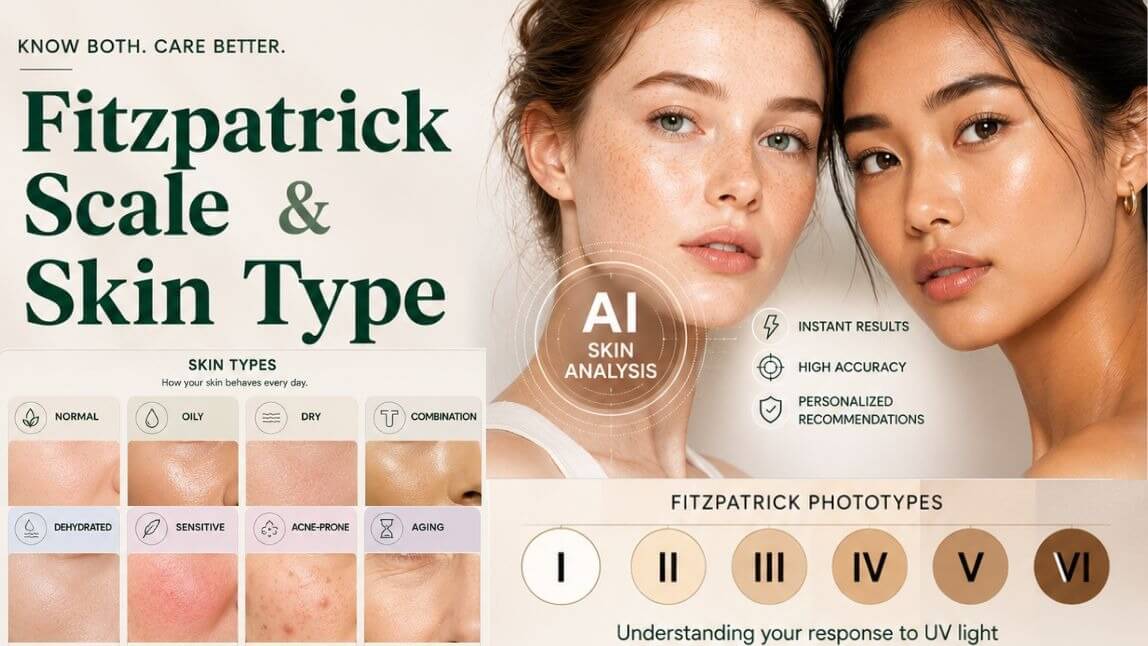
Ask someone their skin type and they'll probably say "oily" or "dry." Ask a dermatologist about their skin and they'll want to know their Fitzpatrick phototype. These two systems aren't the same thing — and confusing them is one of the main reasons skincare routines underperform and cosmetic treatments go wrong.
Skin type tells you how your skin behaves. Fitzpatrick scale tells you how your skin responds to UV light. Both have profound implications for product selection, professional treatments, and long-term skin health. And for the first time, AI skin analysis can determine both — instantly, from a selfie — giving beauty brands and clinics the diagnostic precision that used to require a trained professional and a consultation room.
What Is the Fitzpatrick Scale?
The Fitzpatrick Skin Type Scale is a dermatological classification system developed in 1975 by Dr. Thomas B. Fitzpatrick, a Harvard dermatologist. Originally created to determine safe UV dosing for psoriasis phototherapy, the scale classifies skin into six phototypes (I–VI) based on two key variables: constitutional skin color and the skin's historical response to sun exposure — specifically, how easily it burns and how readily it tans.
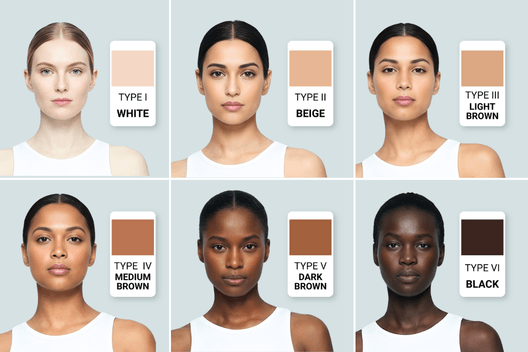
Types V and VI were added in 1988, expanding the scale to better encompass darker skin tones. Today the Fitzpatrick scale remains the global standard in dermatology and cosmetic medicine for predicting how skin responds to UV radiation and light-based treatments.
The Six Fitzpatrick Phototypes
| Type | Skin Color | Sun Response | Typical Features |
| I | Pale white | Always burns, never tans | Red or blonde hair, blue/green eyes, freckles |
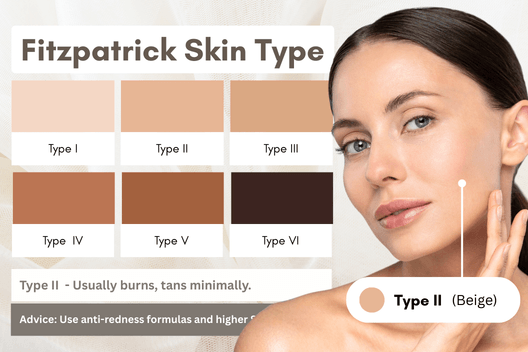
| II | Fair white | Burns easily, tans minimally | Blonde or light brown hair, blue or hazel eyes |
| III | Darker white | Burns moderately, tans gradually | Any eye or hair color; common across Europe and Asia |
| IV | Light brown | Burns minimally, tans easily | Moderate brown skin; common in Mediterranean, Asian, Latino populations |
| V | Brown | Rarely burns, tans darkly | Dark brown skin; common in Middle Eastern, South Asian, Hispanic populations |
| VI | Dark brown to black | Never burns, deeply pigmented | Deeply pigmented skin; higher melanin provides natural UV protection |
Why Does Fitzpatrick Type Matter for Skincare and Treatments?
Knowing your Fitzpatrick type isn't academic — it has direct, practical consequences for which skincare ingredients you should use and which professional treatments are safe for your skin.
Laser and Light-Based Treatments
Laser hair removal, IPL, and laser resurfacing all target melanin. Darker Fitzpatrick types (IV–VI) have higher melanin density, which means improperly calibrated laser settings can cause hyperpigmentation, burns, or permanent scarring. Choosing a practitioner who understands Fitzpatrick typing is non-negotiable for anyone with skin of color.
Chemical Peels
Higher Fitzpatrick types are more prone to post-inflammatory hyperpigmentation (PIH) after medium or deep chemical peels. Peels need to be formulated and timed specifically for skin of color — a generic peel protocol designed for Type II skin can leave lasting pigment damage on Type V or VI skin.
Sun Protection
Types I and II face the highest skin cancer risk from UV exposure and require diligent SPF use year-round. Types V and VI have natural UV protection from higher melanin levels — but this does not eliminate cancer risk, and all phototypes benefit from daily broad-spectrum sun protection.
Active Ingredient Tolerance
Retinoids, AHAs, and certain brightening agents (kojic acid, vitamin C at high concentrations) can trigger irritation responses that manifest differently across Fitzpatrick types. Darker skin tones are more prone to inflammation-triggered pigmentation, making a gentler, more gradual introduction approach critical.
What Is Skin Type — And How Is It Different from Fitzpatrick?
While Fitzpatrick classification describes UV photosensitivity, skin type describes the skin's daily sebaceous and moisture behavior — how much oil it produces, how well it retains hydration, and how it responds to products and environmental triggers.
Traditional dermatology recognized four skin types: normal, oily, dry, and combination. But that model is too coarse to capture the nuance of real-world skin — particularly when redness, barrier dysfunction, and mixed-zone behaviors are factored in.
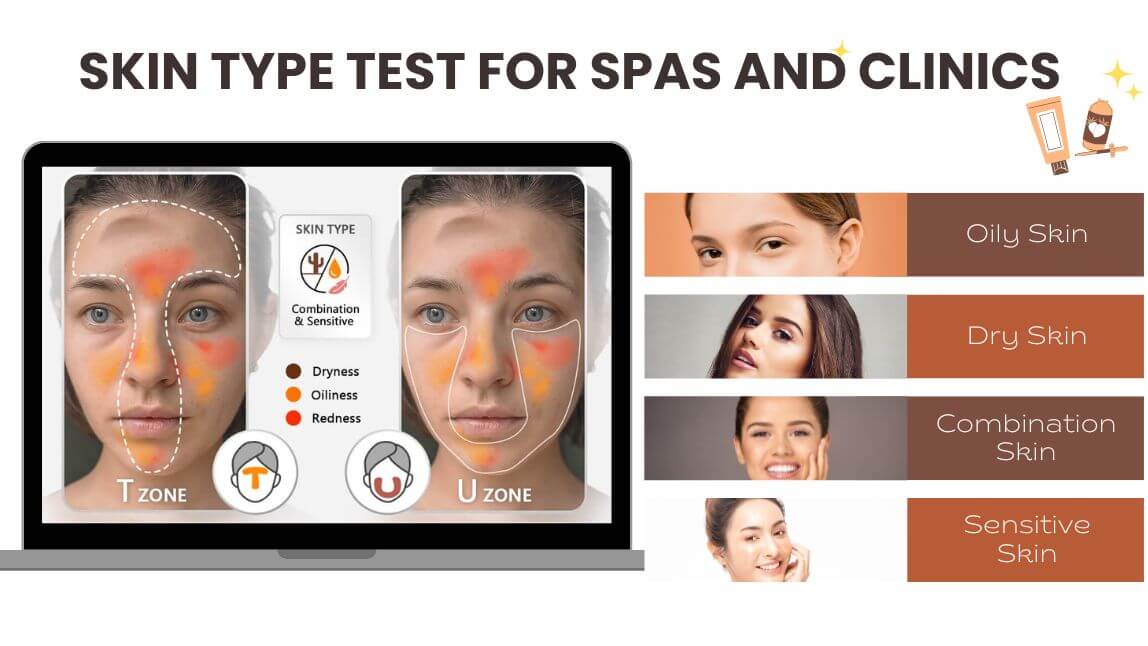
Perfect Corp.'s AI Skin Type Test identifies 8 distinct skin types by analyzing both the T-zone (forehead, nose, chin) and U-zone (cheeks, jaw, around the eyes) independently — a dual-zone approach that captures the real-world complexity that simple self-assessment quizzes miss entirely.
The 8 Skin Types: A Complete Guide
1. Normal Skin
Balanced sebum production with no excessive oiliness or dryness across both T-zone and U-zone. Pores are small, texture is even, and skin generally tolerates most products well. Normal skin still benefits from consistent protection and hydration — "normal" doesn't mean maintenance-free.
2. Oily Skin
Excess sebum production, primarily concentrated in the T-zone but often extending across the full face. Enlarged pores, persistent shine, and acne-prone tendencies are common. The challenge is controlling oil without triggering the rebound overproduction that comes from stripping the skin barrier.
3. Dry Skin
Low sebum production leading to tightness, roughness, or flakiness — typically most pronounced in the U-zone (cheeks and under-eye area). Dry skin is more vulnerable to environmental stressors, faster to show fine lines, and requires consistent lipid-rich barrier support.
4. Combination Skin
The most common skin type globally: oily T-zone, normal-to-dry U-zone. The challenge is managing two conflicting needs simultaneously — controlling sebum centrally while hydrating the drier peripheral zones. Zone-specific routines outperform one-size-fits-all approaches here.
5. Redness Skin
Skin prone to visible blood vessel dilation, flushing, or chronic irritation — typically concentrated in the U-zone (cheeks, nose, chin). Often associated with rosacea, sensitive skin reactivity, or vascular overresponsiveness. This skin type requires anti-inflammatory actives, barrier repair, and avoiding known vasodilatory triggers.
6. Dry & Redness Skin
A combined presentation: compromised skin barrier causing dryness alongside concurrent vascular reactivity. Both conditions amplify each other — a weakened barrier is more permeable to irritants, which drives more redness. Treatment priorities are barrier restoration first, then targeted anti-inflammatory support.
7. Oily & Redness Skin
Excess sebum in the T-zone coexisting with redness or irritation around the nose, cheeks, or chin. This combination is particularly challenging because many sebum-controlling ingredients (alcohol, strong AHAs) can worsen vascular reactivity. Niacinamide is uniquely suited to address both simultaneously.
8. Combination & Redness Skin
Oily T-zone and dry-or-normal U-zone, with additional areas of redness or irritation. The most complex skin type to address — requiring a three-way balance of oil control, hydration, and inflammation management across different facial zones.
Fitzpatrick Scale vs. Skin Type: At a Glance
| Fitzpatrick Scale | Skin Type | |
| What it measures | UV photosensitivity and melanin response | Sebaceous and moisture behavior |
| Scale | Types I–VI | 8 types (Normal, Oily, Dry, Combination + 4 redness variants) |
| Primary clinical use | Laser/light treatment safety; sun protection; PIH risk | Product selection; skincare routine building |
| Changes over time? | Relatively stable (genetic) | Can change with season, hormones, age, products |
| Detected by AI? | Yes — via pigmentation and tone analysis | Yes — via T-zone/U-zone sebum and redness mapping |
How AI Detects Both Fitzpatrick Type and Skin Type — Instantly
Historically, both Fitzpatrick typing and skin type assessment required either self-reporting (which is notoriously inconsistent) or in-person evaluation by a trained professional. Neither scales. Neither is fast enough for a digital commerce experience. And neither delivers the zone-specific precision that the 8-skin-type model requires.
Perfect Corp.'s AI Skin Analysis solves all three problems simultaneously. Using HD imaging and computer vision trained on a globally diverse dataset, the system:
- Detects Fitzpatrick phototype from skin tone and pigmentation analysis
- Classifies skin type from one of 8 categories by independently analyzing the T-zone and U-zone
- Cross-references skin type findings with 15 additional skin concerns (oiliness, redness, pores, texture, firmness, moisture, acne, spots, and more)
- Generates personalized skincare routine recommendations matched to the complete skin profile
A medical study confirms the system achieves a 95% test-retest reliability rate — consistent, repeatable results that give brands and clinics the confidence to act on AI-generated findings.
For MedSpas, aesthetic clinics, and dermatology-adjacent brands, this creates a scalable intake workflow: every customer who takes the skin analysis receives a Fitzpatrick-aware, skin-type-specific recommendation — the kind of nuanced guidance that previously required a 30-minute professional consultation.
Want to detect Fitzpatrick type and skin type in one selfie scan? Explore Perfect Corp's AI Skin Analysis →
Why Fitzpatrick Detection Matters for Inclusive Beauty Tech
One of the most important conversations in AI skincare is bias. Research published in the NIH (2025) found that AI diagnostic models trained predominantly on lighter skin tones showed significantly lower accuracy for melanoma detection in Fitzpatrick Types III–VI. For beauty technology to serve a global market, training data must reflect global skin diversity.
Perfect Corp.'s AI Skin Analysis is trained on a globally diverse image dataset that includes representation across all six Fitzpatrick types. This matters not just for accuracy — it matters for equity. Brands that serve diverse consumer populations need AI tools that perform equally well across all skin tones, not just for the demographic that historically dominated clinical study populations.
See how global beauty brands deploy inclusive AI skin diagnostics.

How to Build a Routine Around Your Fitzpatrick Type and Skin Type
Fitzpatrick I–II + Oily or Combination Skin
Highest UV risk combined with excess sebum. Priority: non-comedogenic SPF 50 daily, BHA exfoliation, oil-free hydration. Retinoids are well-tolerated but require SPF diligence due to photosensitivity.
Fitzpatrick III–IV + Dry or Redness Skin
Moderate UV risk with barrier vulnerability. Priority: ceramide-rich barrier repair, gentle anti-inflammatory actives (niacinamide, centella), and daily SPF. Introduce retinoids slowly to avoid PIH-triggering irritation.
Fitzpatrick V–VI + Any Skin Type
Lower UV burn risk but higher PIH risk from any inflammatory trigger — acne, aggressive actives, or light-based treatments. Priority: gentle actives, rigorous SPF, and professional treatments calibrated for skin of color. Vitamin C and tranexamic acid are preferred brighteners over hydroquinone for long-term use.
Frequently Asked Questions
What is the difference between Fitzpatrick skin type and regular skin type?
Fitzpatrick type describes how your skin responds to UV light — based on melanin levels and burn/tan history. Skin type (normal, oily, dry, combination, etc.) describes your skin's daily sebaceous and moisture behavior. They measure completely different things and are both important for skincare and treatment planning.
Can AI accurately detect Fitzpatrick skin type?
Yes. Advanced AI skin analysis platforms like Perfect Corp's use computer vision to analyze skin tone, pigmentation, and melanin distribution from facial images — achieving high reliability in Fitzpatrick classification across all six phototypes, including skin tones that have historically been underrepresented in AI training datasets.
What are the 8 skin types?
Perfect Corp.'s AI Skin Type Test identifies 8 skin types: Normal, Oily, Dry, Combination, Redness, Dry & Redness, Oily & Redness, and Combination & Redness. These are derived from independent analysis of the T-zone and U-zone, capturing the real-world complexity that four-type models miss.
Why does Fitzpatrick type matter for laser treatments?
Lasers and IPL devices target melanin. Higher Fitzpatrick types (IV–VI) have more melanin, which means improperly calibrated laser settings can cause burns, scarring, or post-inflammatory hyperpigmentation. Accurate Fitzpatrick classification is essential for safe, effective light-based treatment planning.
Can your Fitzpatrick type change?
Fitzpatrick type is largely genetically determined and relatively stable throughout life. However, tanning can temporarily shift your skin's melanin response, and significant UV damage over time can alter how the skin responds. Your skin type (oily, dry, etc.), on the other hand, can change with hormones, season, age, and skincare habits.
How do beauty brands use Fitzpatrick detection?
Beauty brands and MedSpas use Fitzpatrick detection to personalize product recommendations by skin tone, ensure safe ingredient formulation guidance (particularly for brightening and exfoliating actives), and power inclusive AI-driven skin diagnostic experiences that serve customers across all skin tones equitably.
The Bottom Line
Skin type tells your skin what it needs every day. Fitzpatrick type tells your skin what it can safely handle. Both are essential inputs for intelligent skincare — and both have historically been left to guesswork, self-reporting, or in-person consultation.
AI skin analysis changes that. With a single selfie scan, Perfect Corp.'s AI Skin Analysis delivers Fitzpatrick phototype detection, 8-category skin type classification, and a 15-concern full-face diagnostic — giving beauty brands, clinics, and consumers the complete picture they need to make decisions that actually work.
Ready to bring Fitzpatrick-aware, skin-type-specific AI diagnostics to your platform?

Sources
- Typology – Phototypes: What Is the Fitzpatrick Scale? (2025). typology.com
- NIH / Cureus – Performance Evaluation of ChatGPT-4o in Dermatological Diagnoses Across Fitzpatrick Skin Types (2025). ncbi.nlm.nih.gov
- NIH / PMC – The Colorimetric Scale for Skin of Color Should Replace the Fitzpatrick Skin Type Scale (2025). pmc.ncbi.nlm.nih.gov
- ScienceDirect – Human skin type classification using image processing and deep learning (2023). sciencedirect.com
- Perfect Corp. – AI Skin Analysis Solution for Beauty Brands & Clinics. perfectcorp.com
- Perfect Corp. – AI Skin Type Test (8 Skin Types). perfectcorp.com



 English


