


 Author: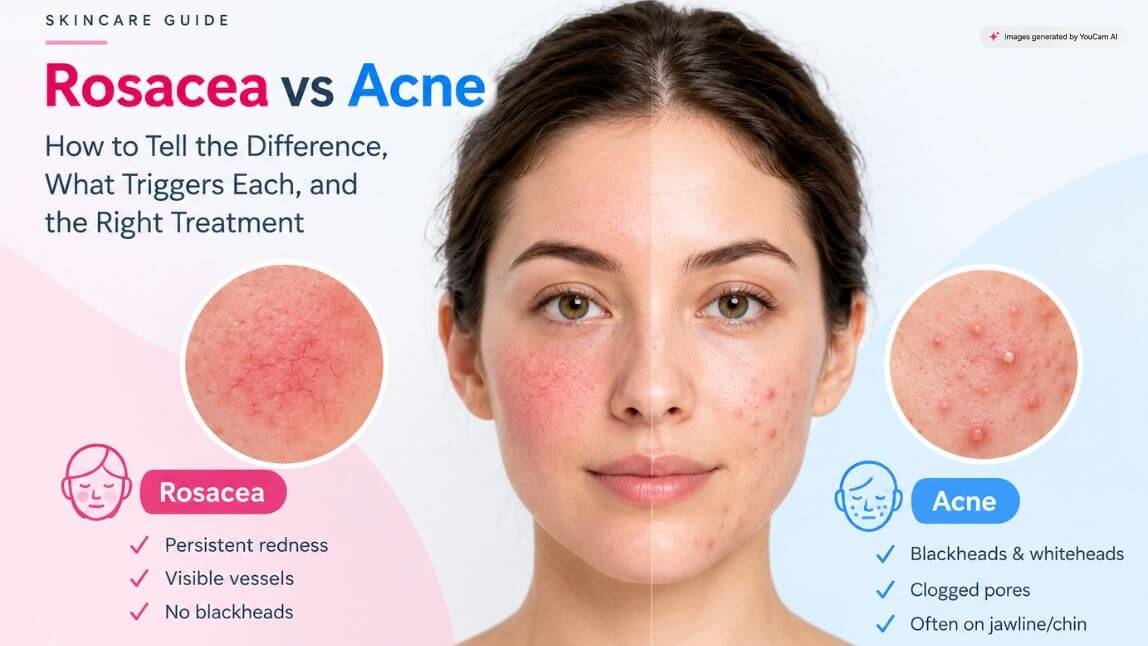
Images generated by YouCam AI
The two conditions look close enough that people treat one while they have the other for years, and the treatments work against each other. Acne care is built on drying and exfoliating. Rosacea gets worse with both. Dermatology has one reliable tell that settles most cases in seconds, and it is not the redness. This guide covers how to tell rosacea and acne apart, what triggers each, where the treatments diverge, and how a skin analysis API scores redness and acne as two separate channels so a product recommendation flow stops sending the wrong routine to the wrong face.
What this guide covers
What Is the Difference Between Rosacea and Acne?
Comedones. Blackheads and whiteheads are a defining feature of acne and are not a feature of rosacea. If you have clogged pores alongside the bumps, you are looking at acne. If you have persistent central facial redness, visible small vessels and flushing without comedones, rosacea is the stronger candidate.
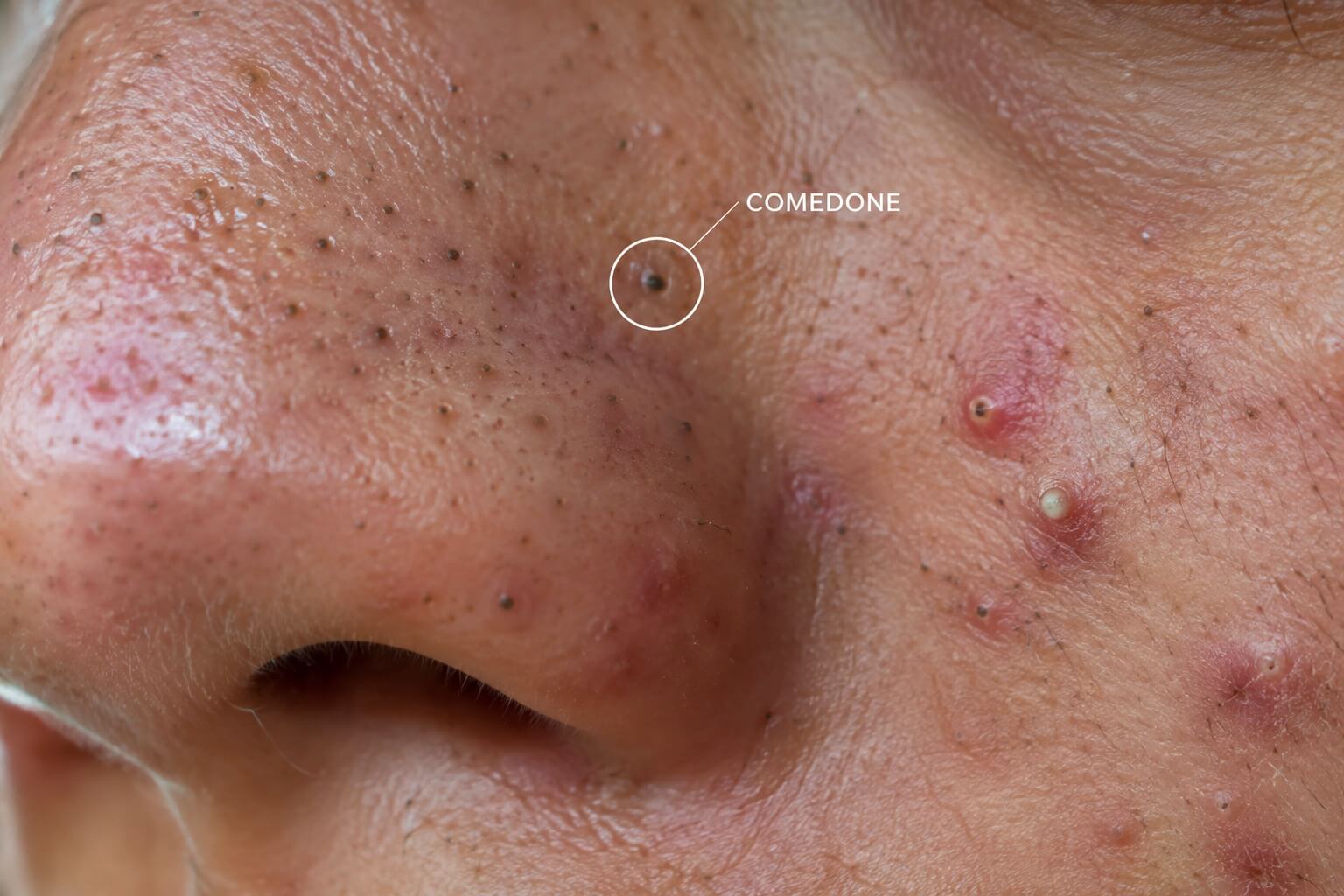
Everything else on the two lists overlaps enough to confuse almost anyone: both produce inflamed bumps, both concentrate on the central face, both flare and settle, and both respond to almost nothing in the first month. The comedone test is the fastest way past that.
What Is Rosacea?
Rosacea is a chronic inflammatory condition of the central face. It is managed rather than cured, it runs in cycles of flare and calm, and it tends to appear later than acne, most commonly from the thirties onward and more often in people who flush easily.
It shows up in several patterns, which is part of why it gets misread.
| Pattern | What it looks like |
| Flushing and persistent redness | Central face redness that stops looking temporary. Often the first stage |
| Visible vessels | Fine threadlike vessels across the cheeks and nose |
| Bumps and pustules | Inflamed papules on a red background, with no blackheads or whiteheads. This is the one mistaken for acne |
| Thickened skin | Skin of the nose and cheeks becoming thicker over time, far less common |
| Eye involvement | Dry, gritty, irritated eyes and lid margins, frequently overlooked |
Two of those, the flushing and the visible vessels, have no equivalent in acne at all. Their presence is close to decisive.
What Is Acne?
Acne is an inflammatory condition of the pore, driven by a combination of oil production, keratin build up, bacteria and inflammation. It usually begins in adolescence, though adult acne is common, particularly along the jaw and chin in women.
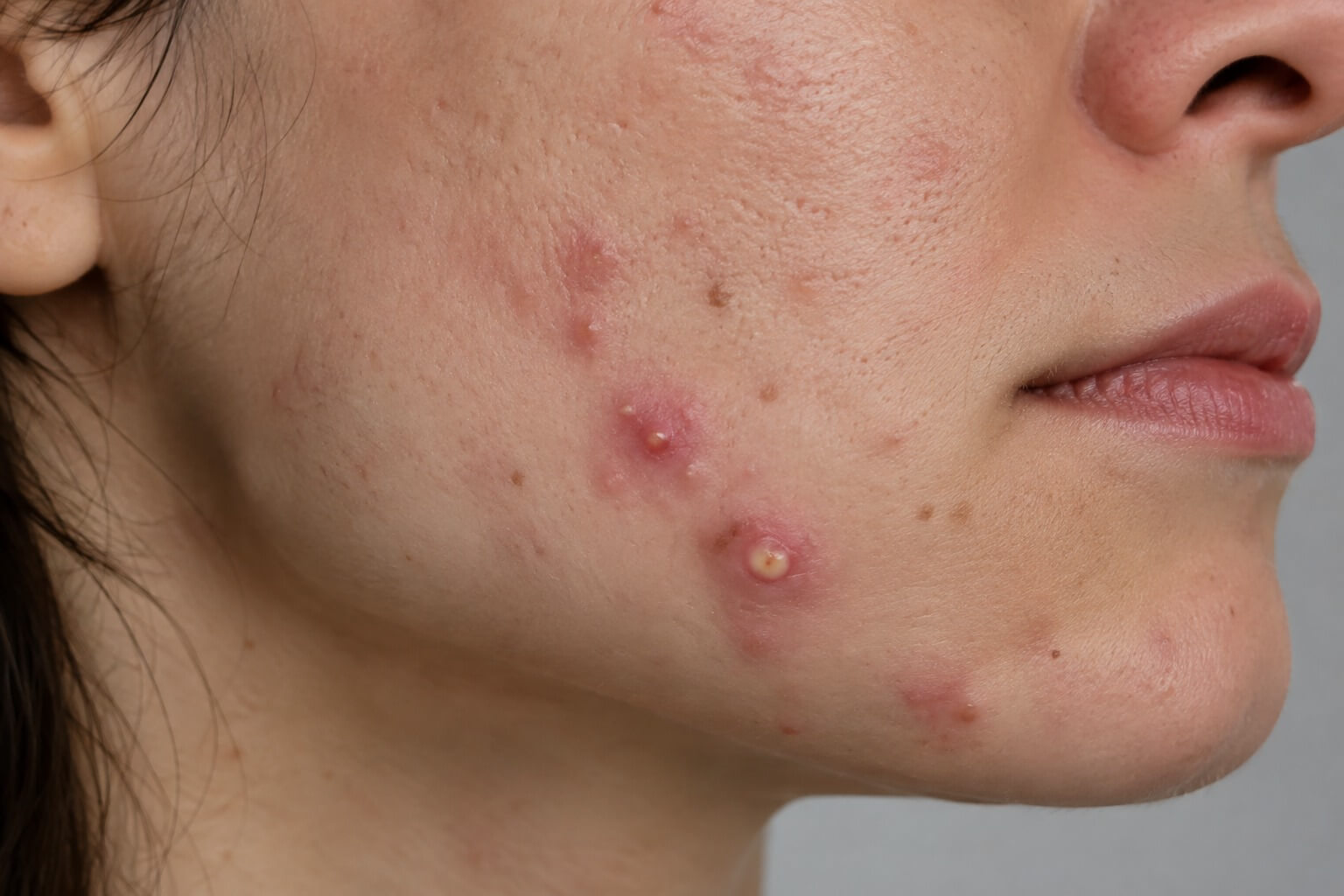
The pore is the whole story, and it is the part rosacea does not share.
| Lesion | What it is | Appears in rosacea? |
| Blackhead | An open clogged pore, oxidized at the surface | No |
| Whitehead | A closed clogged pore | No |
| Papule | A small inflamed bump with no head | Yes, this is the overlap |
| Pustule | An inflamed bump with visible pus | Yes, this is the overlap |
| Nodule or cyst | Deep, painful, often scarring | Rarely, and worth a clinician's opinion |
How Do You Tell Rosacea and Acne Apart?
Six questions, in order of how much they settle.
| Question | Points to rosacea | Points to acne |
| Do you have blackheads or whiteheads? | No | Yes, this is close to definitive |
| Do you flush, and does the redness stay? | Yes, often triggered by heat, alcohol or spice | Flushing is not a feature |
| Can you see fine vessels on the cheeks or nose? | Yes | No |
| Where is it? | Centre of the face: cheeks, nose, chin, between the brows | Anywhere, often jawline, forehead, back and chest too |
| When did it start? | Usually thirties or later | Often teens, or adult acne along the jaw |
| Does the skin sting or burn? | Commonly, especially with products | Less often, unless the barrier is compromised |
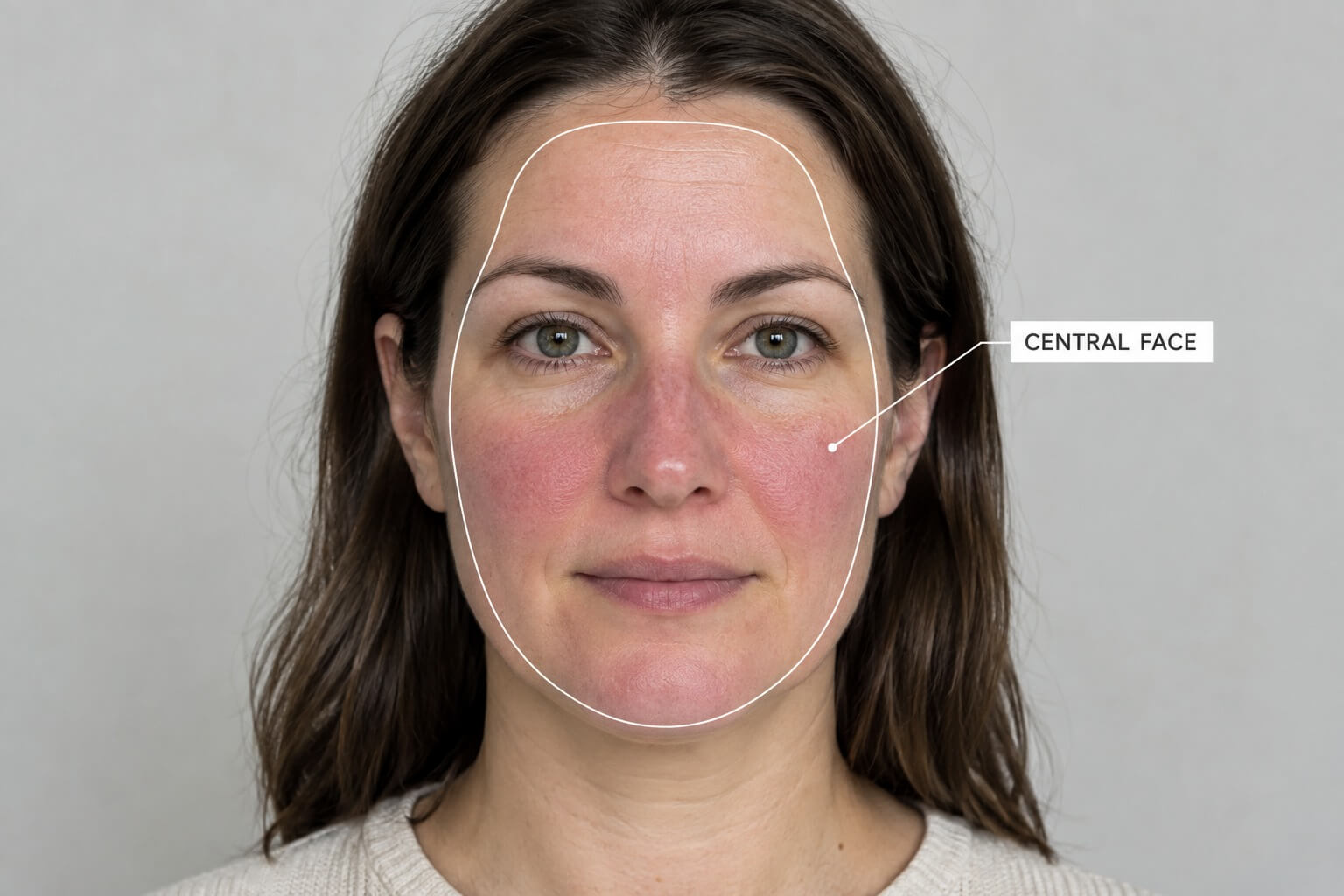
Two more clues worth checking. Rosacea almost never appears on the back or chest, while acne frequently does. And rosacea often brings eye symptoms, so dry, gritty eyes alongside facial redness is a combination that points firmly one way.
Can You Have Both at the Same Time?
Yes, and it is more common than the clean comparison tables suggest. Someone can have comedonal acne on the jaw and rosacea across the cheeks, which is exactly the situation where a single routine does the most damage. The acne products get applied to the whole face, and the rosacea side reacts.
The practical answer when both are present is zone specific care: treat the pore driven areas with pore driven products, and keep the reactive central face on a minimal, barrier supporting routine. That is also why a zone by zone reading is more useful here than a single verdict for the whole face.
What Causes Rosacea and What Causes Acne?
| Rosacea | Acne | |
| Core mechanism | Vascular and immune dysregulation of the central face | Clogged pores plus bacteria plus inflammation |
| Oil production | Not the driver | Central to it |
| Hormones | Not a primary driver | Strongly involved, especially in adult acne |
| Genetics | Family history is common | Family history is common |
| Skin mites and microbiome | Demodex density is associated with some cases | C. acnes is part of the process |
| Barrier function | Frequently impaired, which amplifies everything | Can be impaired, often by over treatment |
Barrier function deserves a separate mention, because it sits underneath both. A compromised barrier makes rosacea sting and flare more easily, and it makes acne treatment intolerable. If products have started burning on application, that is a barrier problem layered on top of whichever condition you have, and it needs handling first.
What Triggers a Rosacea Flare?
Acne does not really have same day triggers. Rosacea does, and mapping yours is most of the management.
- Heat. Hot showers, hot drinks, saunas, hot weather.
- Alcohol. Red wine most often reported.
- Spicy food. Reliable for many people, irrelevant for others.
- Sun exposure. One of the most consistent triggers across sufferers.
- Cold wind. The opposite extreme, equally provoking.
- Stress. Widely reported and hard to control.
- Skincare products. Fragrance, alcohol denat, menthol, and most exfoliating acids.
- Exercise. Intense sessions, mainly through the heat rather than the effort.
The list is individual. Two weeks of noting what preceded each flare will tell you more than any general article, including this one.
How Does a Skin Analysis API Separate Redness from Acne?
By scoring them as different things. This is the part that matters for anyone building a skincare experience, because the moment redness and acne stop being one blurred concern, the recommendation logic downstream gets dramatically better.
The YouCam AI Skin Analysis API analyzes 15 skin concerns from a single selfie, dermatologist verified, and returns them as individual scored values rather than one label. Four of those concerns carry the rosacea and acne signal:
| Scored concern | What it captures | Which way it points |
| Redness | Diffuse erythema and its distribution across the face | High and centrally concentrated leans rosacea |
| Acne | Inflammatory lesions | Present in both, so on its own it settles nothing |
| Pores and texture | Clogging and surface irregularity, the comedone signal | The decider. Clogging with inflammation leans acne |
| Moisture and oiliness | Hydration and sebum, measured separately | High sebum supports acne, low moisture flags the barrier problem sitting underneath |
Read as a combination, the pattern is legible. High redness with low clogging and normal sebum is a very different face from moderate redness with heavy clogging and high sebum, even though a customer would describe both as "my skin is red and bumpy". That combination is what routes them to a barrier and calming routine rather than to salicylic acid.
Two more API pieces make the flow complete. The Fitzpatrick skin type API matters because redness reads differently across skin tones and is frequently under detected in deeper tones, so tone aware handling is not optional. And the AI Skin Simulation API produces before and after comparisons over time, which is how a user sees a calming routine working during the weeks when they would otherwise give up.
What Can and Cannot Be Detected from a Photo?
This section exists because overselling here is both wrong and commercially stupid. Be precise about the boundary and the feature earns trust. Blur it and you earn a complaint.
| A photo based reading can | A photo based reading cannot |
| Score redness intensity and where it sits on the face | Diagnose rosacea. Diagnosis is a clinical act |
| Score inflammatory lesions and surface clogging | Distinguish a rosacea papule from an acne papule lesion by lesion |
| Track change across repeated scans under the same conditions | Detect eye involvement, or anything below the surface |
| Flag a pattern worth a professional opinion | Replace that opinion, or rule out another condition |
| Route a shopper away from products likely to make it worse | Prescribe, or promise a result |
The right product language is "your reading shows high redness with low clogging, which is a pattern worth discussing with a dermatologist", never "you have rosacea". The first sentence is useful, defensible and converts. The second is a liability.
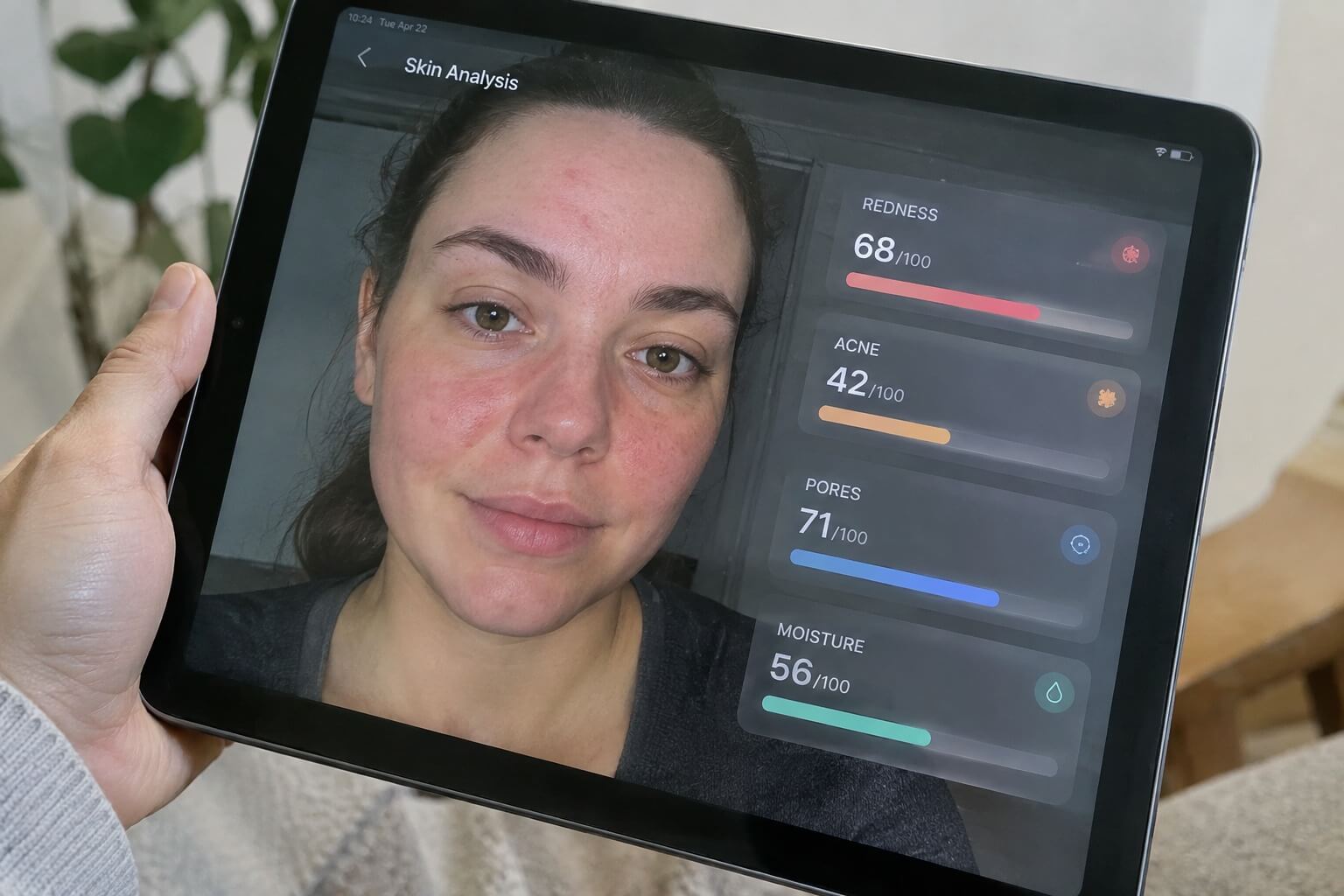
Capture conditions matter more here than in any other concern. Redness swings with room temperature, with what the person drank an hour ago, and heavily with white balance. Any comparison between two scans needs the same room, the same time of day, the same distance and no beauty filters, or you are measuring the lighting.
What Does Rosacea Look Like on Deeper Skin Tones?
Different, and that difference is the reason rosacea goes undiagnosed for years in people with deeper skin. Almost every article and every clinical photo set you will find, including most of the results above this one in search, shows rosacea on fair skin, where the redness is obvious. On deeper skin tones the same condition presents with far less visible erythema, so the signals shift.
| What to look for instead of obvious redness | Why it matters |
| Warmth or a dusky, violaceous tone rather than bright red | Erythema reads darker rather than brighter against more melanin |
| Swelling across the central face | Often more noticeable than colour change |
| Burning and stinging with products | The symptom is identical regardless of tone, and it is frequently the strongest clue |
| Bumps and pustules with no comedones | The comedone test works equally well on every skin tone |
| Post-inflammatory pigmentation where flares have settled | More prominent, and often the thing that brings people in |
| Dry, gritty eyes alongside facial symptoms | Not tone dependent at all |
This has a direct engineering consequence. A redness detection threshold tuned on fair skin will under-report on deeper tones, which is why tone classification belongs alongside the concern scores rather than as an afterthought. Running Fitzpatrick classification in the same call and adjusting thresholds per type is the difference between a feature that works for your whole customer base and one that quietly works for part of it.
How Do the Treatments Differ?
This is where getting the identification wrong becomes expensive.
| Rosacea | Acne | |
| Goal | Reduce inflammation and avoid triggers. Managed, not cured | Clear pores, reduce bacteria and inflammation, prevent scarring |
| Typical topicals | Azelaic acid, metronidazole, ivermectin, prescription vasoconstrictors | Benzoyl peroxide, salicylic acid, retinoids, topical antibiotics |
| Oral options | Low dose doxycycline in some cases | Antibiotics, hormonal treatment, isotretinoin for severe cases |
| Procedures | Vascular laser or IPL for persistent vessels | Extractions, chemical peels, resurfacing for scarring |
| Cleansing | Gentle, non-foaming, lukewarm water | Gentle, twice daily, foaming acceptable for oily skin |
| Sunscreen | Essential. Mineral filters often better tolerated | Essential, especially on retinoids |
| Exfoliation | Generally avoided | Useful, in moderation |
Azelaic acid is the one ingredient that shows up on both lists, which makes it a reasonable starting point when someone genuinely cannot tell which they have and cannot get to a clinician quickly.
What Makes Each One Worse?
The mis-treatment trap, stated plainly.
- Acne products on rosacea. Benzoyl peroxide, strong salicylic acid, scrubs and alcohol based toners are drying and irritating by design. On rosacea they drive flares and damage the barrier, which makes the next flare easier.
- Rosacea care on acne. Rich occlusive creams are soothing for rosacea and can worsen clogging on acne prone skin. Less dramatic than the reverse, but still a slow deterioration.
- Over-cleansing, on either. The instinct when skin looks angry is to wash it more. Both conditions get worse.
- Stacking actives while inflamed. Adding a second active to skin that is already reacting is the most common self inflicted setback in both.
If products have started stinging on application, stop all actives for two weeks and rebuild the barrier before resuming any treatment decision. Nothing you conclude about your skin while it is in that state will be reliable.
What Does a 90 Day Plan Look Like for Each?
Both conditions punish impatience, and they punish it on different schedules. Setting the expectation up front is most of what keeps someone on a routine long enough for it to work.
| Stage | If it is rosacea | If it is acne |
| Week 0 | Baseline scan. Strip back to gentle cleanser, bland moisturizer, mineral sunscreen. Start a trigger diary | Baseline scan. Gentle cleanser, light moisturizer, sunscreen. Pick one active, not three |
| Weeks 1 to 2 | No actives at all. Note what preceded each flare | Introduce the single active every other night, building up |
| Weeks 3 to 4 | Stinging should be gone. Consider azelaic acid or a prescription if you have one | Purging is possible and normal. Hold the course |
| Week 4 | Second scan, same conditions. Redness should be measurably lower | Second scan. Expect little visible change yet |
| Weeks 5 to 8 | Trigger list should be taking shape. Flares shorter and less frequent | First real improvement in inflammatory lesions |
| Weeks 9 to 12 | Discuss vascular procedures for persistent vessels, which topicals do not clear | Assess whether the active is enough or escalation is needed |
| Week 12 | Third scan. Compare all three, not just the last two | Third scan. Marks may remain after the lesions clear, which is normal |
Two honest notes. Rosacea never finishes this table, because management continues, and the goal is longer quiet stretches rather than an end date. And acne marks left behind after the lesions clear are pigment rather than active acne, so they follow a different and slower timeline.
How Do Teams Build This into an App with an API?
For the builders reading this, here is the shape of a flow that handles the rosacea and acne overlap responsibly.
- Capture with guardrails. Prompt for even lighting and no filters, and reject frames that fail. Everything downstream depends on this one step, and it is the one most teams skip.
- Read the concern set, not a label. Call the skin analysis endpoint and keep redness, acne, pores, texture and moisture as separate values in your own model. Do not collapse them into a single "skin concern" field.
- Branch on the combination. High redness with low clogging routes to calming and barrier products. Moderate redness with high clogging and high sebum routes to acne care. Both elevated routes to zone specific advice plus a professional referral prompt.
- Layer tone awareness. Run Fitzpatrick classification alongside, so redness thresholds are not tuned only for lighter skin.
- Re-scan on a schedule. Two to four weeks, under the same capture rules. A calming routine shows almost nothing at week one, and that is when people quit.
- Write careful copy. Report patterns and suggest a professional opinion. Never output a condition name as a conclusion.
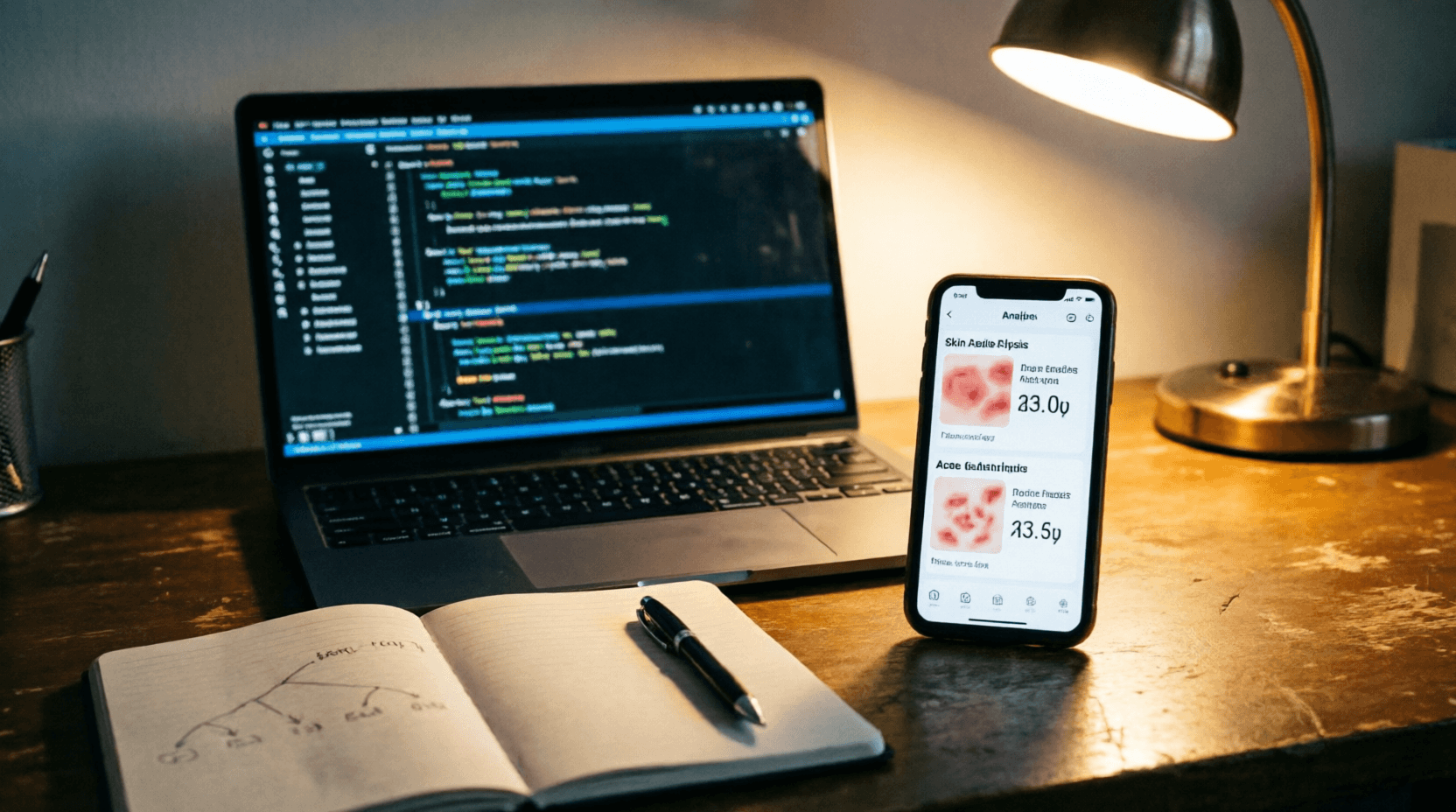
The branching step is where most implementations get vague, so here is the routing logic written out. Treat the thresholds as a starting point to tune against your own catalogue.
| Redness | Pores and texture | Oiliness | Route the customer to |
| High | Low | Normal or low | Calming and barrier products, mineral sunscreen. Prompt a professional opinion |
| Low or moderate | High | High | Standard acne care, salicylic acid or a retinoid, oil control |
| High | High | High | Zone specific advice, gentle actives only, strong referral prompt |
| High | Any | Any, with low moisture | Barrier repair first. Hold every active for two weeks, then re-scan |
| Low | Low | Any | Maintenance and prevention. Do not invent a concern to sell into |
The last row is worth defending internally. A flow that always finds something to treat loses trust quickly, and the reading gives you a defensible reason to tell someone their skin is fine.
You can run all of this against real images in the YouCam AI API Playground before writing integration code, and our walkthrough of how to use an API for digital skin analysis covers the request and response shape in detail. Perfect Corp works with 800+ brand partners running variations of this flow.
When Should You See a Dermatologist?
Sooner than most people do, and in these situations specifically:
- Persistent central facial redness that has lasted more than three months
- Visible vessels on the cheeks or nose
- Bumps with no blackheads or whiteheads anywhere
- Dry, gritty or irritated eyes alongside facial redness
- Skin that stings from most products
- Deep, painful lesions, or any scarring
- Three months of over the counter treatment with no improvement
Rosacea is a clinical diagnosis and it responds well to prescription treatment, so the appointment is usually the shortest path. A scan is a good way to arrive with evidence, not a substitute for going.
Rosacea vs Acne FAQ
What is the main difference between rosacea and acne?
Comedones. Blackheads and whiteheads are a defining feature of acne and do not occur in rosacea. Rosacea adds flushing and visible fine vessels, which acne does not produce.
Can rosacea be misdiagnosed as acne?
Frequently, particularly the bump and pustule pattern, which looks like adult acne on a red background. The distinguishing detail is the absence of clogged pores and the presence of flushing.
Can you have rosacea and acne at the same time?
Yes, and it is common enough to plan for. Zone specific care is the usual answer, keeping pore treatments on the pore driven areas and a minimal barrier routine on the reactive central face.
Does rosacea look like acne in photos?
It can. In a photograph the giveaways are the distribution, central face rather than jawline and back, the diffuse background redness, and the absence of blackheads on the nose.
What age does rosacea usually start?
Most commonly from the thirties onward, and often in people who have flushed easily for years. Acne typically begins earlier, though adult acne along the jaw is common.
Can an app or API diagnose rosacea?
No. A skin analysis API scores visible signs such as redness intensity and distribution, inflammatory lesions and pore clogging, which is enough to flag a pattern and route product advice. Diagnosis is a clinical act and needs a professional.
How accurate is AI redness detection?
Useful for relative comparison, sensitive to capture conditions. Scores are only comparable across scans taken in the same light, at the same distance, with filters off. Tone aware handling also matters, since redness is under detected in deeper skin tones without it.
Which skincare ingredients should be avoided with rosacea?
Fragrance, denatured alcohol, menthol, witch hazel, physical scrubs, and most exfoliating acids. Benzoyl peroxide and strong salicylic acid, both staples of acne care, are common flare triggers.
Does azelaic acid work for both?
It is used in both, which makes it a reasonable starting point when the picture is unclear. It addresses inflammation and clogging and is generally better tolerated on reactive skin than benzoyl peroxide.
Is rosacea curable?
It is managed rather than cured. Trigger avoidance, a minimal routine, daily sun protection and prescription treatment can keep it quiet for long stretches, and vascular procedures address persistent vessels.
Why does my skin sting when I apply products?
Usually a compromised barrier, which occurs alongside both conditions and amplifies both. Stop all actives, simplify to a gentle cleanser, a ceramide moisturizer and sunscreen, and reassess in two weeks.
Why is rosacea missed on deeper skin tones?
Because the redness that defines it in most clinical images is far less visible against more melanin. On deeper tones it often presents as warmth, a dusky tone, swelling, burning with products, and post-inflammatory pigmentation after flares. The comedone test still works identically, which makes it the most reliable check across every skin tone.
How long before treatment shows any difference?
Rosacea usually shows measurably lower redness by around week four on a stripped back routine, with flares becoming shorter over the following two months. Acne typically shows little in the first month, real improvement in inflammatory lesions from weeks five to eight, and leaves marks that fade on a slower timeline than the lesions themselves.
Does a skin analysis API work on video or only photos?
Both approaches exist, and the constraint is the same either way: the reading is only comparable across sessions when lighting, distance and processing are consistent. A live capture flow with on-screen guidance and filter detection is usually more reliable than accepting whatever image a user uploads from their camera roll.
Can a skin analysis API tell them apart on its own?
It can separate the signals that matter, redness from acne from clogging, and that combination is usually enough to route a customer to the right products and away from the wrong ones. It should present that as a pattern, not as a condition name.
One Question Settles Most of It
Look for blackheads. Their presence points to acne, their absence alongside flushing and visible vessels points to rosacea, and the answer changes almost every product decision that follows. For anyone building the recommendation rather than receiving it, the same logic holds in code: keep redness, acne and pore clogging as separate scored values, branch on the combination, and never let the output claim a diagnosis.
Test the skin analysis API in the YouCam AI Playground, or contact Perfect Corp for a demo to see how the concern set fits your own customer flow.



 English


