


 Author: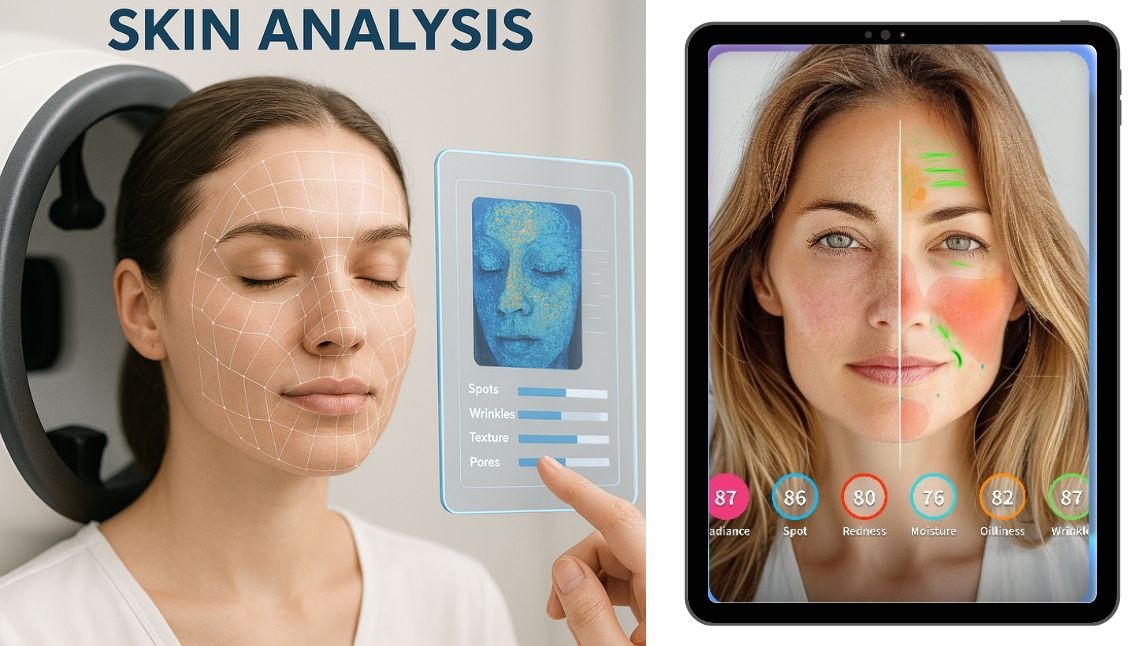
What Is “Skin Derma” — and Why It Matters for Beauty Brands
Skincare has always been personal. The challenge for brands has been delivering on that promise at any meaningful scale.
For most of the industry's history, skin assessment relied on manual consultations, visual judgment, or simple questionnaire flows. These methods work — up to a point. A well-trained aesthetician can evaluate skin texture and surface congestion in person. A paper quiz cannot. Neither can a static "skin type" selector buried in an e-commerce product page.
Skin Derma represents a meaningful upgrade to this infrastructure. At its core, it's the application of AI-driven skin analysis to the consultation layer — using deep learning models trained on dermatology-grade datasets to evaluate skin condition objectively, consistently, and in real time.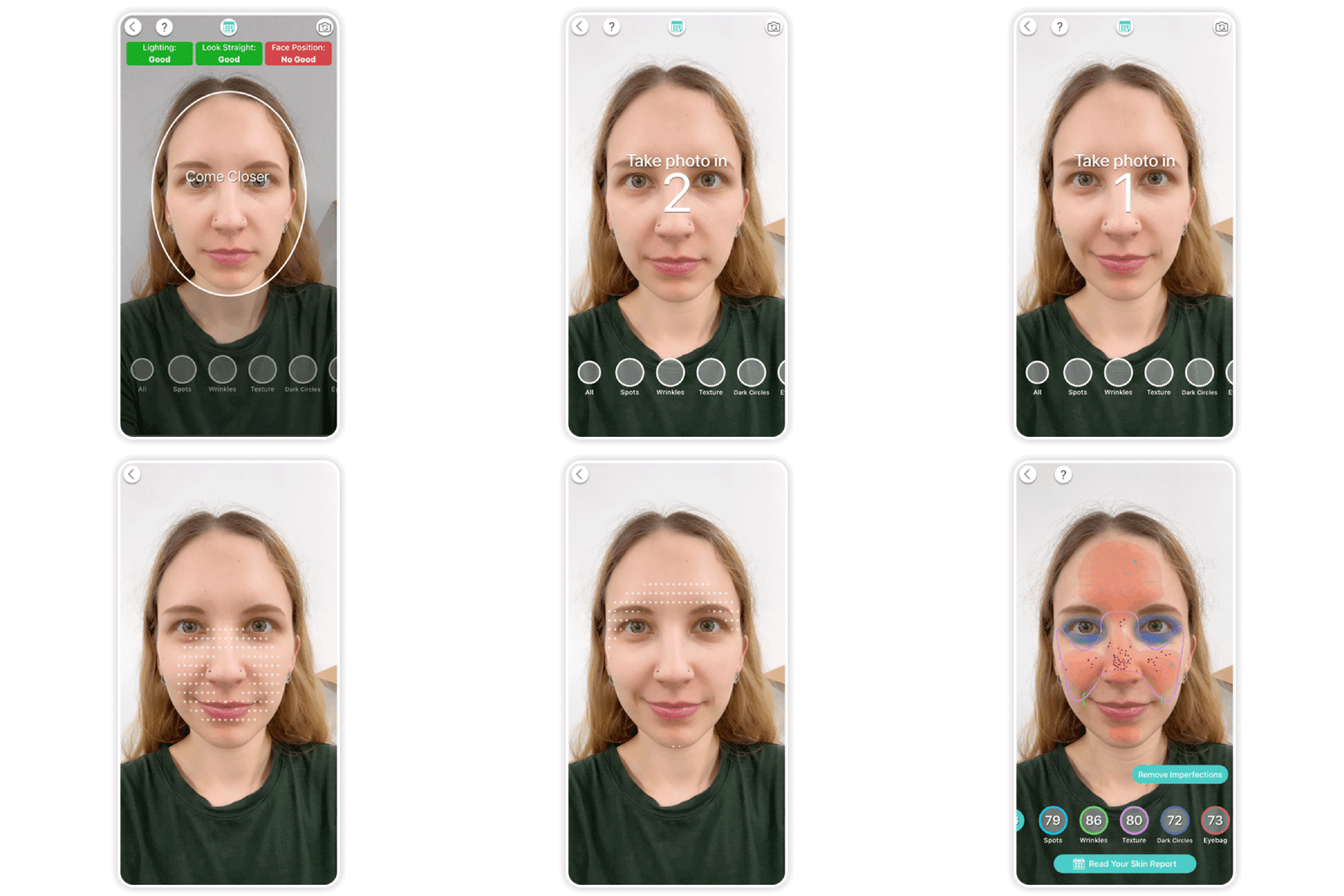
"The most significant shift in skincare retail isn't the products — it's the intelligence layer between the product and the customer. Skin Derma is that layer." — Beauty Tech Industry Observer
What makes this commercially significant isn't just the technology itself. It's that the technology is now accurate enough, fast enough, and deployable enough to work across e-commerce, retail counters, and clinical environments simultaneously. A brand can run the same quality of skin analysis consultation whether the customer is in a flagship store in Tokyo or completing an online quiz in São Paulo.
For beauty brands evaluating where to invest in personalization infrastructure, AI skin analysis is increasingly less of a differentiator and more of a baseline expectation — particularly among consumers under 35, who tend to arrive at consultations already informed by social content and expect brands to match that level of specificity.
The Market Context: Why AI Skin Analysis Is Becoming a Baseline Expectation
The beauty industry's move toward AI personalization has accelerated considerably over the past three years. The global AI in beauty and cosmetics market, valued at approximately $4.9 billion in 2025, is projected to reach $33.75 billion by 2035 — a 22% CAGR driven by personalized recommendation tools, skin and hair analysis platforms, and virtual consultation infrastructure.
Within that broader trend, skin analysis specifically is one of the highest-growth segments. The U.S. AI skin analysis market alone was valued at $388 million in 2024 and is projected to reach $1.83 billion by 2034, growing at approximately 16.8% annually. This growth is not purely technology adoption — it reflects a structural change in how consumers evaluate and purchase skincare products.
The operational implications are worth noting. When a consumer receives an objective skin analysis result before a product recommendation, the dynamic of the consultation shifts. The recommendation is no longer a sales pitch — it's a response to data the customer has just seen for themselves. This changes conversion behavior meaningfully.
Research in the med spa segment illustrates the pattern well: 81% of medspa patients report a high level of trust in their service providers, and AI personalization reinforces that trust by delivering care that feels informed and individualized rather than templated.
From an operational standpoint, the pressure on brands to adopt AI-driven skin intelligence is also coming from the competitive environment. Major beauty groups — including L'Oréal, Estée Lauder, and Shiseido — have each made significant investments in AI skin diagnostic capabilities. Brands that rely on static product finders or generic skin-type selectors are increasingly at a visible disadvantage in customer-facing consultations.
"We're past the point where AI skin analysis is a premium feature. For brands competing seriously in personalized skincare, it's infrastructure." — Beauty Tech Analyst, 2024
The shift is particularly pronounced in three areas: direct-to-consumer e-commerce (where an AI skin scan can replace or augment a traditional skin quiz), retail (where staff-assisted consultations can be standardized and scaled), and med spa or aesthetic clinic environments (where clinical credibility and consistent assessment quality are operational requirements).

How AI Skin Analysis Powers the Skin Derma Experience
The technical architecture behind Skin Derma is worth understanding in practical terms, because it shapes what brands can and cannot realistically expect from deployment.
Perfect Corp.'s AI Skin Analysis uses deep learning models to analyze facial images — captured via smartphone or tablet camera — and assess over 15 distinct skin parameters: spots, wrinkles, pore condition, texture irregularity, skin tone evenness, redness, dark circles, hydration indicators, and more. The analysis runs in real time and is calibrated against dermatologist-reviewed datasets to maintain clinical-grade consistency.
A few practical notes for operators evaluating this technology:
Input quality matters. The accuracy of AI skin analysis is sensitive to lighting conditions and image resolution. Most enterprise deployments address this through guided capture interfaces that prompt users to adjust positioning and lighting before analysis begins. In controlled retail environments, this is manageable. For fully self-service web implementations, it's a variable worth planning for.
Consistency is a core value proposition. One of the less-discussed but commercially significant advantages of AI-driven skin analysis is that it produces consistent outputs regardless of which staff member runs the consultation, which shift it is, or how much foot traffic the store is managing. For multi-location operators, this is operationally meaningful — it means every customer gets the same quality of baseline assessment.
The model requires ongoing calibration. AI skin analysis systems trained on limited demographic datasets can produce less reliable results across diverse skin tones and types. This is an industry-wide challenge. Perfect Corp. addresses this through continuous model refinement and clinician collaboration, but brands integrating any AI skin analysis technology should ask specifically about dataset diversity and validation methodology.
"The clinical value of AI skin analysis lies not in its novelty but in its consistency. A trained aesthetician has good days and bad days. A well-calibrated model does not." — Aesthetic Industry Consultant
Key capabilities of Perfect Corp.'s AI skin analysis platform:
- Real-time detection and assessment of 15+ skin parameters via standard camera input
- Scientifically validated against dermatologist-reviewed benchmarks
- Customizable integration across web, native mobile, and tablet (iPad/iPhone) environments
- Scalable deployment suitable for single-location boutiques and global enterprise rollouts
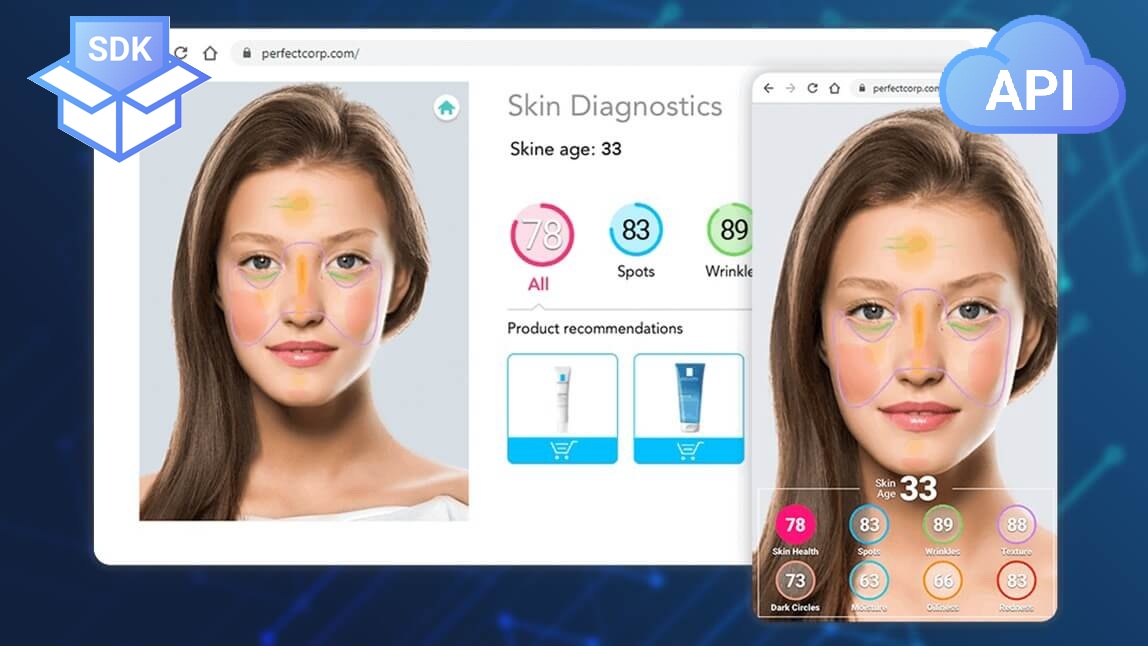
- API-level integration for brands building proprietary product recommendation flows on top of the analysis layer
The Business Impact: Why Skin Derma Matters for You
For beauty brands and skincare operators, the business case for Skin Derma breaks down across four practical dimensions:
1. Consultation quality and consistency
Skin analysis removes the most subjective element of a skincare consultation — the initial assessment. When a customer walks in with a data-driven skin profile already generated, the conversation can focus on priorities, sensitivities, and treatment history rather than starting from a blank slate. AI skin consultation solutions are reshaping how aestheticians and professionals approach skin assessments and product recommendations — enabling faster, more accurate consultations without requiring extensive specialist training on every device.
For multi-location operators, this is particularly relevant. Consultation quality at a flagship store in a major city should not be materially better than at a suburban mall location. AI skin analysis narrows that gap.
2. Conversion behavior
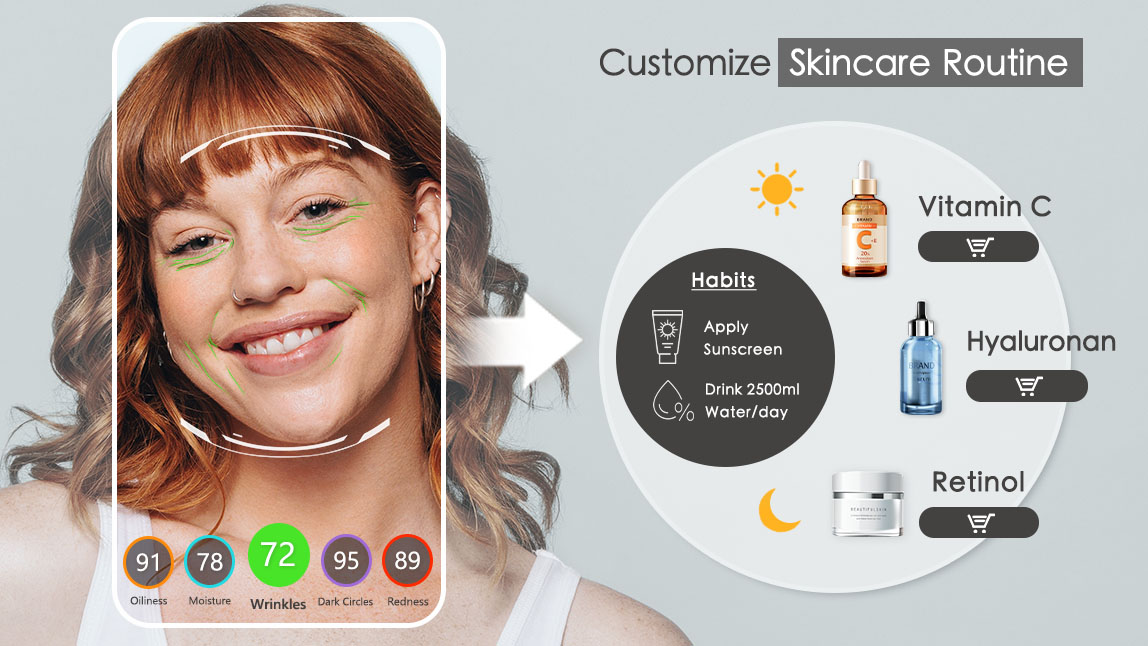
There is a measurable relationship between diagnostic specificity and purchase confidence. When a customer can see an objective analysis of their skin condition — with visual output showing hydration levels, pore size, or early wrinkle patterns — the product recommendation that follows carries a different weight. It's no longer a suggestion; it's a response to something they can see.
This matters most at the mid-funnel stage, where customers are comparing options and weighing whether a premium product is worth the premium price. A credible, personalized recommendation supported by skin analysis data meaningfully strengthens the case.
3. Staff scalability and training overhead
Advanced AI skin analysis offers precise, data-driven skin diagnostics that improve treatment plans and boost patient confidence — and documentation automation can speed up workflows considerably, allowing practitioners to focus more on care delivery.
In high-volume retail environments, the ROI on AI skin analysis often comes as much from operational efficiency as from conversion lift. When an aesthetician can conduct a full-parameter skin assessment in under a minute — rather than spending five minutes on visual assessment and intake questions — consultation throughput improves without sacrificing quality.
4. Data infrastructure for product development and marketing
Aggregate skin analysis data, properly managed and anonymized, is a strategic asset. Brands with large-scale deployment can identify patterns in skin concerns by geography, season, demographic segment, or product usage history. This has legitimate applications in R&D prioritization, campaign targeting, and new product validation. It's worth noting, however, that this use case requires careful privacy governance — customers who share skin data for personalization purposes have not necessarily consented to broader analytical use.
"The brands that extract the most long-term value from AI skin analysis are the ones that treat the data layer as seriously as the customer experience layer." — Beauty Tech Strategy Consultant
Use Cases Across Retail, E-Commerce, and Clinical Settings
The operational deployment of AI skin analysis looks different depending on the environment. Below are the scenarios where the technology delivers the most tangible business value:
Skincare Retail — In-Store Consultation Enhancement
For beauty retailers, AI skin analysis most commonly functions as a consultation enabler at the counter or treatment bar. A customer sits down, captures a facial image on an iPad, and within seconds receives a multi-parameter skin profile. The staff member uses that output as the basis for a structured product recommendation conversation.
The key operational benefit here is that the consultation is anchored in something objective. Instead of the aesthetician forming an assessment and then working backward to justify it, the analysis arrives first and the recommendation follows. Customers tend to respond differently to this sequence — it feels more diagnostic than sales-driven.
E-Commerce — Online Skin Diagnostic Integration
For DTC skincare brands, web-based AI skin analysis replaces (or meaningfully upgrades) the traditional skin quiz. Rather than asking users to self-assess their skin type — an exercise that produces notoriously unreliable results, since most consumers misidentify their own skin type — brands can offer a genuine analysis via webcam capture.
This has measurable effects on downstream recommendation accuracy and, consequently, on return rates and repurchase behavior. When someone buys a product aligned with their actual skin condition rather than their perceived skin type, product performance improves.
Med Spa and Aesthetic Clinic — Pre-Treatment Assessment
The integration of AI in medical spa environments is setting a new benchmark for accessibility, personalization, and efficiency — enabling clients to receive detailed pre-consultation skin assessments that arrive with clinical credibility and privacy compliance built in.
In aesthetic clinic environments, AI skin analysis serves a slightly different function. Rather than driving product sales, it supports treatment planning and expectation setting. A patient scheduled for a brightening treatment or a resurfacing procedure benefits from a baseline skin assessment that can be compared against post-treatment results. This is clinically useful and commercially valuable — it creates a visual record of progress that supports patient retention and referral behavior.
One real-world example: SkinZone Medical implemented AI-driven personalization workflows and, through automated re-engagement campaigns segmented by patient history, recovered 275 lapsed guests and generated a 27% revenue impact from patients who returned for additional visits.
Enterprise Multi-Brand — Standardization Across Channels
For large beauty groups operating multiple brands across retail, e-commerce, and clinical channels, the consistency argument is especially compelling. AI skin analysis provides a common analytical framework — the same 15+ parameters assessed by the same validated model — regardless of which touchpoint the customer uses. This makes cross-channel personalization far more coherent than it is when each channel runs separate diagnostic tools or relies on staff judgment.
AI Skin Analysis vs. Traditional Consultation Methods: An Honest Comparison
The following is a practical comparison for operators evaluating whether and how to deploy AI skin analysis alongside or in place of traditional consultation approaches:
| Factor | Traditional Consultation | AI Skin Analysis |
| Consistency | Varies by staff skill and engagement | Consistent across all locations and touchpoints |
| Speed | 5–15 minutes for full assessment | Under 60 seconds per analysis |
| Scalability | Limited by staff headcount and training | Deployable across unlimited concurrent sessions |
| Accuracy | High for experienced specialists; lower for junior staff | Validated against dermatologist benchmarks; affected by image quality |
| Customer perception | High trust when staff is credible | Increasingly accepted; some skepticism among older demographics |
| Data output | Anecdotal; rarely documented | Structured, storable, and analyzable |
| Cost at scale | High (labor-intensive) | Lower marginal cost per consultation at volume |
| Implementation complexity | Low (no technology required) | Moderate; requires integration planning and staff orientation |
The honest framing here is that AI skin analysis does not replace skilled human consultation — it standardizes and supplements it. For businesses where consultation quality is highly variable across staff or locations, AI analysis raises the floor considerably. For businesses with world-class consultation staff, it provides a structured data layer that makes those consultations more efficient and more documentable.
Where AI skin analysis currently underperforms is in the nuanced, conversational aspects of a consultation: understanding a patient's emotional relationship with their skin, navigating contraindications, adjusting for unreported topical medications, or reading behavioral cues that suggest a customer is not being forthcoming about their routine. These remain human domains.
The Broader Shift: What Skin Derma Signals for the Industry
Skin Derma is best understood not as a single technology feature but as an indicator of a broader structural shift in how beauty and skincare operate.
The economics of skincare personalization have changed. Five years ago, genuine personalization at scale required either an army of trained aestheticians or an extensive laboratory diagnostic process. Today, a validated AI skin analysis can be embedded in a mobile checkout flow, a retail iPad, or a med spa intake form — and deliver results that are clinically defensible.
This changes the competitive dynamics of the industry in several ways:
Smaller brands and independent clinics can now offer consultation experiences that were previously only available through high-end retail or clinical settings. The barrier to meaningful personalization has come down significantly.
Consumer expectations have shifted accordingly. Shoppers who have experienced an AI skin analysis consultation — even once — arrive at subsequent consultations with a higher baseline expectation of specificity. Generic product recommendations feel less credible by comparison.
The data layer is becoming a strategic asset in its own right. Brands that have been running AI skin analysis consultations at scale for two or three years are accumulating proprietary datasets that have legitimate value for product development, seasonal formulation planning, and targeted digital marketing. This is a compounding advantage that brands late to adoption will find difficult to catch up to.
"In five years, the question won't be whether you offer AI skin analysis. It will be what you do with the data it generates." — Beauty Tech Strategist
The brands that are investing in this infrastructure now — not just in the consumer-facing experience but in the data governance and downstream personalization logic — are building a capability that scales. Those treating it as a single campaign feature will capture some short-term engagement lift but will miss the longer-term strategic value.
Perfect Corp.'s AI Skin Analysis: An Enterprise-Ready Approach
For brands evaluating AI skin analysis infrastructure, Perfect Corp. is one of the most established operators in this space, with over a decade of investment in beauty AI and a client base that spans major global skincare brands, specialist retailers, and aesthetic clinic networks.
Their AI Skin Analysis platform is enterprise-ready in the operational sense that matters: it handles diverse skin types across the Fitzpatrick scale, it integrates across web, native mobile, and in-store tablet environments, and it connects to product recommendation and CRM systems through documented APIs. The analysis covers 15+ skin parameters, is validated in collaboration with dermatologists, and can be customized to surface brand-specific product recommendations from analysis outputs.
In July 2024, Perfect Corp. introduced an upgraded HD AI Skin Analysis system with 2x higher-resolution scans — reflecting continued investment in diagnostic accuracy as customer expectations for clinical-grade precision have increased.
For businesses that are earlier in their AI adoption journey, Perfect Corp. also offers a self-service Skin Analyzer solution deployable on iPad and iPhone — an accessible entry point for clinics and boutique retailers that want to introduce AI-powered consultations without a large enterprise integration project.
The practical question for most operators isn't whether to adopt AI skin analysis — that decision is increasingly being made by competitive pressure rather than internal initiative. The more relevant question is which platform provides the combination of clinical accuracy, integration flexibility, and scalability that fits the specific business model.
If your brand serves customers across multiple geographies, channels, or demographic segments, the consistency and scalability argument for a platform like Perfect Corp.'s is particularly strong. If you operate a single-location boutique or aesthetic clinic, the ROI case is more about consultation quality and staff efficiency than scale.
Either way, the starting point is understanding what the technology actually does — and deploying it in a context where it genuinely improves the customer experience rather than adding friction to it.

What is AI Skin Analysis?

AI Skin Analysis uses deep learning to detect and assess multiple skin conditions — including spots, wrinkles, pore quality, texture, hydration, and redness — through standard camera input, delivering results that are benchmarked against dermatologist-reviewed data. It provides a structured, objective baseline for skincare consultations that manual assessment methods cannot consistently replicate at scale.
How accurate is AI skin analysis in practice?
Accuracy depends on several factors: image quality, lighting conditions at capture, and the diversity of the dataset the model was trained on. Enterprise-grade systems like Perfect Corp.'s are validated against clinical benchmarks and refined continuously. For deployments targeting diverse demographics, it's worth asking vendors specifically about Fitzpatrick-scale coverage in their validation data.
How do businesses actually integrate AI skin analysis?
Integration typically involves embedding the analysis tool into an existing e-commerce platform, retail tablet setup, or clinical intake workflow — with the output connected to a product recommendation engine or consultation record system. The technical lift varies significantly depending on the existing stack. Most enterprise vendors offer API access and documented integration support.
What is Skin Derma?
Skin Derma refers to the convergence of dermatological methodology and AI diagnostic capability — the application of clinical-grade skin assessment logic to digital and physical beauty consultation environments. It describes both a technology category and a shift in how brands approach the relationship between skin analysis, personalization, and product recommendation.
Is AI skin analysis suitable for med spa and clinical environments?
Yes, and adoption in clinical environments is growing. In med spa settings, AI skin analysis is most commonly used for pre-treatment assessment, progress documentation, and intake standardization. The key operational benefits in clinical contexts are consistency across practitioners and a documented baseline for tracking treatment outcomes over time.



 English


