


 Author:
Skincare brands have spent years asking the same operational question: how do you deliver a genuinely useful skin assessment to every customer, not just the ones who book a consultation? Hardware-based diagnostics were the answer for a long time — and for clinical settings, they still are. But for brands trying to personalize at retail scale, the model has always had limits that rarely get acknowledged in the sales pitch.
AI skin analysis doesn't just offer an alternative. It removes the structural constraints that made detailed diagnostics the exception rather than the norm.
This article examines where AI skin analysis holds a real operational advantage over traditional hardware, and how brands across retail, e-commerce, and clinical settings are putting that to work.
"The shift toward AI skin analysis isn't about replacing expertise — it's about making consistent, quality assessment available at every touchpoint, not just the ones with a trained specialist behind them."
The Evolution of Skincare
Every meaningful shift in skincare technology has done the same thing: moved quality guidance closer to the customer. Ingredient science moved efficacy out of the compounding pharmacy. Clinical imaging moved diagnostics into the treatment room. AI is moving it onto the customer's own device.
That pattern matters because what's changing isn't just the tool — it's who has access to detailed skin guidance, and under what conditions. Hardware diagnostics require a physical location, a trained operator, and often a scheduled appointment. A software-based AI system running on a tablet or smartphone has none of those dependencies.
Perfect Corp.'s AI Skin Analysis tool reflects this shift directly. Customers receive detailed insight into their skin health, biological skin age, and specific concern areas — through a web interface, an app, or an in-store tablet — without the infrastructure that clinical hardware demands. For brands managing multiple customer touchpoints, that consistency of access is commercially significant.

Both approaches have a legitimate place in the skincare ecosystem. What's changed is which one makes operational sense for the majority of brand use cases.
Shared Materials by Strapi
*Adjust the size of images ONLY. Please go to Strapi to edit the materials info.
Understanding Traditional Hardware-Based Skincare
Devices like VISIA (Canfield Scientific), Vectra 3D, and DermaScan earned their place in clinical skincare for good reason. Multispectral imaging — combining standard photography with cross-polarized and UV illumination — reveals subsurface pigmentation, early vascular irregularities, and pore structure that standard cameras simply can't capture. In a dermatology practice or a high-end aesthetic clinic, that depth of imaging informs treatment decisions in ways that genuinely matter.
The limitations of hardware aren't really about what the technology does. They're about what it requires. Consistent results depend on controlled lighting conditions, precise camera positioning, and operator training that goes beyond reading an instruction manual. Results from the same device can vary meaningfully between sessions if any of those conditions shift — which makes longitudinal skin tracking less reliable than the hardware brochures tend to suggest.
For brands outside the clinical setting, the operational burden compounds quickly. Deploying hardware across 20, 50, or 100 locations means capital expenditure at each one, ongoing maintenance contracts, staff training programs, and the ongoing question of whether each unit is actually being used with enough consistency to produce comparable data.

"Hardware diagnostics perform well when the conditions are right. The challenge for retail brands is that maintaining those conditions across multiple locations and varying staff is harder than it looks — and more expensive than it sounds.
That gap between clinical potential and retail reality is exactly where AI-based solutions have found their opening.
The Rise of AI in Skincare
AI skin analysis doesn't replicate what clinical hardware does — it solves a different problem. Instead of multispectral imaging in a controlled environment, these systems use machine learning models trained on large, clinically annotated skin image datasets to assess visible skin conditions from a standard camera. The output — a detailed skin assessment with specific condition findings and personalized product recommendations — arrives in seconds, through whatever device the customer is already holding.
One practical challenge that gets raised about AI skin analysis is lighting variability. Unlike hardware environments where lighting is fixed, real-world capture conditions range from a well-lit retail counter to a customer's dimly lit bathroom. Perfect Corp. addresses this directly: the platform incorporates automatic light compensation to normalize image data across different lighting conditions, and surfaces real-time quality detection prompts when capture conditions fall below the threshold needed for accurate analysis. The system guides users toward a better capture rather than silently delivering a degraded result.
That approach to image quality is worth noting because it's where many AI skin analysis tools fall short. Accurate analysis depends on accurate input — and leaving lighting management entirely to the user produces inconsistent results at scale.
Perfect Corp.'s AI Skin Analysis tool completes a full assessment in under two seconds, with personalized product and routine recommendations built into the results experience. For brands with large SKU catalogs, those recommendations can map directly to purchasable products — collapsing the distance between diagnosis and conversion.
The Advantages of AI Technology Over Hardware
The operational case for AI skin analysis over hardware comes down to a few structural differences that matter more as a brand's footprint grows.
1. Personalized Skincare Solutions
The gap between a skin type classification and genuine skin analysis is wider than most beauty brands acknowledge. Telling a customer their skin is "combination" and pointing them toward the combination skin shelf is a categorization exercise, not a personalized assessment. AI skin analysis operates on a different logic: multiple concurrent conditions, assessed in real time, mapped to recommendations specific to that individual's current skin state.
Perfect Corp.'s AI skincare technology identifies and weights the specific conditions present — wrinkles, sun spots, pores, texture irregularities, moisture levels, and more — to generate recommendations that reflect the actual picture of that customer's skin, not a population average.
The platform's Skincare AR technology powers this through several distinct analytical capabilities:
- Wrinkle detection: Micro-texture analysis that surfaces fine lines before they're fully visible to the naked eye, supporting earlier intervention recommendation
- Spot detection: Differentiated pigmentation analysis that distinguishes between acne marks, sun damage, and uneven tone — conditions that call for different product responses.
- Texture analysis: Surface uniformity mapping across skin zones, used to guide exfoliation frequency and barrier-support product selection.
- Skin score and biological age: A benchmarkable skin health index that gives customers a metric they can track — and gives brands a framework for longitudinal engagement
- Condition tracking: Session-to-session monitoring that surfaces whether recommended routines are producing measurable improvement over time.
The commercial implication is straightforward. Customers who receive recommendations grounded in their own skin data — rather than a generic skin type — convert at higher rates and return more reliably. According to McKinsey research on personalization, 71% of consumers expect individualized experiences, and express measurable dissatisfaction when that expectation isn't met. In skincare, where getting the product wrong has consequences for the skin, the stakes of poor personalization are higher than in most categories.
"Personalization in skincare used to depend on having the right consultant in the right store on the right day. AI skin analysis decouples that expertise from individual staff availability — and makes it consistent across every customer interaction."
Shared Materials by Strapi
*Adjust the size of images ONLY. Please go to Strapi to edit the materials info.
2. Real-Time Analysis and Feedback
Speed matters in skincare consultations, but not for the obvious reason. The real value of real-time analysis isn't just that customers don't have to wait — it's that the gap between assessment and action closes. A customer who receives a skin analysis result and a product recommendation in the same moment is in a fundamentally different position than one who leaves with a diagnostic printout and a follow-up call scheduled.
Perfect Corp.'s Live AI Skin Analysis delivers results in under two seconds, with a live 3D rendering that highlights areas of concern as the customer moves through the capture process. A 30-degree wide-angle view ensures full facial coverage, including the peripheral zones that standard front-facing captures often miss.
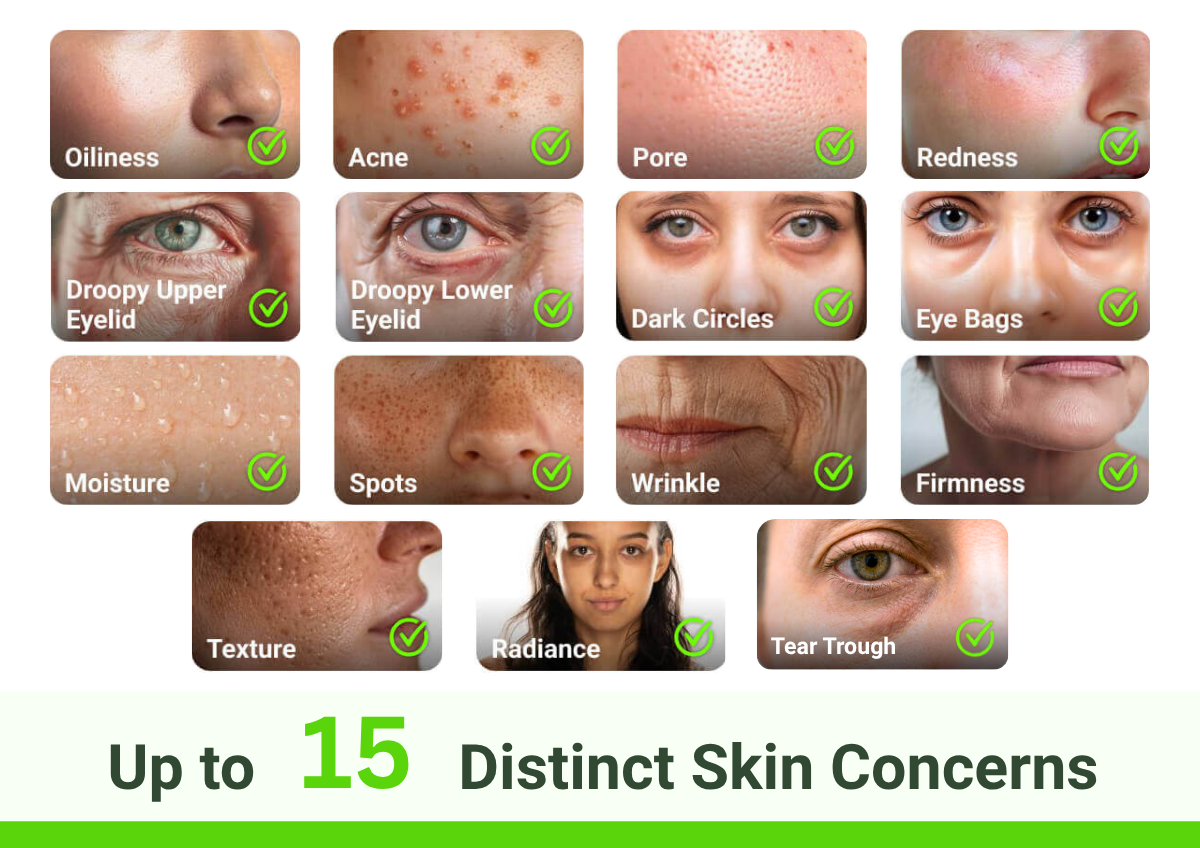
The system assesses up to 15 skin health parameters in real time: spots, wrinkles, texture, redness, oiliness, moisture, eye bags, acne, droopy upper and lower eyelids, firmness, radiance, dark circles, and pores. That breadth of assessment — delivered before the consultation conversation has ended — changes the dynamic of the interaction.
For med spas and skincare clinics, there's a specific workflow advantage here that goes beyond the retail use case. Clients who complete an AI skin analysis ahead of their appointment arrive with a defined set of skin concerns already surfaced and quantified. The practitioner starts with objective data rather than building from scratch during the session, which improves the quality and efficiency of the consultation itself.
3. Cost-Effectiveness and Accessibility
The capital cost of clinical imaging hardware — typically $10,000 to $50,000 or more per unit — is the obvious entry in the cost comparison. But for brands evaluating deployment at scale, the more meaningful number is total cost of consistency: what does it actually take to deliver a comparable quality of skin assessment across every location, every day, with every staff member?
Hardware requires calibration schedules, maintenance contracts, operator training programs, and physical space at each location. Software-based AI analysis, deployed through existing tablets or web interfaces, sidesteps most of that infrastructure. The same analysis capability — with the same output quality — runs across every deployment from a single software update.
For customers, AI skin analysis removes the access barriers that have historically kept detailed skin diagnostics out of reach for most people. No appointment, no specialist, no consultation fee. A brand's website or app becomes a diagnostic touchpoint that's available to any customer, regardless of geography or price point — a meaningful shift in who gets access to quality skincare guidance.
4. Enhanced Product Recommendations
Hardware diagnostic tools are built to assess. The translation of that assessment into specific product recommendations — the step that actually drives purchase behavior — typically happens in a separate conversation, with a separate person, at a later point. That handoff loses customers.
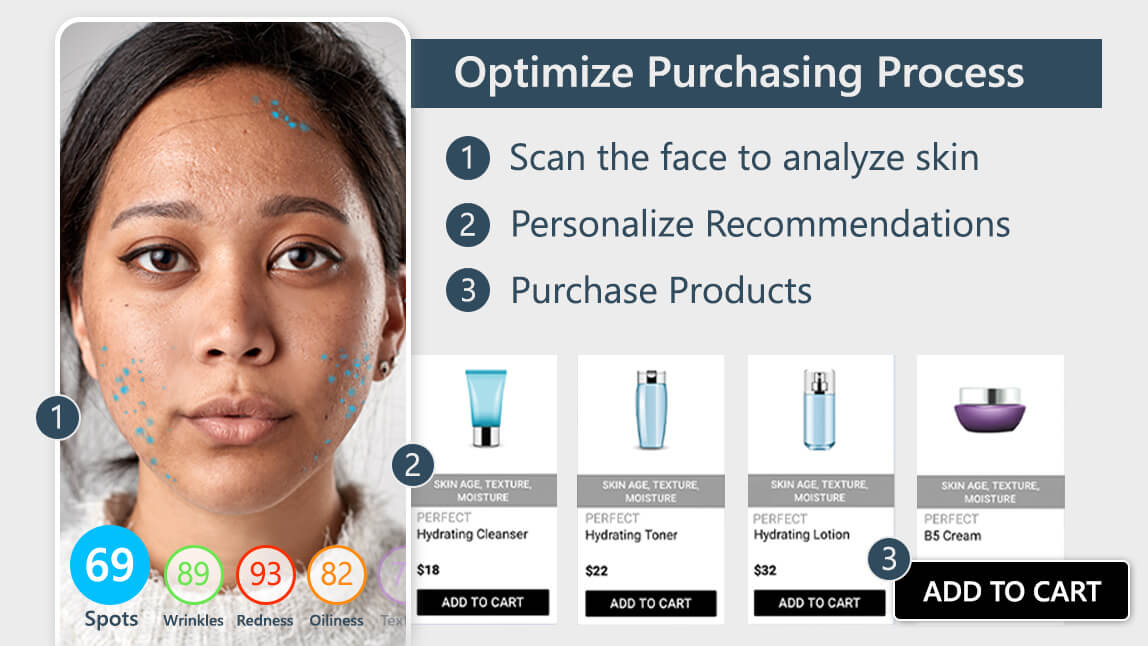
AI skin analysis treats assessment and recommendation as a single interaction. The findings from a real-time skin analysis map directly to specific products, with purchase links embedded in the results. The customer moves from "here's what's happening with your skin" to "here's what to do about it" in the same session.
"The most significant commercial advantage of AI skin analysis isn't the analysis itself — it's the removal of the gap between diagnosis and purchase decision."
For brands with large or complex product catalogs, this recommendation logic becomes a meaningful conversion tool. A customer who has just seen that their analysis flags moisture loss and early texture irregularity, and receives a specific serum and exfoliant recommendation with rationale attached, is significantly more likely to purchase than one browsing the same category without that context.
Shared Materials by Strapi
*Adjust the size of images ONLY. Please go to Strapi to edit the materials info.
5. Sustainability and Eco-Friendliness
Skincare's sustainability problem isn't packaging alone — it's the volume of products that get purchased, partially used, and discarded because they weren't the right fit. That trial-and-error cycle is an industry norm that better personalization has a real chance of reducing.

When AI skin analysis produces recommendations that match actual skin conditions — rather than broad skin type categories — the mismatched purchase rate goes down. Customers buy fewer products that don't work for them, which means less packaging waste and fewer abandoned products.
AI tools can also incorporate sustainability preferences directly into the recommendation logic: flagging products with refillable formats, plastic-free packaging, or relevant certifications for customers who have indicated those priorities. Because the system is software-based, it operates with a significantly smaller physical footprint than hardware — no manufacturing, no dedicated floor space, no end-of-life disposal considerations.
For brands with formal ESG commitments, the alignment between accurate personalization and reduced product waste is a practical supporting argument that holds up beyond the marketing narrative.
Level Up With AI Skin Analysis Technology
Hardware remains the appropriate tool in clinical contexts where subsurface imaging informs treatment decisions — that capability is real, and it has its place. But for the majority of skincare brands operating in retail, e-commerce, or consultation environments, clinical imaging isn't the problem they're trying to solve.
What they need is consistent, scalable skin assessment that works across every customer touchpoint without requiring clinical infrastructure. AI skin analysis delivers that — and as the platform matures, the gap between software-based analysis and hardware-based assessment continues to narrow for most practical use cases.
Perfect Corp. works with more than 600 brands globally across retail, e-commerce, and clinical settings. Try the AI Skin Analysis demo to see how the analysis and recommendation experience works in practice, or contact the team to discuss what deployment looks like for your specific brand context.
Get expert advice from Perfect Corp. and be part of the beauty tech trend. Contact us for details on beauty tech solutions trusted by 600+ brands globally.
Shared Materials by Strapi
*Adjust the size of images ONLY. Please go to Strapi to edit the materials info.
Read our “Beauty Tech: The Complete Guide” to unlock powerful ROI secrets.



 English


