


 Author: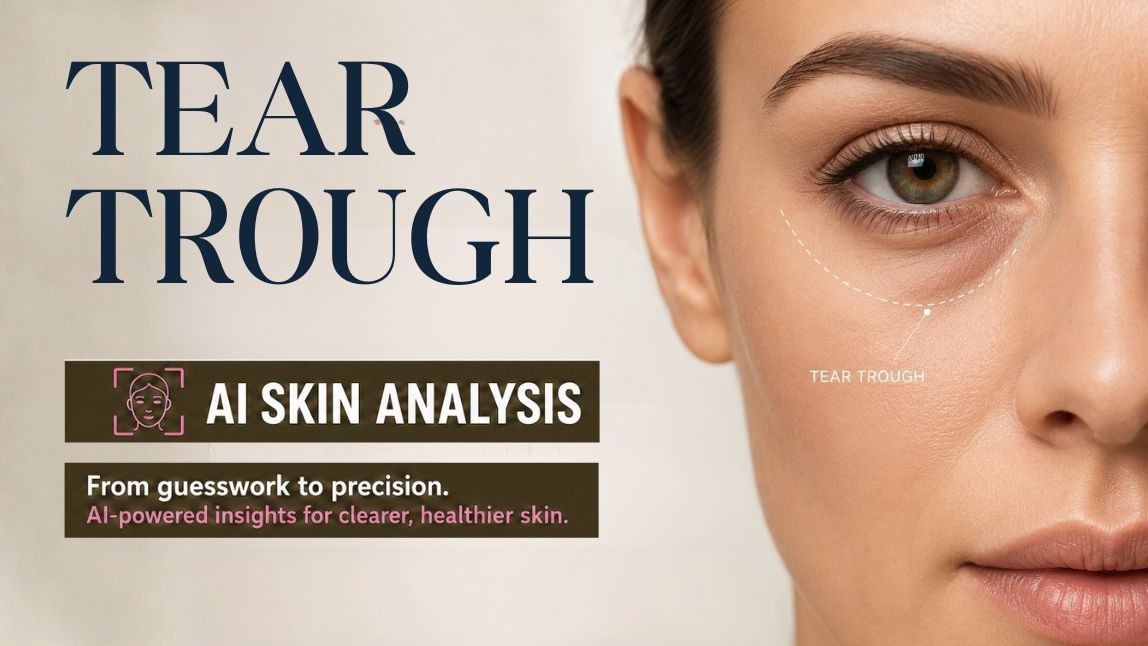
You're not tired. You slept well. You're not hungover. But the person looking back from the mirror tells a different story — sunken hollows beneath both eyes casting a permanent shadow that no amount of concealer quite erases.
That hollow is the tear trough. It's one of the most diagnostically precise concerns in aesthetic medicine — and one of the most commonly misunderstood in beauty. It's not dark circles. It's not eye bags. It's a distinct anatomical structure that develops when the volume and support beneath the lower eyelid depletes, creating a groove that casts a shadow, deepens with age, and reshapes the entire midface.
This guide covers the anatomy of the tear trough, why it forms, how it's clinically classified, which treatments match which severity level, and how AI skin analysis now detects and scores tear trough deformity — at scale, from a selfie — giving beauty brands and aesthetic clinics the diagnostic precision that previously required specialist evaluation.
What Is the Tear Trough?
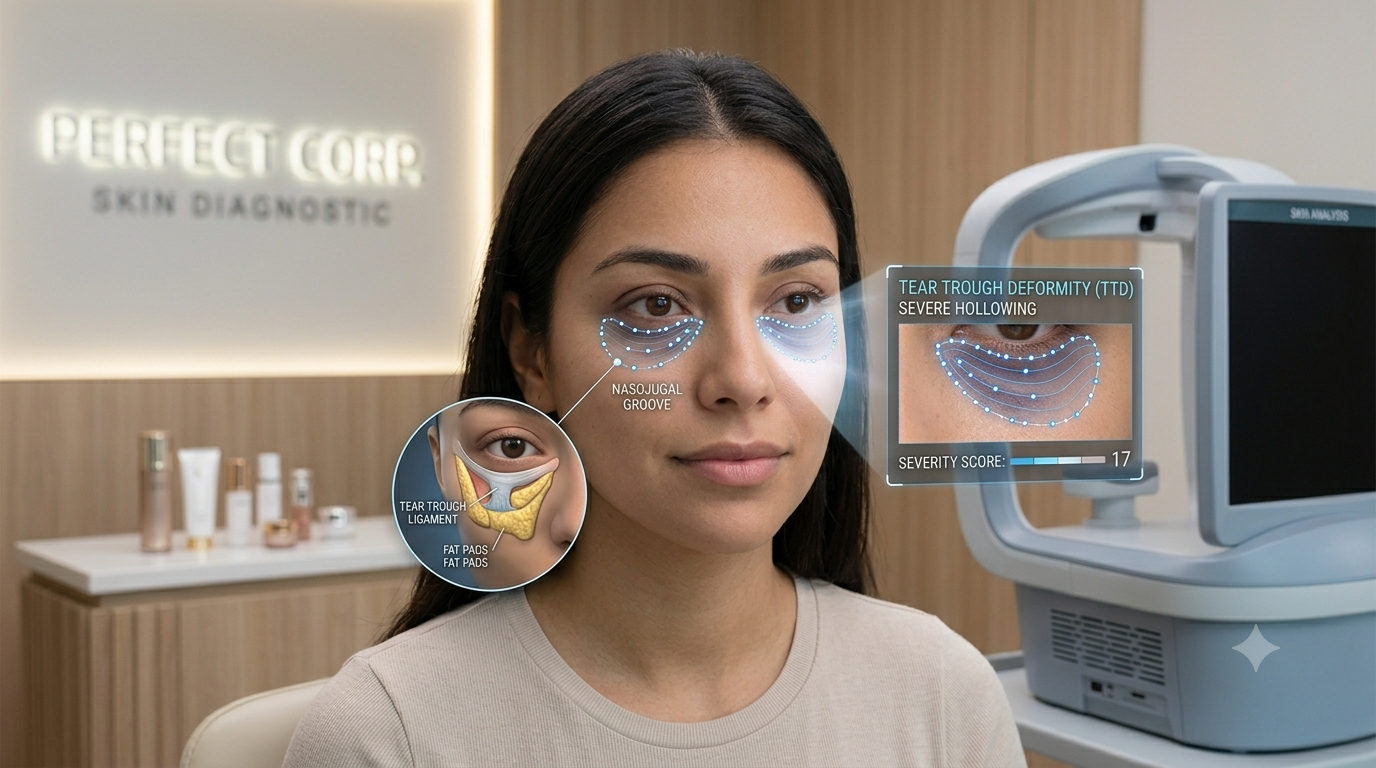
The tear trough (also called the nasojugal groove or infraorbital hollow) is an anatomical depression that runs from the inner corner of the eye (the medial canthus) obliquely downward and outward across the cheek. In youth, this transition from eyelid to cheek is smooth and gently curved. As the supporting structures beneath it weaken, the groove deepens into a visible hollow — a condition clinically called tear trough deformity (TTD).
Unlike eye bags (which push forward) or dark circles (which involve discoloration), the tear trough is a hollowing — a concavity formed by the loss of the volume that used to fill the space between the lower eyelid and the cheek. The shadow it casts is the most persistent, most lighting-independent form of under-eye darkness.
The Anatomy Behind Tear Trough Formation
The Tear Trough Ligament
A fibrous attachment connecting the skin directly to the orbital rim. This ligament creates the visible groove by tethering the overlying skin downward. In youth, surrounding fat volume masks this tethering. As fat depletes, the ligament's pull becomes visible as the tear trough depression.
The Orbital Fat Compartments
Three fat pads sit behind the orbital septum beneath the lower eyelid — medial, central, and lateral. In youth, this fat provides support and volume at the eyelid-cheek junction. With aging, the septum weakens and fat herniates forward (creating eye bags) while the volume deficit in the groove deepens the tear trough hollowing. Both often develop simultaneously because they share the same underlying anatomical deterioration.
The Midface Fat Pads
The cheek malar fat pad and suborbicularis oculi fat (SOOF) provide the scaffolding that supports the lower eyelid from below. As these descend and deflate with age, the eyelid-cheek junction drops, the cheek flattens, and the tear trough deepens from below as well as above.
What Causes Tear Trough Deformity?
1. Aging and Volume Loss
The primary driver in most adults. Collagen, elastin, and subcutaneous fat all decline with age — reducing the volume that formerly masked the tear trough ligament and supported the eyelid-cheek junction. Periorbital skin loses elasticity and thins. The combined result: a deepening groove that typically becomes visible in the mid-30s and progresses through the 40s and 50s.
2. Genetics
Tear trough deformity is among the most genetically influenced periorbital concerns. Some individuals develop visible hollowing in their twenties — or even in childhood — due to inherited orbital bone architecture, thin periorbital skin, or genetically shallower midface fat volumes. If a parent has visible tear troughs at a young age, early onset in the next generation is common.
3. Significant Weight Loss
The infraorbital fat compartments are volume-dependent structures. Significant or rapid weight loss — even in younger patients — depletes periorbital fat and can produce tear trough deformity at ages where aging would not yet be a factor. This is a common complaint in patients post-bariatric surgery or after prolonged illness-related weight loss.
4. Sun Damage
Chronic UV exposure accelerates collagen breakdown and skin thinning in the periorbital zone. Photoaged periorbital skin loses its ability to mask underlying structural changes — making the tear trough shadow more visible even at stages of volume depletion where well-protected skin would still maintain coverage.
5. Sleep Position and Lifestyle
Side sleeping compresses periorbital tissues nightly over years, contributing to asymmetric volume redistribution and lymphatic stasis. Chronic dehydration, smoking, and high cortisol states all accelerate the collagen loss and skin thinning that makes tear troughs more prominent.
Clinical Grading: How Severe Is Your Tear Trough?
The tear trough exists on a continuum of severity. Dermatologists and aesthetic physicians use established grading systems to characterize this — most commonly the Hirmand Classification and Barton Grading System.
The Hirmand Classification (3 Types)
| Class | Description | Treatment Indication |
| Class I | Volume deficit confined to the medial (inner) tear trough only — mild hollowing at the inner corner of the eye | Conservative filler (0.3–0.5ml per side); topical support |
| Class II | Volume loss extending across both medial and lateral infraorbital regions — tear trough becomes continuous with the palpebromalar groove | Moderate filler volume; may require midface support |
| Class III | Arc-shaped hollowing along the entire infraorbital rim from medial to lateral — the most pronounced deformity | Larger filler volumes; surgical fat repositioning or grafting often preferred |
The Barton Grading System (Grades 0–3)
An anatomically based grading scale ranging from Grade 0 (no deformity) to Grade 3 (severe hollowing with visible shadow extending into the midcheek). This system is frequently used in surgical outcome assessments and was the grading framework adopted in the first published study of AI-assisted tear trough grading (Journal of Plastic, Reconstructive & Aesthetic Surgery, 2024) — which analyzed 504 patients and 983 photographs, achieving an AUROC of 0.85 and demonstrating that AI-assisted grading of tear trough severity from standard photographic images is both feasible and clinically useful.
Tear Trough vs. Eye Bags vs. Dark Circles: The Critical Distinction
| Concern | What It Is | Appearance | Primary Treatment |
| Tear Trough | Concave hollow at the eyelid-cheek junction | Shadowed groove, deepens from inner to outer corner | Volume restoration (filler, fat grafting) |
| Eye Bags | Convex puffiness from fat herniation | Puffy bulging below the eyelid | Blepharoplasty, fat repositioning, RF |
| Dark Circles | Discoloration or shadow under the eye | Pigmented, vascular, or structural shadow | Depends on type: laser, filler, topicals |
These three concerns frequently coexist — the "tear trough triad" of fat herniation (eye bags), orbital fat volume loss (tear trough), and associated skin changes is a recognized clinical pattern. Someone whose "dark circles" are actually structural shadow from tear trough hollowing will see no improvement from a vitamin C serum — but potentially dramatic improvement from a single filler treatment. Accurate diagnosis is everything.
What Skincare Can (and Cannot) Do for Tear Troughs
Topical products cannot reverse structural volume loss or fill an anatomical groove. However, they can meaningfully support the appearance of the tear trough area by thickening periorbital skin, improving hydration, and slowing the structural changes that deepen tear troughs over time.
| Ingredient | How It Helps | Realistic Expectation |
| Retinoids (Retinol / Tretinoin) | Stimulate collagen synthesis; thicken periorbital skin; reduce shadow-amplifying effect of thin skin | Modest improvement in early/mild cases; not a substitute for volume restoration |
| Peptides | Signal fibroblasts to produce collagen and elastin; gentler than retinoids for daily periorbital use | Supportive; best as maintenance alongside procedures |
| Hyaluronic Acid (topical) | Hydrates and temporarily plumps periorbital skin; reduces visual contrast of the hollow | Good for dehydration-related worsening; transient effect |
| Vitamin C | Antioxidant; collagen cofactor; brightens pigmentation shadow overlaying the structural groove | Addresses the pigmentation component, not the volume deficit |
| Niacinamide | Strengthens skin barrier; reduces translucency; anti-inflammatory | Supportive; reduces darkness from vascular visibility through thin skin |
| Caffeine | Vasoconstrictor; reduces morning puffiness and vascular congestion around the hollow | Transient visual improvement; best in morning routine |
Professional Treatments for Tear Trough Deformity
Hyaluronic Acid Filler (Gold Standard)
Tear trough filler with hyaluronic acid is the most performed and most studied non-surgical treatment. A retrospective study published in the Journal of Clinical and Aesthetic Dermatology (2025) analyzed 155 patients treated between 2007 and 2023 — finding that average duration of effect exceeded the commonly cited 6–12 months for many patients.
- Product selection: Softer, lower-viscosity HA formulations are preferred — the Tyndall effect (bluish discoloration from superficially placed filler) is a recognized risk of harder products in this thin-skinned zone
- Injection depth: Deep supraperiosteal placement (against the orbital rim bone) is the preferred technique — avoids Tyndall effect and produces a natural, diffuse volume effect
- Volume: Typically 0.3–1.0ml per side depending on Hirmand class
- Cost: Approximately $684 per syringe (ASPS average); total $684–$1,500 depending on volume needed
- Duration: Average 10.8 months; some patients maintain results significantly longer
Fat Grafting
Autologous fat (harvested from abdomen or thigh) is injected to restore volume permanently. Retention rates vary 40–80%, often requiring touch-up sessions. Preferred for patients with significant volume loss who want a more durable solution.
Fat Repositioning (Surgical)
During lower blepharoplasty, herniated orbital fat is redirected downward into the hollow groove — simultaneously reducing eye bags and filling the tear trough with the patient's own tissue. Considered one of the most anatomically elegant solutions to the tear trough triad.
Sculptra (Poly-L-Lactic Acid)
A collagen biostimulator that works progressively over months — appropriate for patients wanting gradual, natural-looking volume restoration. Results build over 3–6 months and can last 2+ years. Used off-label in the periorbital area by experienced injectors.
Treatment Selection by Severity
| Hirmand Class / Severity | Preferred Treatment | Notes |
| Class I (Mild, medial only) | Conservative HA filler (0.3–0.5ml/side); topical retinoids + peptides | Excellent outcomes; low risk; strong candidate for filler |
| Class II (Moderate, medial + lateral) | HA filler (0.5–0.8ml/side); midface support may be needed | May combine with cheek filler for structural support |
| Class III (Severe, full infraorbital arc) | Fat grafting; fat repositioning (blepharoplasty); large-volume HA filler | Surgical options often preferred; high-volume filler carries greater risk |
How AI Detects and Scores Tear Trough Deformity
Tear trough assessment has historically required in-person clinical evaluation — examining the depth of the groove under raking light, assessing skin thickness, and applying grading criteria in a clinical setting. Human variability introduces error, particularly for less experienced practitioners.
Published research in the Journal of Plastic, Reconstructive & Aesthetic Surgery (2024) demonstrated for the first time that AI deep learning technology can accurately grade tear trough deformity from standard smartphone photographs — achieving an AUROC of 0.85, and concluding that AI-assisted grading "can reduce errors during clinical patient evaluations, particularly for less experienced practitioners."
Perfect Corp.'s AI Skin Analysis includes tear trough detection as one of its 15 core skin concerns, using 180° HD full-face mapping to assess the infraorbital groove independently across both sides of the face. The system produces a tear trough severity score that is:
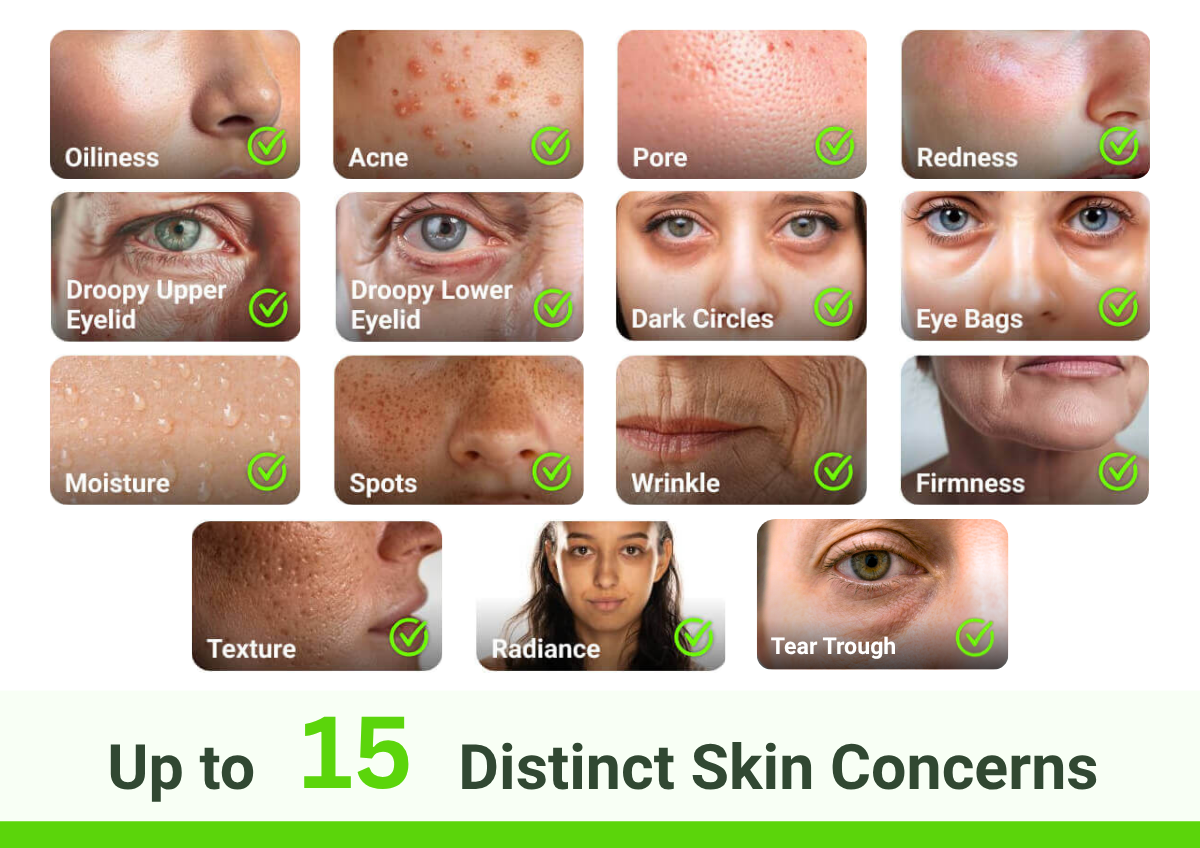
- Tracked over time — enabling brands to demonstrate product or treatment efficacy with quantitative before-and-after comparison
- Cross-referenced with eye bags, dark circles, and droopy eyelid findings — delivering a complete periorbital diagnostic profile in one scan
- Integrated with AI recommendation engines — routing customers to tear-trough-specific products, treatments, or clinical referrals based on their severity score
A medical study confirms Perfect Corp.'s AI Skin Analyzer achieves a 95% test-retest reliability rate across its skin concern assessments — providing the consistency that consumer-facing diagnostic tools demand.
Want to detect tear trough deformity in your customers — before they buy the wrong product?

Why Tear Trough Detection Matters for Beauty and Aesthetic Brands
The tear trough is one of the periorbital concerns most commonly mistaken for something else — and that mistaken identity drives a disproportionate share of eye care product returns, failed expectations, and customer frustration.
Someone buying a brightening eye cream for what they think are "dark circles" — when the darkness is actually structural shadow from tear trough hollowing — will not see meaningful results. Someone using a caffeine de-puffing serum when hollowing is the primary concern will be equally disappointed. These are not product failures. They are diagnosis failures.
AI skin analysis gives brands the infrastructure to prevent these failures at scale. By accurately distinguishing tear trough from eye bags, dark circles, and droopy eyelids in the same diagnostic scan, Perfect Corp.'s platform delivers the precision that turns a one-time purchase into a verified solution — and a verified solution into a loyal customer relationship.
The global AI skin analysis market is valued at USD 2.13 billion in 2026 and is projected to reach USD 6.30 billion by 2033 at a CAGR of 16.8%. Periorbital concern detection — tear trough included — is one of the highest-engagement and highest-conversion-impact use cases in the entire platform.
See how leading beauty brands use AI periorbital detection to reduce returns and drive loyalty.

When to See a Specialist About Tear Troughs
Consult a board-certified dermatologist, oculoplastic surgeon, or aesthetic physician if:
- Tear trough hollowing is causing significant cosmetic distress and has not responded to topical products
- You are considering filler and want an accurate severity grading — the Hirmand class determines appropriate filler volume
- You have significant eye bags alongside the hollowing — the tear trough triad may warrant a surgical consultation for fat repositioning
- You have had filler previously and are experiencing persistent asymmetry, the Tyndall effect, or nodule formation
- Hollow appearance is accompanied by rapidly worsening orbital changes — medical evaluation to rule out orbital pathology
Frequently Asked Questions
What exactly is a tear trough — and is it the same as dark circles?
No — they are distinct concerns that frequently coexist. The tear trough is a concave groove at the eyelid-cheek junction formed by volume loss and anatomical tethering by the tear trough ligament. Dark circles refer to discoloration of the under-eye skin, caused by pigmentation, blood vessel visibility, or the shadow cast by the tear trough hollow itself. A patient can have one without the other, though they are commonly present together.
At what age does tear trough deformity typically appear?
In most people, visible tear trough hollowing develops in the mid-30s to early 40s as midface fat depletes and skin loses elasticity. Genetically predisposed individuals may develop visible hollowing in their 20s or even in childhood. Significant weight loss can also produce tear trough deformity at any age.
Is tear trough filler safe?
When performed by an appropriately trained, board-certified practitioner using a soft HA formulation placed at the correct depth (supraperiosteal), tear trough filler has a strong safety profile and high patient satisfaction. The most common risks — the Tyndall effect, bruising, and asymmetry — are technique-dependent and manageable. Practitioner experience is critical to outcomes.
How long does tear trough filler last?
Published literature reports an average duration of approximately 10.8 months. A retrospective study of 155 patients found that many maintained visible improvement beyond the commonly cited 6–12 month range. Results vary by product, volume, patient metabolism, and individual tissue factors.
Can AI accurately detect a tear trough?
Yes. A peer-reviewed study in the Journal of Plastic, Reconstructive & Aesthetic Surgery (2024) was the first to demonstrate AI-assisted tear trough grading via smartphone photography — achieving an AUROC of 0.85. Perfect Corp.'s AI Skin Analysis detects tear trough as one of 15 skin concerns, cross-referenced with eye bags, dark circles, and eyelid laxity — with a 95% test-retest reliability rate.
How do beauty brands use AI tear trough detection?
Brands use AI tear trough detection to accurately match customers to the correct product or treatment category — distinguishing structural volume loss from pigmentation or puffiness. This improves recommendation accuracy, reduces returns, and drives the trust that converts one-time purchasers into loyal brand advocates.
The Bottom Line
The tear trough is not dark circles. It's not eye bags. It's a distinct, anatomically grounded hollowing that requires its own diagnostic language, its own severity classification, and its own treatment pathway. Every recommendation that conflates it with adjacent under-eye concerns is a recommendation that's likely to disappoint.
AI skin analysis makes accurate tear trough detection scalable — not just for experienced oculoplastic surgeons, but for any digital beauty touchpoint. Perfect Corp.'s AI Skin Analysis detects tear trough as a dedicated concern within a 15-point full-face assessment, cross-referenced with eye bags, dark circles, and eyelid findings — giving brands and consumers the complete periorbital picture they need to make decisions that actually deliver results.
Ready to bring AI-powered tear trough detection to your platform?

Sources
- Journal of Plastic, Reconstructive & Aesthetic Surgery – Artificial intelligence-assisted grading for tear trough deformity (2024). pubmed.ncbi.nlm.nih.gov
- Journal of Clinical and Aesthetic Dermatology – Long-Term Effects of Tear Trough Hyaluronic Acid Filler: A Retrospective Study (2025). jcadonline.com
- MDPI Life – Anatomical-Based Filler Injection Techniques: Infraorbital Groove and Hollowness (2025). mdpi.com
- Dove Medical Press / CCID – Management of tear trough with hyaluronic acid fillers. dovepress.com
- NIH / PMC – Tear trough deformity: different types of anatomy and treatment options. pmc.ncbi.nlm.nih.gov
- Healthline – Tear Trough Filler: Procedure, Safety, Cost & Results. healthline.com
- Coherent Market Insights – AI Skin Analysis Market Size, Trends & Forecast 2026–2033. coherentmarketinsights.com
- Perfect Corp. – AI Skin Analysis Solution for Beauty Brands & Clinics. perfectcorp.com



 English


