 Author:



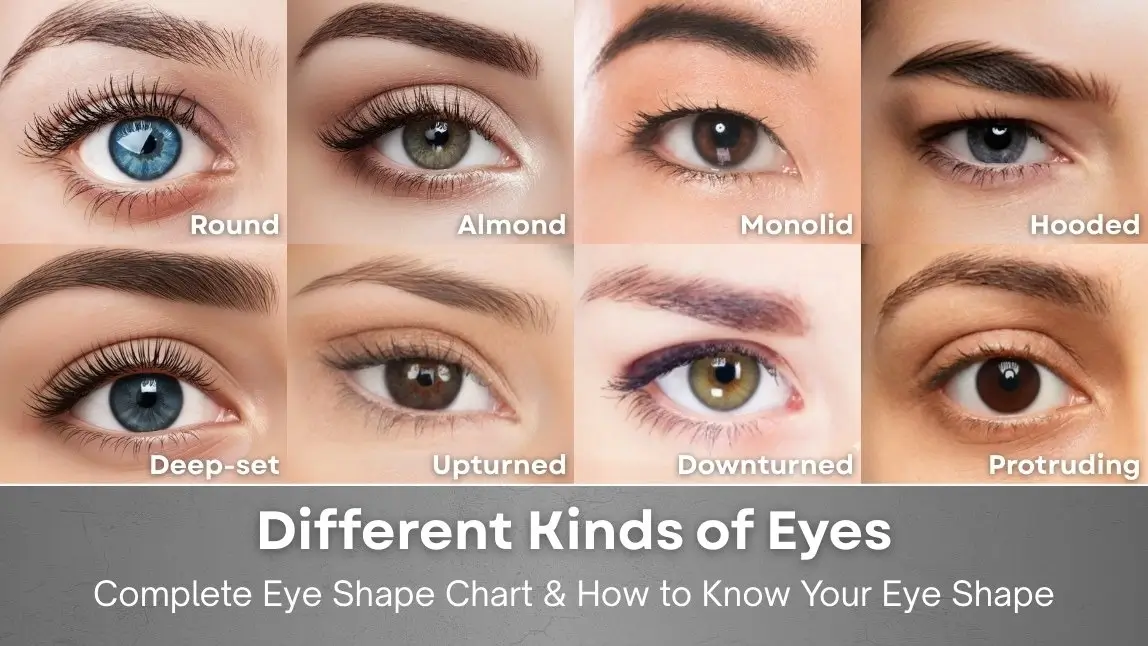
There are 10 common types of eyes: eight eye shapes (almond, round, monolid, hooded, upturned, downturned, deep-set and protruding) plus two spacing types (close-set and wide-set). Almond is widely considered the most common eye shape. To find yours, look straight into a mirror or camera and check three things: whether you can see a crease on your upper lid, whether white shows above or below the iris, and whether your outer corners tilt up or down. For an instant answer, upload a selfie to the AI Face Analyzer to detect your eye shape.
This guide includes an eye shape chart with names, a quick test to identify your eye shape and eyelid type, and makeup tips for each shape. It also covers how beauty brands use Perfect Corp.'s AI eye shape detection to deliver personalized makeup, eyewear and beauty recommendations.
Table of Contents
What Are the Different Types of Eyes?
Eye shape comes down to four traits: the type of eyelid (creased, hooded or monolid), how open the eye is, the angle of the outer corner, and how deep the eye sits in the socket. Eye spacing, the distance between the two eyes, adds two more categories: close-set and wide-set. Most people are a mix, for example almond and slightly hooded, so it helps to check each trait on its own.
10 Types of Eye Shapes Explained
Each eye shape below includes the visual trait that defines it and a makeup tip that works with it.
1. Round Eyes
Round eyes look about as tall as they are wide, and white is visible above or below the iris. The opening is wide and the corners are less tapered. A winged liner or a darker shade on the outer third of the lid elongates the shape.

2. Almond Eyes
Almond eyes are longer than they are tall and taper at both the inner and outer corners. The iris usually touches the upper lid, the lower lid or both, so little white shows around it. Almond is widely considered the most common and most versatile eye shape for makeup, from cat-eye liner to smoky shadow.

3. Monolid Eyes
Monolid eyes have no visible crease on the upper lid, so the lid looks smooth from lashes to brow. This shape is common in East Asian populations, although not every person of East Asian descent has monolids. Shadow blended in a gradient from the lash line upward and liner that thickens toward the outer corner add definition.

4. Hooded Eyes
Hooded eyes have a fold of skin that drops over the crease and covers part or all of the lid when the eye is open. Hooding can be natural or develop with age as skin loses firmness. Placing crease shadow slightly above the natural crease, with eyes open, keeps the color visible.

5. Upturned Eyes
Upturned eyes have outer corners that sit higher than the inner corners, giving a natural lift. This angle is known as positive canthal tilt; the canthal tilt guide explains how it is measured. Liner along the outer lower lash line balances the upward angle.

6. Downturned Eyes
Downturned eyes have outer corners that sit lower than the inner corners. Lifting liner and shadow upward at the outer corner, instead of following the lower lash line down, creates a more open look.

7. Deep-Set Eyes
Deep-set eyes sit further back in the socket under a more prominent brow bone, which creates natural shadow around the lid. Light or shimmery shades on the lid bring the eyes forward, while very dark colors in the crease can make them look more recessed.

8. Protruding Eyes
Protruding eyes, also called prominent eyes, project slightly forward, so more of the lid and eyeball is visible. Matte, medium-to-deep shades on the lid help the eye recede visually. Eyes that start to bulge suddenly, or only on one side, should be checked by an eye doctor, since this can signal a medical condition such as thyroid eye disease.

9–10. Close-Set and Wide-Set Eyes
Spacing is measured against the width of one eye. Close-set eyes are less than one eye width apart, and wide-set eyes are more than one eye width apart. Close-set eyes look more balanced with a highlight on the inner corners and darker color on the outer half of the lid; wide-set eyes benefit from definition toward the inner corners. The eye separation ratio guide covers how spacing is calculated.

How to Find Your Eye Shape

Use a front-facing selfie or a mirror at eye level, in even light and without makeup. Keep your face relaxed and look straight ahead, then run these three checks:
- Check for a crease: a visible fold above the lashes means a creased lid. If skin covers the crease, the eyes are hooded. If there is no fold at all, they are monolid.
- Check the white around the iris: white above or below the iris points to round eyes. If the iris touches the upper or lower lid, the eyes are likely almond.
- Check the corner angle: imagine a straight line through both corners of one eye. An outer corner above the line means upturned eyes; below the line means downturned eyes.
Then look at depth and spacing: a prominent brow bone that shades the lid suggests deep-set eyes, and a gap wider than one eye between the eyes suggests wide-set eyes.
Find Your Eye Shape with AI
The AI Face Analyzer measures these traits from one photo:
- Open the AI Face Analyzer demo page.
- Click Try Myself and take or upload a front-facing photo to detect your eye shape.
AI Face Analyzer
Upload a front-facing photo to detect your eye shape, face shape and other facial features.
What Eyelid Type Do I Have?
There are four main eyelid types. Look at your open eye straight on to tell them apart:
- Double eyelid (creased): a visible fold sits above the lashes, with lid space between the lashes and the crease.
- Inner double eyelid: the crease is present but narrows toward the inner corner, so it is mostly visible at the outer half of the lid.
- Hooded eyelid: skin from the brow area hangs over the crease and covers part or all of the lid space.
- Monolid: there is no visible fold, and the lid looks smooth from lashes to brow.
Eyelids can change over time. Skin naturally loses elasticity with age, so a creased lid can become hooded, while the underlying eye shape stays the same.

Eye Shape Chart with Names
An eye shape chart compares every type side by side. Use the image for a visual match and the table to confirm the trait that defines each shape.

| Eye shape | How to spot it | Makeup tip |
|---|---|---|
| Round | White shows above or below the iris; eye looks as tall as it is wide | Winged liner to elongate |
| Almond | Iris touches the lid; tapered corners; longer than tall | Most looks work, from cat-eye to smoky |
| Monolid | No visible crease on the upper lid | Gradient shadow from the lash line up |
| Hooded | Skin fold covers the crease when the eye is open | Crease shadow placed above the natural crease |
| Upturned | Outer corner higher than the inner corner | Liner on the outer lower lash line |
| Downturned | Outer corner lower than the inner corner | Lift liner and shadow at the outer corner |
| Deep-set | Prominent brow bone; eye sits back in the socket | Light or shimmery shades on the lid |
| Protruding | Lid and eye project forward | Matte, medium-to-deep lid shades |
| Close-set | Less than one eye width between the eyes | Highlight the inner corners |
| Wide-set | More than one eye width between the eyes | Define the inner corners |
What Is the Most Common Eye Shape?
Almond is widely considered the most common eye shape worldwide. Monolid eyes are especially common in East Asian populations, and hooded lids become more common with age. Prevalence depends on the population, and most people combine more than one trait, such as almond and hooded or round and upturned.
What Is the Rarest Eye Shape?
No single eye shape is scientifically ranked as the rarest. Some shapes are less common in certain regions, and some combinations are less common overall, for example strongly upturned eyes that are also deep-set, or protruding eyes with a pronounced downturn. How common a shape looks also depends on the population being compared.

Almond vs Round Eyes
The quickest way to tell almond and round eyes apart is the white around the iris. Round eyes show white above or below the iris and look about as tall as they are wide. Almond eyes are longer than they are tall, taper at both corners, and the iris usually touches the upper or lower lid. Many people fall in between, with a roundish almond shape.

Eye Shapes for Women and Men
Eye shapes are the same for women and men; the same 10 categories apply to everyone. What differs is how people choose to enhance them:
- Makeup: hooded eyes benefit from shadow placed just above the natural crease, round eyes from a winged liner, and downturned eyes from color lifted at the outer corner.
- Eyewear and grooming: frame shape, brow shaping and lash styles are often chosen to balance eye spacing, depth and corner angle.
Popular terms such as hunter eyes describe a combination of traits rather than a separate eye shape. The hunter eyes guide explains which traits create that look.


How AI Analyzes Eye Shapes
Perfect Corp.'s AI Face Analyzer detects more than 70 facial features from a single photo, covering six areas: face, eyes, eyebrows, lips, nose and cheekbones. Each area is broken down into categories such as eye shape, dimensions, angles, widths and heights. The AI engine was trained on 100,000 faces across different genders and ethnic backgrounds.

For beauty, eyewear and lash brands, eye shape detection turns a generic product page into a personalized recommendation. A shopper uploads a selfie, the AI identifies the eye shape, and the brand suggests matching eyeliner styles, lash types or frames. The guide to facial analysis for beauty brands covers this personalization in more detail, and the soft vs sharp facial features guide shows how overall feature style is assessed.
The AI Face Analyzer is available as a web module, API, mobile app SDK and in-store consultation tool, so brands can add real-time detection to their own websites or apps. Perfect Corp.'s platform and cloud infrastructure are ISO/IEC 27001:2022 certified, and data processing follows GDPR principles across all Perfect Corp. solutions. Details are on the compliance page.
FAQ
How many eye shapes are there?
There are eight commonly recognized eye shapes: almond, round, monolid, hooded, upturned, downturned, deep-set and protruding. Close-set and wide-set describe spacing, which brings the total to 10 types of eyes.
What eye shape do I have?
Check three traits in a mirror: whether you have a visible crease, whether white shows above or below the iris, and whether your outer corners tilt up or down. An AI face analyzer can also detect your eye shape from a selfie.
Do I have round or almond eyes?
If white shows above or below your iris when you look straight ahead, your eyes are round. If your iris touches the upper or lower lid and your corners taper, they are almond.
What is the most attractive eye shape?
No eye shape is objectively the most attractive; preferences vary by culture and person. Almond eyes are often described in beauty media as the most versatile shape for makeup.
Can your eye shape change with age?
The underlying eye shape stays mostly the same, but skin loses elasticity over time, so eyelids can become hooded and outer corners can appear more downturned with age.
Is eye shape genetic?
Yes. Eye shape is largely inherited through bone structure and eyelid anatomy, which is why it often runs in families and varies between populations.
Conclusion
Most people fit one of 10 types of eyes, or a mix of two: almond, round, monolid, hooded, upturned, downturned, deep-set, protruding, close-set or wide-set. Three quick checks (the crease, the white around the iris and the corner angle) are enough to identify an eye shape, and an eye shape chart helps confirm the result. For brands, AI eye shape detection turns that same analysis into personalized makeup, lash and eyewear recommendations at scale.
AI Face Analysis for Brands
Detect 70+ facial features, including eye shape, to power personalized makeup, eyewear and hairstyle recommendations.
This article was edited and reviewed by the Perfect Corp. editorial team. Welcome to contact us or give us more suggestions.