 Author:


A shea butter moisturizer is a skincare product built around fat extracted from the nuts of the West African shea tree (Vitellaria paradoxa). Rich in oleic and stearic fatty acids plus vitamins A and E, it softens skin, seals in moisture, and calms irritation, making it one of the most popular emollients in modern skincare.
Simple enough. Except the internet can't agree on who should actually use one.
Search "shea butter moisturizer" and you'll find one camp calling it a clear-skin champion with a comedogenic rating of zero, and another citing dermatologists who warn it can clog pores on acne-prone skin. Both camps have receipts. Both are, in a sense, right.

That contradiction is exactly why this article exists, and why the smartest beauty brands have stopped answering the question with a blanket "yes" or "no."
Instead, they let AI skin analysis answer it per face. Let's break down what shea butter moisturizers actually do, who they're best for, and how AI-powered skin detection turns a divisive ingredient into a personalized recommendation.
What Makes Shea Butter Such an Effective Moisturizer?
Shea butter isn't popular by accident. Its fatty acid profile reads like a wishlist for barrier repair.
Roughly half of shea butter is oleic acid, the same fatty acid that dominates human sebum. Your skin recognizes it as native, which helps it absorb rather than sit on the surface.
Another 40% or so is stearic acid, which forms a thin, structured lipid film that locks moisture in without fully occluding pores.

Then come the extras. Unrefined shea butter carries vitamins A and E, polyphenols, and triterpenes with documented anti-inflammatory effects. In practice, that translates to:
- Deep, lasting hydration: the emollient film keeps moisture sealed for hours
- Barrier support: it helps restore the skin's hydrolipidic film, the first line of defense against external stressors
- Soothing effects: anti-inflammatory compounds calm redness and irritation
- Anti-aging potential: early evidence points to collagen support, though mechanisms are still being studied
This is why shea butter shows up everywhere from drugstore body lotions to prestige face creams. The ingredient works. The question is whether it works for you—or for your customer.
Is Shea Butter Moisturizer Good for Every Skin Type?
Short answer: it's good for most, ideal for some, and risky for a few. Here's the honest breakdown.
| Skin Type | Fit | What to Know |
|---|---|---|
| Dry skin | Excellent | The richness is exactly what a compromised moisture barrier needs. Expect less flaking and tightness. |
| Mature skin | Excellent | Vitamins A and E plus barrier repair make it a natural anti-aging ally. |
| Sensitive skin | Very good | Anti-inflammatory properties calm reactivity. Patch test first, as with anything. |
| Normal skin | Good | A reliable daily moisturizer, especially in cold or dry climates. |
| Combination skin | Conditional | Targeted application to dry zones works better than full-face use. |
| Oily / acne-prone skin | It depends | Low comedogenic rating, but heavy layers can feel congested. Amount and formulation decide the outcome. |
Notice how many of those verdicts hinge on "it depends"? That's the personalization gap in action. A shea butter moisturizer that transforms one customer's winter-dry cheeks can leave another customer's oily T-zone feeling suffocated. Same jar, opposite reviews.
The Real Problem: A Great Ingredient Can't Read Your Customer's Skin
Here's where most shea butter content stops—and where the more interesting story begins.
Every guide ends with the same advice: "know your skin type." But most consumers don't. Studies and in-store consultations consistently reveal that shoppers misjudge their own skin.
Dehydrated skin gets mistaken for dry, oily skin gets over-stripped, and combination skin gets treated as one uniform surface.

When they guess wrong, the product gets the blame. Cue the one-star review: "This broke me out."
For beauty brands, this is a measurable business problem. Mismatched products drive returns, negative reviews, and churn, especially for an ingredient like shea butter where fit genuinely varies by skin condition. The fix isn't a better FAQ. It's removing the guesswork entirely.
How AI Skin Analysis Matches Shea Butter Moisturizers to the Right Skin
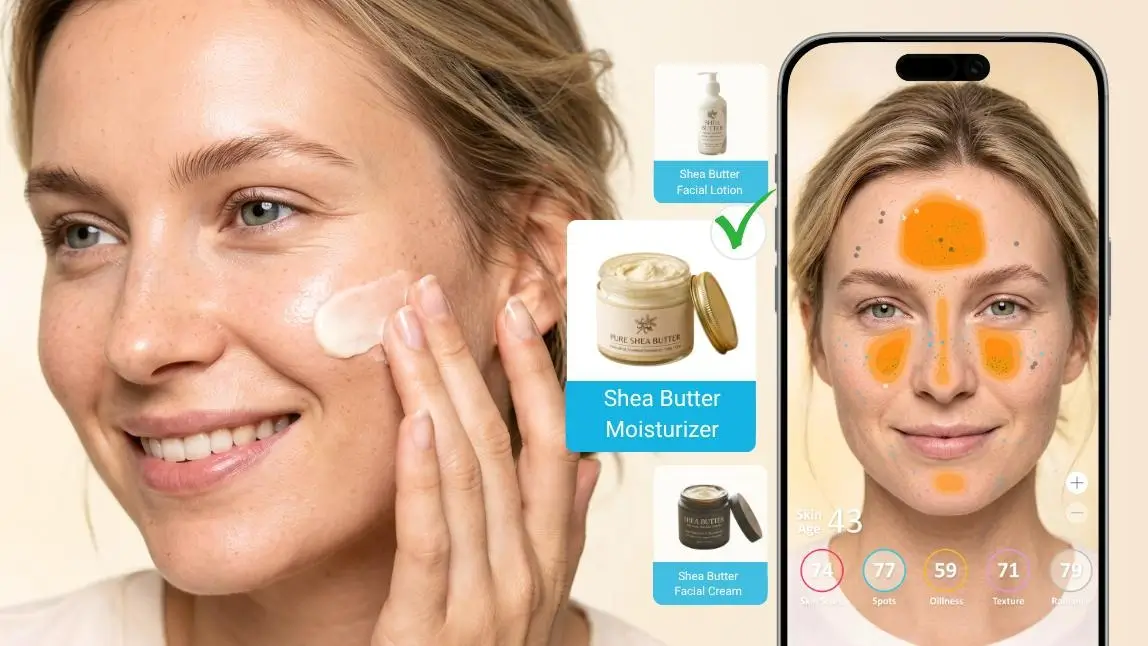
AI skin analysis flips the recommendation flow. Instead of asking customers to self-diagnose, the technology reads their skin directly—from a selfie.

Perfect Corp's AI Skin Analysis uses deep learning trained in collaboration with dermatologists to detect 15+ skin concerns in seconds, including moisture level, oiliness, texture, redness, pores, and radiance.
The output isn't a vague skin-type label; it's a quantified skin report with scores for each concern.
Now connect that to shea butter. A recommendation engine layered on top of the analysis can apply exactly the logic dermatologists use:
- Low moisture + high texture score? Recommend the rich unrefined shea butter night cream.
- High oiliness + visible pores? Route the customer to the lightweight shea-infused lotion—or a shea oil formula—with usage guidance on amount.
- Redness and sensitivity flags? Highlight the fragrance-free shea formula and its anti-inflammatory benefits.
- Combination patterns? Suggest zone-based application instead of a different product entirely.

Here are general suggestions. Please consult a doctor for personalized recommendations.
Why Beauty Brands Are Wiring Ingredients to AI Recommendations
This isn't hypothetical. Perfect Corp's beauty tech powers experiences for 800+ brand partners worldwide, and skin analysis has become one of the highest-converting touchpoints in digital beauty retail. The pattern repeats across channels:

Clarins Drives Omnichannel Engagement Through AI—from Makeup VTO to Skincare Personalization. Learn more>
E-commerce. A skin analysis widget on the product page turns a static "shea butter moisturizer" listing into a consultation. Customers see why this formula fits their measured skin state—which builds the confidence to click buy.
In-store. Smart mirrors and tablet-based consultations give beauty advisors objective skin data, so the shea butter recommendation comes with evidence instead of intuition.
Apps and loyalty programs. Repeat scans track how skin changes across seasons—flagging when a customer's summer gel moisturizer should give way to a richer shea butter cream in winter. That's a replenishment trigger disguised as skincare advice.
Use "Claude + 1 Prompt" to Create Your Skin Analysis Tool
Now, with Claude AI and just a short prompt, you can create your own online skin detection tool to stay on top of your skin's condition.

Does Shea Butter Clog Pores? The Comedogenic Debate, Settled-ish
This is the number one question shoppers ask, so let's give it the nuance it deserves.

Most comedogenic rating guides place shea butter between 0 and 2 on the 0–5 scale—among the lowest of any plant butter.
For comparison, cocoa butter and coconut oil typically rate a 4.
Some cosmetic chemists list shea at a flat zero, which is why it appears in products formulated for oily and acne-prone skin.
But this "non-comedogenic" verdict isn't universal. Dermatologists and estheticians caution that shea butter's richness can still congest already-oily or acne-prone skin—especially when applied heavily or in pure form rather than at the small percentages used in balanced formulations (Source1, Source2). Real-world breakout reports exist. Who's right?
Everyone, partially. Three variables explain the contradiction:
- Grade matters. Refined shea butter tends to be lower-comedogenic than unrefined.
- Dose matters. A pea-sized amount on damp skin behaves very differently from a thick occlusive layer.
- Formulation matters. A moisturizer with 5–15% shea butter isn't the same as raw butter straight from the jar—and blame often belongs to the coconut oil or waxes sharing the ingredient list.
The takeaway for consumers: patch test, start small, apply to slightly damp skin. The takeaway for brands: stop marketing shea butter products to "everyone" and start matching them to the skin conditions they actually serve.
Refined vs. Unrefined: Which Shea Butter Belongs in a Moisturizer?
Not all shea butter arrives at your face the same way.
Unrefined (raw) shea butter is minimally processed, keeping its vitamins, polyphenols, and a distinctive nutty, smoky scent from traditional West African processing. Maximum actives, maximum character.
Refined shea butter is filtered and deodorized for a neutral scent, lighter color, and more predictable texture, at the cost of some nutrient content. It's the workhorse of large-scale formulation.
Many face-focused moisturizers blend both: enough unrefined to deliver the functional benefits, enough refined to keep scent and texture consistent batch to batch.
If a customer wants the full nutrient payload for body care, unrefined wins. For a fragrance-sensitive face cream, refined or blended formulas are usually the smarter call.
How to Use a Shea Butter Moisturizer (the Right Way)
Whichever side of the counter you're on, correct usage prevents most shea butter complaints:
- Start with a pea-sized amount for the full face—less than most people expect. Overuse is the top cause of congestion and greasy feel.
- Apply to slightly damp skin after cleansing so the emollient film seals water in, not out.
- Warm it between fingertips until it melts, then press into skin rather than dragging.
- Give it 5–10 minutes to absorb. Still greasy? Use less next time, or switch to a lighter shea-infused lotion.
- Time it seasonally. Skin that loves shea butter in dry winter air may prefer a lighter texture in humid summer months.
Frequently Asked Questions
Is shea butter moisturizer good for your face?
Yes, for most skin types. Its oleic and stearic fatty acids mirror skin's natural lipids, delivering hydration and barrier support. Acne-prone users should choose lighter formulations, use small amounts, and patch test first.
Does shea butter clog pores?
Rarely. Shea butter rates 0–2 on the comedogenic scale—far lower than coconut oil or cocoa butter. However, heavy application on already-oily skin can contribute to congestion, and some dermatologists advise caution for acne-prone skin. Dose and formulation determine the outcome.
Can I use a shea butter moisturizer every day?
Yes. Daily use suits dry, normal, mature, and sensitive skin. Oily and combination types do better with smaller amounts or targeted application to drier zones.
Is shea butter good for oily or acne-prone skin?
It can be, in the right format. A pea-sized amount of a lightweight shea-infused lotion—or shea oil, the lighter liquid form—generally works better than thick balms. If congestion persists, that's a signal the formula, not the ingredient category, is the mismatch.
What's the difference between refined and unrefined shea butter?
Unrefined retains more vitamins, polyphenols, and a natural smoky scent. Refined is filtered for neutral scent and consistent texture but loses some nutrients. Many facial moisturizers blend both.
Can shea butter replace my regular moisturizer?
Pure shea butter can serve as a moisturizer for dry skin and body care, but it lacks the humectants (like hyaluronic acid) found in complete formulations. Most people get better results from a formulated shea butter moisturizer than from the raw ingredient alone.
How does AI skin analysis recommend the right moisturizer?
AI skin analysis scans a selfie to score concerns like moisture, oiliness, texture, and redness, then maps those scores to products whose formulations address them. Instead of guessing their skin type, customers receive recommendations grounded in measured skin data.
The Bottom Line
Shea butter moisturizers earn their reputation: few ingredients hydrate, soothe, and repair the skin barrier as reliably. But "great ingredient" and "right product for this face" are two different claims—and the gap between them is where breakouts, returns, and bad reviews live.
AI skin analysis closes that gap. When a brand can detect a customer's actual skin condition and route them to the shea butter formula built for it, a divisive ingredient becomes a precision recommendation. The skin wins. The conversion rate isn't far behind.
Ready to see it work? Contact Perfect Corp. for a demo and turn every product page into a skin consultation.