


 Author: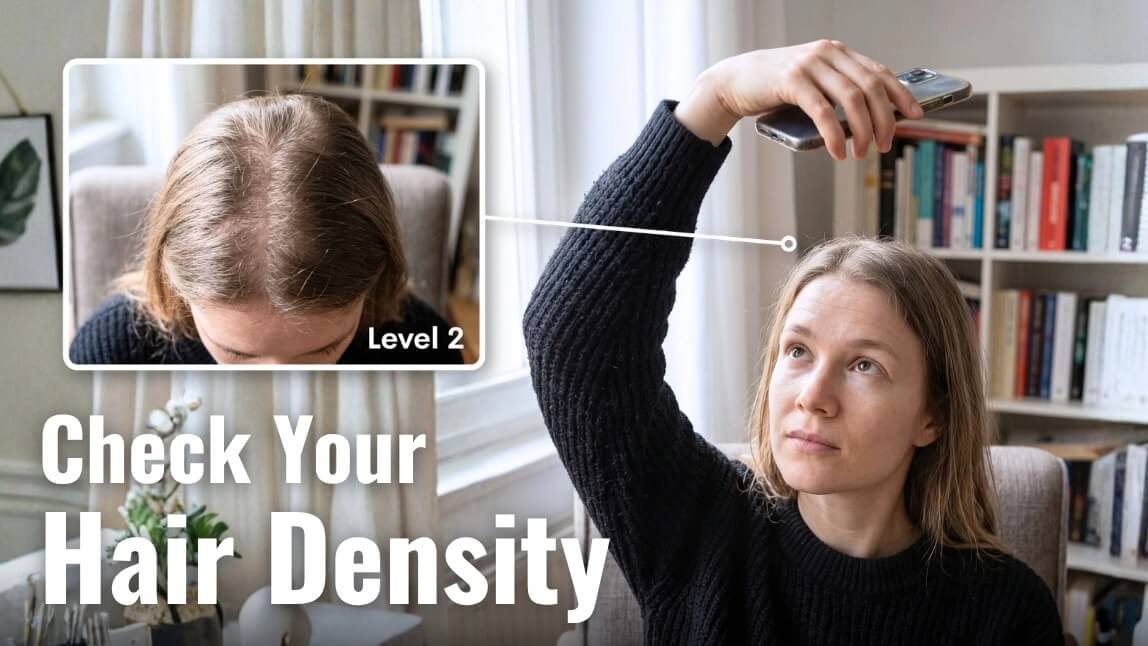
Disclaimer: Some images in this article may have been created or modified by AI
Your stylist says your hair is "thick." Your shampoo bottle says it is for "fine, flat hair." Your bathroom mirror says something else entirely. Who is right? The answer starts with one number most people have never checked: hair density.
Density decides which cut holds shape, which products weigh you down, and whether a widening part is worth a second look. The good news is you can check hair density in under five minutes with a mirror, a soft tape measure, or a single top-down photo. For haircare brands, salons, and clinics, AI now turns that same photo into a four-level density grade that powers product matching at scale.
This guide walks through every method, from the classic ponytail test to the dermatologist's trichoscope, and shows you which one is actually worth trusting.
Table of Contents
- What Is Hair Density?
- Is Hair Density the Same as Hair Thickness?
- How Do You Check Hair Density at Home?
- How Do Dermatologists Measure Hair Density?
- What Is a Normal Hair Density?
- What If Your Hair Density Is Uneven?
- Which Hair Density Test Is Most Accurate?
- What Makes Hair Density Change Over Time?
- What Should You Do With Your Results?
- How Do Beauty Brands Check Hair Density at Scale?
- Hair Density FAQ
What Is Hair Density?
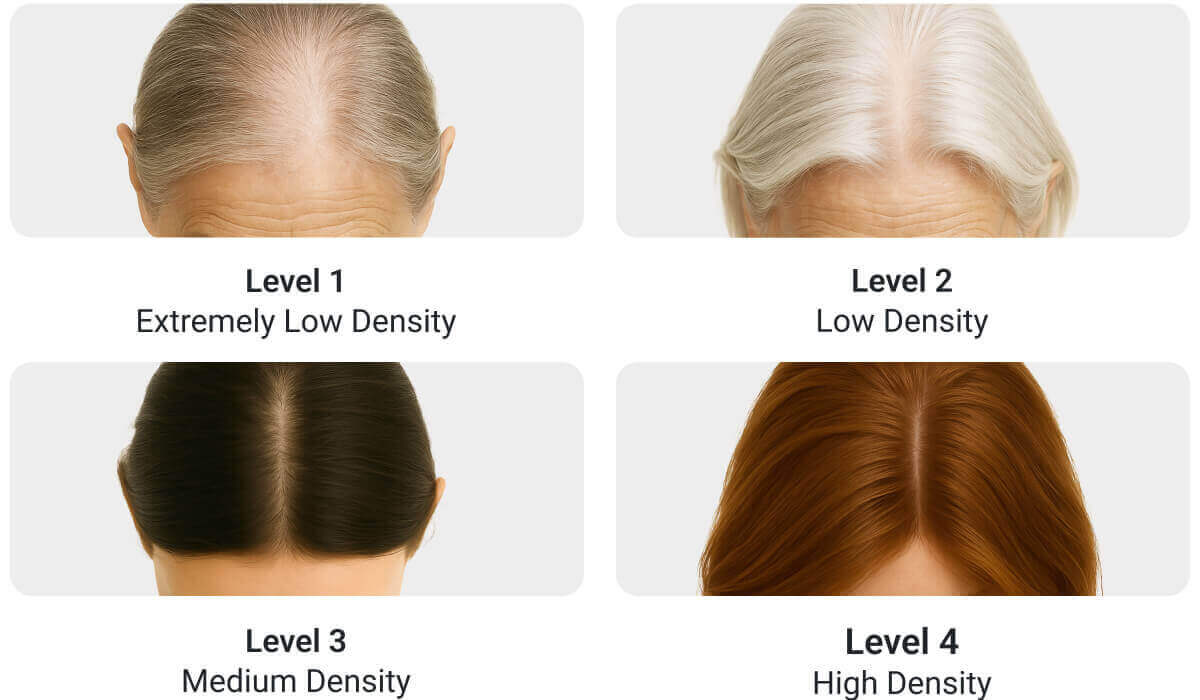
See which of the four density levels you are with the free AI hair density demo.
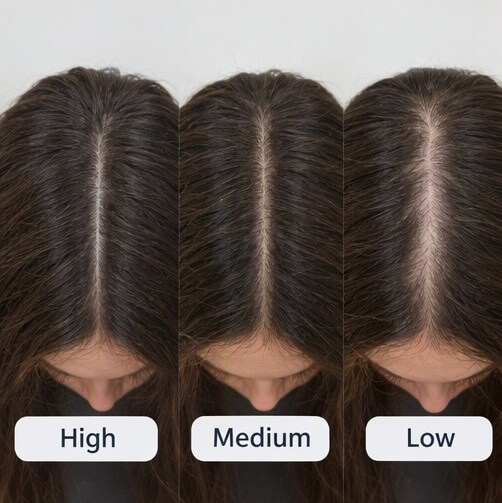
Hair density is the number of individual hair strands growing per square inch (or square centimeter) of your scalp. It measures how closely packed your follicles are, not how wide each strand is. Density is usually grouped into low, medium, and high, and it is best checked by looking at scalp visibility, ponytail circumference, or an AI scalp scan.
Think of your scalp as a lawn. Density is how many blades of grass grow in each patch. Thickness is how wide each blade is. A lawn can have fine blades packed tightly together, or chunky blades spaced far apart, and both look very different when you mow them.
Most adults carry somewhere around 80,000 to 120,000 hairs on their heads in total. What matters for styling, though, is how that number is spread across the scalp, which is exactly what a density check tells you.
| Density Level | What You See | Typical Ponytail Circumference |
|---|---|---|
| Low | Scalp easily visible, even without parting | Under 2 inches |
| Medium | Some scalp visible along the part | 2 to 3 inches |
| High | Scalp hard to see even when you part it | 4 inches or more |
Is Hair Density the Same as Hair Thickness?
No, and mixing them up is the number one reason people buy the wrong products. Density is about quantity. Thickness (also called strand diameter or texture) is about the width of a single hair. Porosity, the third member of the trio, is about how easily each strand absorbs moisture.
That means you can have fine strands at high density (lots of skinny hairs that tangle and feel full) or coarse strands at low density (a few wide hairs with visible scalp between them). Each combination needs a different routine.
| Hair Trait | What It Measures | Quick Check |
|---|---|---|
| Density | Strands per square inch of scalp | Scalp visibility, ponytail tape, AI photo scan |
| Thickness | Diameter of a single strand | Roll one strand between your fingers, or compare it to sewing thread |
| Porosity | How well a strand absorbs and holds water | Float a clean strand in water and watch how fast it sinks |
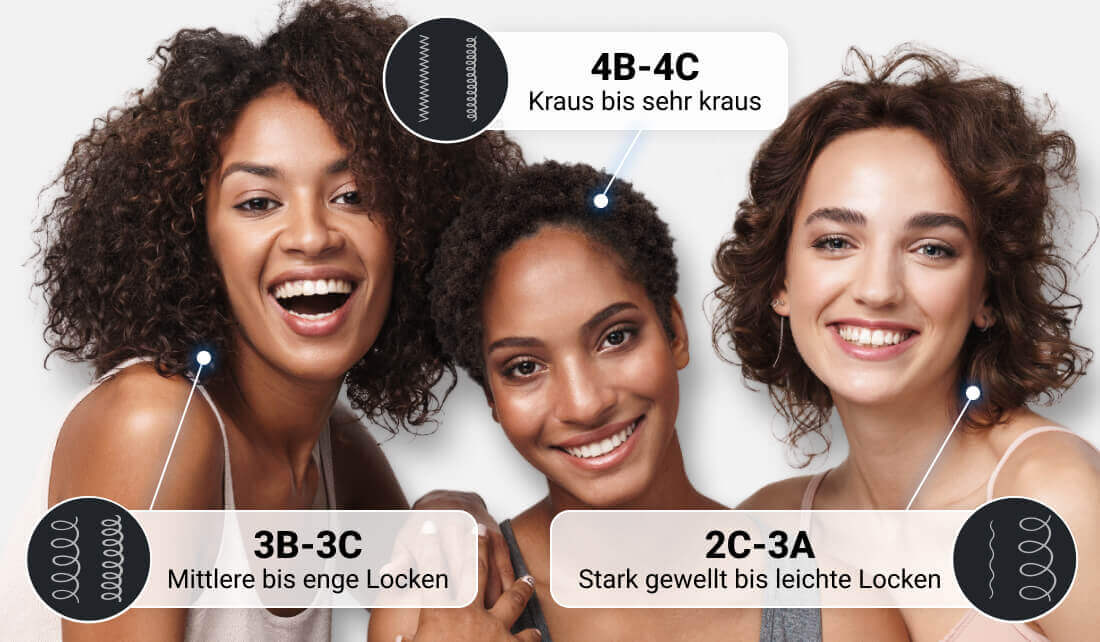
| Curl pattern | Shape of the strand, 1A to 4C | Air dry without product and compare to a hair type chart |
Want to see how these traits combine? Our guide to the AI hair type quiz breaks down how texture and pattern are detected from a photo.
How Do You Check Hair Density at Home?
There are five reliable ways to check hair density without a clinic visit. Start with clean, fully dry hair and no product, because conditioner, oil, and dry shampoo all change how hair clumps and how much scalp shows. Do your check in bright, even daylight.
Test 1: The Scalp Visibility Test
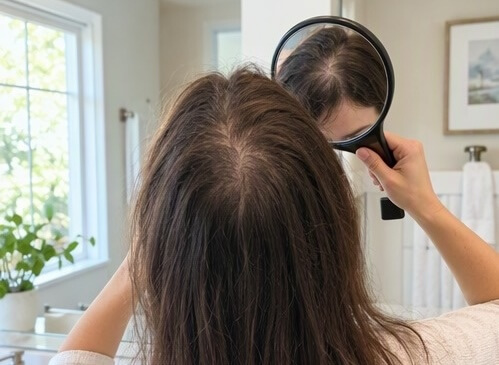
This is the fastest check and the one most stylists use. Stand in front of a mirror and let your hair fall naturally, no parting.
- You see a lot of scalp: low density
- You see some scalp, mostly near the crown or part: medium density
- You barely see scalp at all: high density
Now lift a section at the crown with your fingers. If your scalp disappears almost instantly as hair falls back, that is a strong high density signal. A handheld mirror or your phone's front camera helps you see the crown, which is the area most people misjudge.
Test 2: The Ponytail Circumference Test
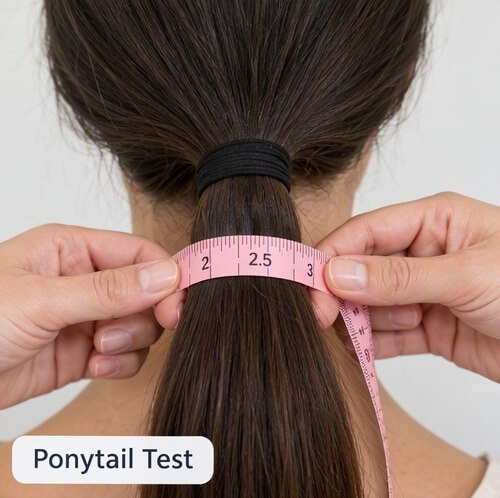
Skip the tape measure: see how the AI Hair Density Analysis grades density from one photo.
Gather all your hair into a ponytail at the base of the neck, the same way you would for a workout. Wrap a soft tape measure around the ponytail, right under the hair tie.
- Under 2 inches: low density
- 2 to 3 inches: medium density
- 4 inches or more: high density
It is simple and repeatable, which makes it great for tracking change over months. The catch? It only works if your hair is at least shoulder length, and coarse or curly strands take up more room, so they can nudge the number higher than your true follicle count.
Test 3: The Part Width Test
Make a clean center part with a fine-tooth comb. Look at how wide the line of exposed scalp is.
- A thin, barely visible line points to high density
- A pencil-width line points to medium density
- A wide, easily visible stripe points to low density
Repeat the part one inch to the left and one inch to the right. If the part widens as you move toward the crown or temples, you have found an uneven density pattern (more on that below).
Test 4: The Monthly Photo Journal
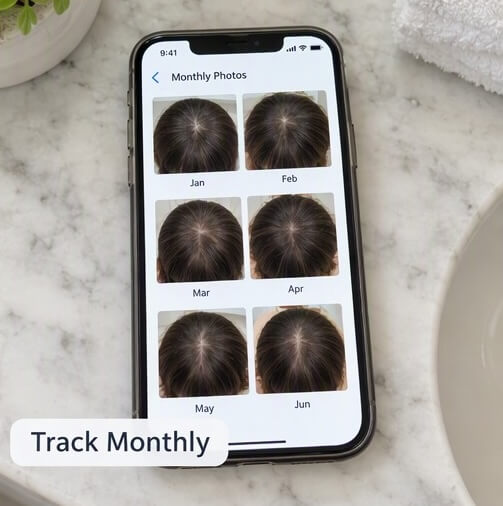
A single look tells you where you are today. A photo series tells you where you are heading. Take a top-down photo of your part and one of your crown on the same day each month, in the same lighting, with hair dry and unstyled.
Line them up side by side every three months. Gradual change is almost impossible to notice in the mirror, but it jumps out in a photo grid. This is also the habit dermatologists recommend before a consultation, because it gives them real history to work with.
Test 5: The AI Hair Density Scan
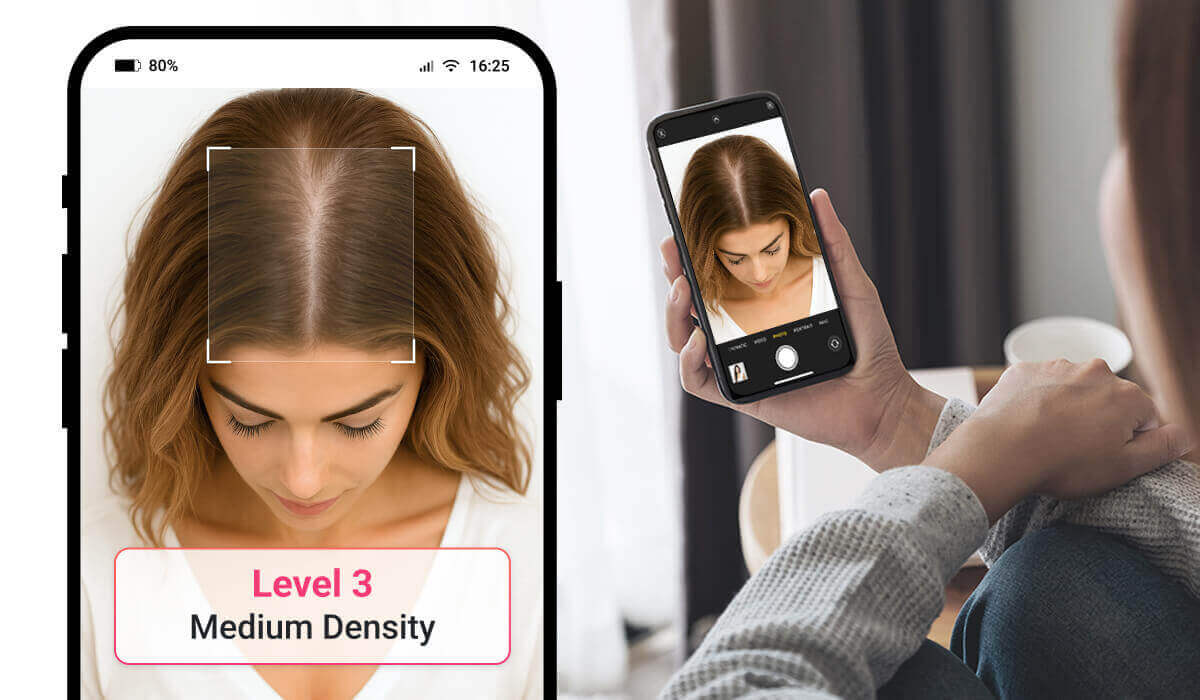
Here is where a phone photo becomes an actual measurement. An AI hair density test analyzes a single top-down image of the head, detects how much scalp is exposed, reads how hair is distributed, and returns a density grade in seconds. No tape measure, no guessing about lighting in your bathroom.
Perfect Corp's AI engine classifies results into four levels:
- Level 1: Extremely Low Density
- Level 2: Low Density
- Level 3: Medium Density
- Level 4: High Density
That fourth "extremely low" bucket matters. The ponytail test lumps everything under 2 inches together, but an AI scan can separate naturally fine hair from hair that may be showing signs of thinning, which is precisely the difference a shopper or a salon client cares about.
Try it yourself: check your hair density with the free AI demo, upload one photo, and get your level plus product suggestions instantly.
How Do Dermatologists Measure Hair Density?
At-home tests estimate density. Clinical tests count it. If you are worried about hair loss, these are the tools a dermatologist or trichologist is likely to use.
Trichoscopy
A trichoscope is a handheld dermatoscope that magnifies the scalp, typically somewhere between 10x and several hundred times. The clinician can see individual follicular units, count hairs per unit, and spot miniaturized (thinner, shorter) hairs that signal pattern thinning long before it is visible in the mirror.
Phototrichogram
A tiny patch of scalp, usually about one square centimeter, is trimmed short and photographed under magnification. A few days later, the same patch is photographed again. Comparing the two shows exactly how many hairs are present and how many are actively growing. It is one of the most precise methods available, and it is common in clinical trials for hair growth treatments.
Hair Pull Test
The clinician gently pulls a small bundle of about 50 to 60 hairs. If more than a handful come out, that suggests active shedding. It does not measure density directly, but it tells you whether density is likely to drop.
These methods are accurate, but they need equipment, a trained eye, and an appointment. That gap between "rough home guess" and "clinic visit" is exactly what photo-based AI analysis was built to close.
Want trichoscopy-inspired density checks in your clinic or salon? Talk to our team.
What Is a Normal Hair Density?
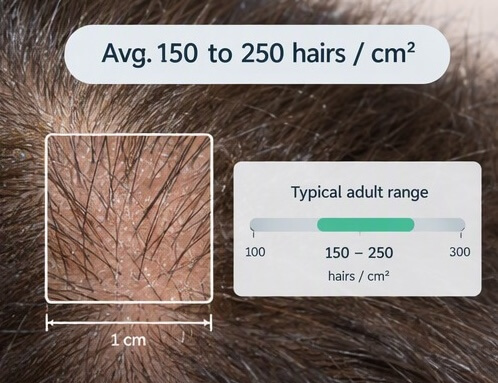
There is no single "normal." Density varies widely with genetics, ancestry, and age. Clinical sources commonly cite an average of roughly 150 to 250 hairs per square centimeter on a healthy adult scalp, with individual follicular units holding one to four hairs each.
Research summarized by Healthline reported approximate averages per square inch that differ noticeably by ancestry, and a separate study of Thai adults showed density gently declining with each decade of age.
| Group (study reported) | Approximate Hairs per Square Inch |
|---|---|
| Caucasian adults | About 1,458 |
| Hispanic adults | About 1,148 |
| African adults | About 961 |
| Thai adults, age 20 to 29 | About 1,064 |
| Thai adults, age 60 to 69 | About 1,004 |
Two takeaways. First, a lower number is not automatically a problem; many people with naturally lower density have full, healthy looking hair thanks to coarser strands or tighter curl patterns. Second, the most useful comparison is you versus your own baseline, which is why repeatable checks beat one-off guesses.
What If Your Hair Density Is Uneven?
Upload a top-down photo and see how your crown and part compare in the hair density demo.
Almost everyone's density varies across the scalp, and this is the part most guides skip. Your nape and sides are usually denser than your crown. A single "medium" label can hide a crown that is noticeably lower than the rest.
Check these four zones separately:
- Front hairline and temples: look for recession or a see-through fringe
- Center part: check whether the part widens toward the back
- Crown (vertex): photograph from directly above; this is the easiest area to miss
- Sides and nape: usually your densest zone and a good personal reference point
If one zone is clearly lower than the others, note it in your photo journal. Patterns concentrated at the temples, crown, or a widening part are worth mentioning to a dermatologist, especially if they are changing month to month. Evenly low density across the whole head, on the other hand, is often simply genetic.
For businesses, zone-aware analysis is a big upgrade: a top-down photo reveals crown and part distribution that a ponytail tape measure will never capture.
Which Hair Density Test Is Most Accurate?
Every method trades off accuracy, convenience, and cost. Here is how they compare side by side.
| Method | Accuracy | Time | Tools Needed | Best For |
|---|---|---|---|---|
| Scalp visibility | Low to moderate | 1 minute | Mirror | A quick first guess |
| Ponytail circumference | Moderate | 2 minutes | Soft tape measure | Tracking change on long hair |
| Part width | Moderate | 2 minutes | Fine-tooth comb, mirror | Spotting uneven zones |
| Monthly photo journal | Moderate over time | 2 minutes per month | Phone camera | Seeing slow trends |
| AI hair density scan | High consistency | Seconds | One top-down photo | Objective grading, any hair length |
| Trichoscopy / phototrichogram | Highest | Clinic visit | Dermatoscope, clinician | Diagnosing hair loss |
The verdict: For diagnosing a medical concern, nothing replaces a clinician with a trichoscope. For everyone else, and for every brand trying to recommend the right product, an AI scan hits the sweet spot. It removes the biggest weakness of home tests (human judgment under bad lighting), works on short hair where the ponytail test fails, and gives the same answer for the same photo every time. Pair it with a monthly photo habit and you have a surprisingly solid picture of your hair.
What Makes Hair Density Change Over Time?
You are born with a set number of follicles, but not all of them stay active forever. Density can shift because of:
- Genetics: the biggest factor, including hereditary pattern thinning in both men and women
- Age: density tends to peak in your twenties and slowly decline after your mid-thirties
- Hormones: pregnancy, postpartum shifts, menopause, and thyroid changes can all affect shedding
- Nutrition: low iron, protein, or certain vitamins can reduce how many hairs are actively growing
- Stress and illness: a major stressor can push many hairs into the shedding phase at once, usually a few months later
- Styling tension: tight ponytails, braids, and extensions can cause traction thinning along the hairline
Match every shopper to the right formula with AI-graded hair density.
Temporary shedding often recovers on its own. Sudden, patchy, or fast progressing loss should always be checked by a doctor. This article is educational and is not a substitute for medical advice.
What Should You Do With Your Results?
Knowing your density is only useful if it changes what you buy and how you style. Here is the cheat sheet.
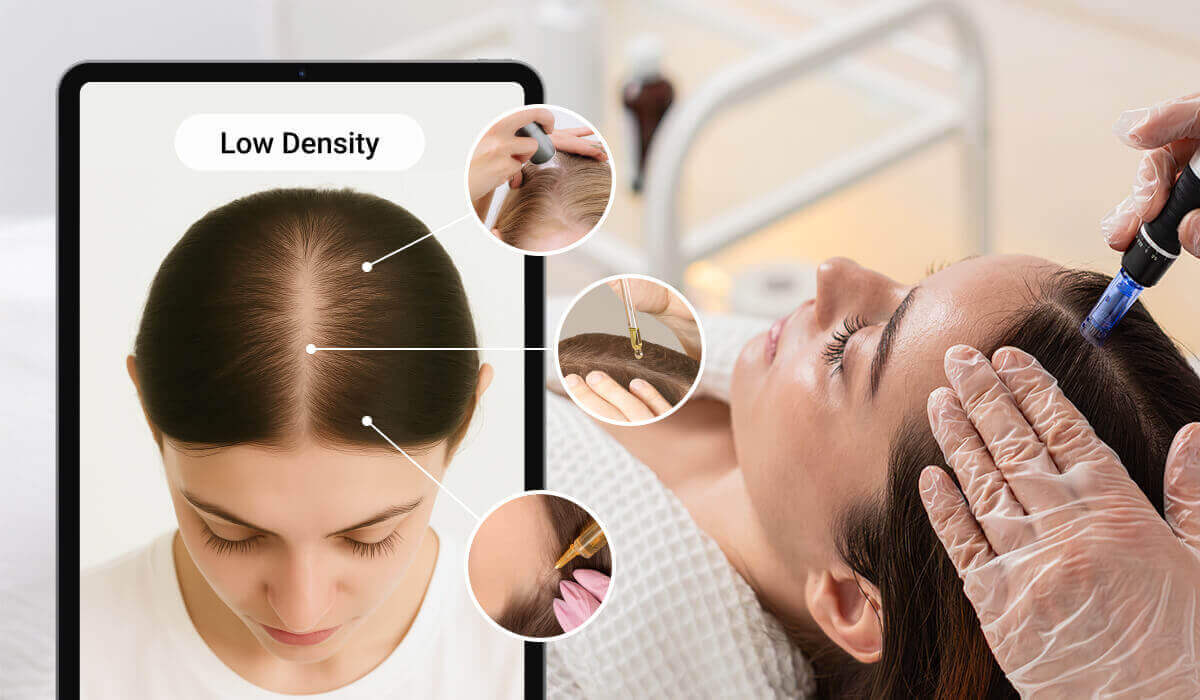
Low Density Hair
- Choose lightweight volumizing shampoos and conditioners; apply conditioner mid-length to ends only
- Skip heavy oils and butters at the root; they flatten hair and make scalp more visible
- Try blunt cuts, long bobs, and subtle face-framing layers that make the ends look fuller
- Root-lift sprays, texturizing powder, and a change of part direction add instant lift
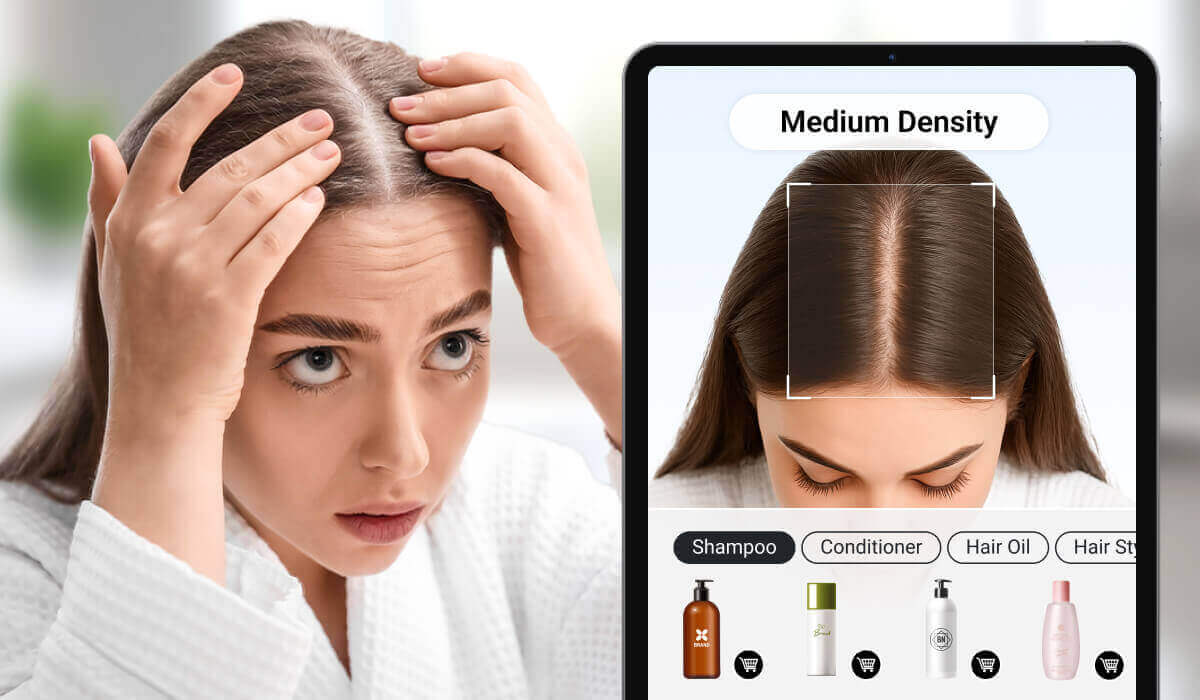
Medium Density Hair
- You have the most flexibility; balance moisture and volume based on your strand thickness
- Soft layers, curtain bangs, and shoulder-length cuts hold shape well
- Use a lightweight leave-in and adjust product amount by season and humidity
High Density Hair
Building a density-based haircare quiz for your brand? Contact us for a demo.
- Richer creams, masks, and leave-ins help product actually reach every strand
- Apply products in sections so nothing gets missed
- Long layers, internal thinning, and undercuts remove bulk without losing length
- Budget extra drying time; a diffuser or sectioned blow-dry helps prevent a damp inner layer
Not sure which cut suits your density? You can preview styles first with a virtual hairstyle try-on before committing to the chair.
How Do Beauty Brands Check Hair Density at Scale?

Try the shopper experience yourself with the free online hair density checker.
Here is the business problem. A shopper lands on a haircare site, sees "for fine hair," "for thick hair," and "for thinning hair," and has no idea which one is theirs. So they guess, get the wrong product, and blame the brand. Salons face the same issue at consultation: density is judged by eye, and two stylists can give two different answers.
AI hair density analysis replaces that guess with a consistent, photo-based grade. The AI Hair Density Test from Perfect Corp works in three steps:
- Upload: the customer takes or uploads a top-down photo of their head on mobile or desktop
- Analyze: AI detects scalp visibility and hair distribution patterns, inspired by trichoscopy principles
- Recommend: the result returns a density level from 1 to 4 with a visual report, which maps directly to product and service suggestions
Where it fits:
- Haircare brands and retailers: guide low-density shoppers toward volumizing lines and high-density shoppers toward richer formulas, right on the product page
- Salons and barbershops: start every consultation with an objective density read and recommend cuts that work with it
- Hair clinics and scalp care specialists: flag possible thinning early and track density across visits
- Wig, extension, and hair system brands: match base density so added hair blends naturally
Building It Into Your Own App With an API
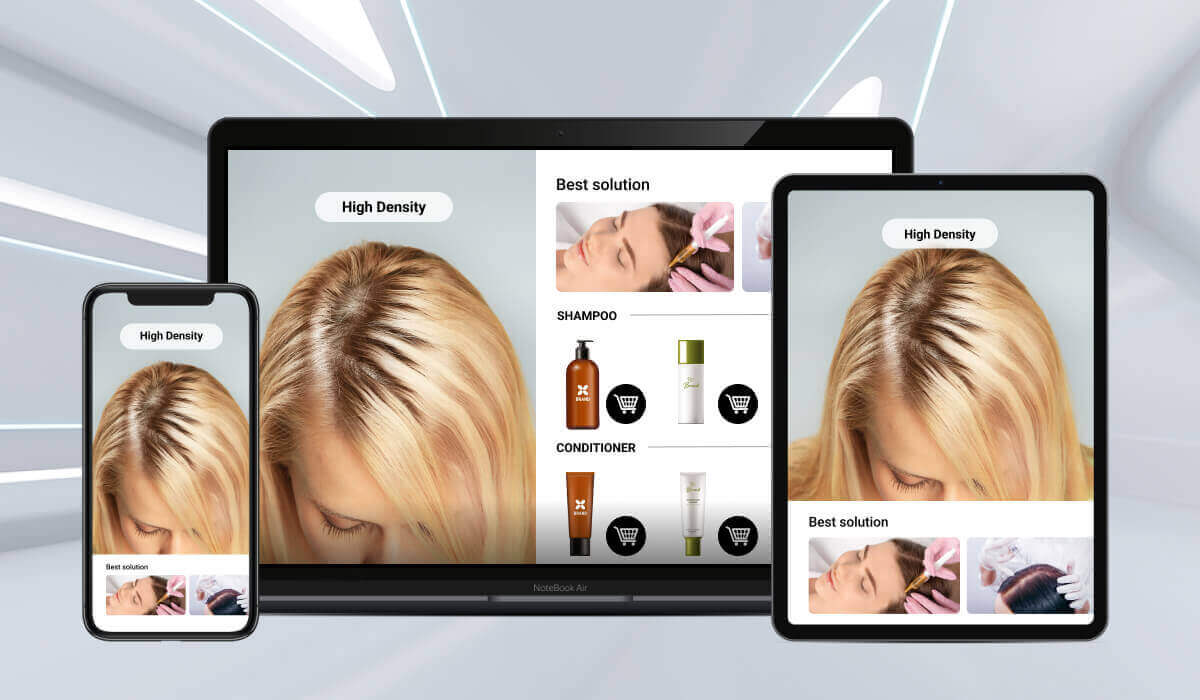
Explore web, app, and API integration options for hair density analysis.
For teams that want density checks inside their own app, kiosk, or e-commerce flow, Perfect Corp offers AI Hair Density Detection as part of its Hair and Beard API suite. The suite includes 11 APIs, pairing four hair analysis tools (hair type, length, frizziness, and density) with seven virtual try-on tools such as hair color, hairstyle, bangs, and hair volume.
That combination unlocks a full journey in a single integration: detect density, recommend a product, then let the shopper preview a fuller, voluminous style on their own photo. Developers can test endpoints and sample outputs in the YouCam API Playground before writing a line of production code.
Perfect Corp's AI and AR beauty technology already powers experiences for more than 800 global brand partners, which is why density analysis plugs into the same platform brands already use for skin analysis and virtual try-on.
Ready to turn hair density into personalized recommendations? Contact Perfect Corp. for a demo and see how it works with your product catalog.
Match every shopper to the right formula with AI-graded hair density.
Hair Density FAQ
How do I check my hair density?
Start with clean, dry hair in bright light. Check how much scalp shows without parting, measure your ponytail circumference under the tie, and look at the width of your part. For an objective grade, upload a top-down photo to an AI hair density test, which classifies density into levels in seconds.
How do I know if my hair is thick or thin?
"Thick" and "thin" can describe two different things. If you mean the amount of hair, check density with the scalp visibility or ponytail test. If you mean strand width, roll one hair between your fingers: if you can barely feel it, it is fine; if it feels like thread or wire, it is coarse.
Is hair density the same as hair thickness?
No. Density is how many strands grow per square inch of scalp. Thickness is the diameter of each individual strand. You can have fine hair at high density or coarse hair at low density.
How accurate is the ponytail test for hair density?
It is a decent estimate for shoulder-length or longer hair, but it measures total hair volume, not follicle count. Coarse or curly strands take up more space and can make density seem higher, and it does not work on short hair at all.
What is a normal hair density?
Clinical sources commonly cite an average of about 150 to 250 hairs per square centimeter for healthy adults. Normal ranges differ by ancestry and age, so comparing against your own baseline over time is more meaningful than comparing to an average.
Can hair density change over time?
Yes. Density usually peaks in early adulthood and declines gradually with age. Hormonal changes, stress, nutrition, illness, and tight hairstyles can also reduce the number of actively growing hairs, sometimes temporarily.
Can you increase hair density?
You cannot create new follicles, but you can help dormant or struggling ones. Addressing nutritional gaps, reducing traction from tight styles, managing stress, and dermatologist-recommended treatments may help some people. Volumizing products and the right cut can also make density look higher.
Can AI check hair density from a photo?
Yes. AI hair density analysis reads a top-down photo, detects scalp exposure and hair distribution, and returns a density level. Perfect Corp's model grades density on four levels, from extremely low to high, without any clinical hardware.
When should I see a dermatologist about hair density?
Book a visit if you notice sudden shedding, bald patches, a part or crown that widens quickly, or scalp itching, redness, or pain. A dermatologist can use trichoscopy to find the cause and recommend treatment.
What does low hair density look like?
Low density hair usually shows scalp through the hair even when it is not parted, especially under overhead lighting. Ponytails feel small (under about 2 inches around), and styles tend to fall flat quickly. Low density can be completely natural, so it is only a concern if it is new or getting worse.
Does curly hair make density look higher?
Often, yes. Curly and coily strands take up more space and hide the scalp better, so they can look denser than straight hair with the same follicle count. That is why the ponytail test can overestimate density on curly hair, and why a scalp-focused photo check is more reliable.
Is hair density different for men and women?
Average follicle counts are broadly similar, but the pattern of change differs. Men more often lose density at the temples and crown, while women more often notice a widening part. Checking each zone separately catches both patterns.
What is the best time to check hair density?
Check on clean, fully dry, product-free hair in natural daylight. If you are tracking change, use the same time of day, lighting, and angle each month so the comparison stays fair.



 English


