 Author:


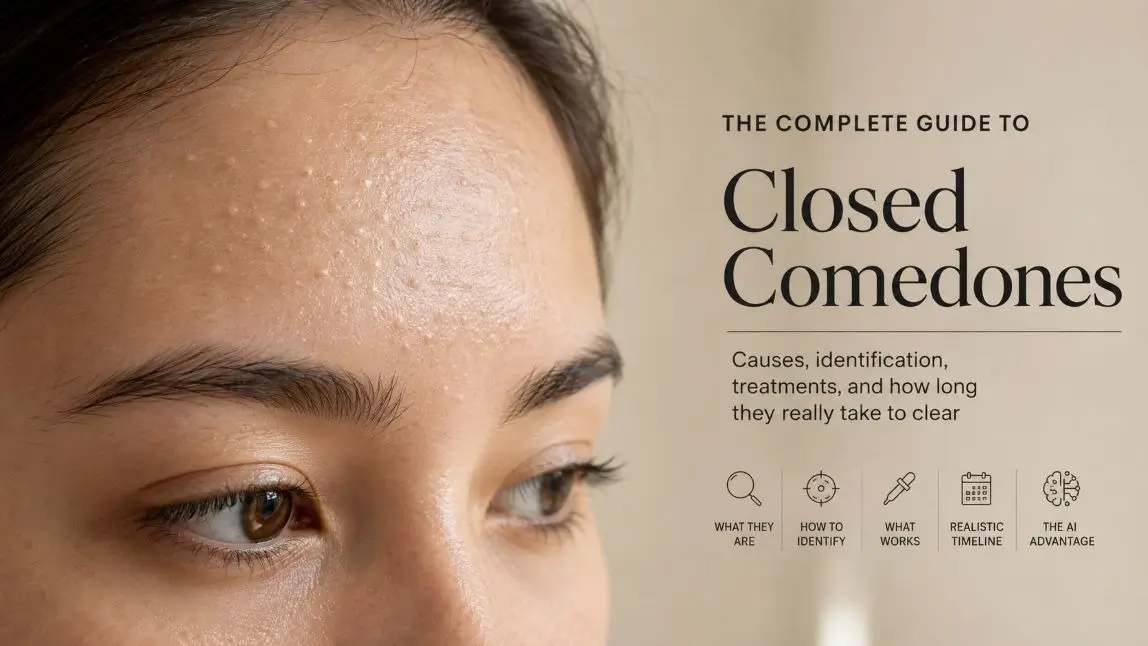
Images generated by YouCam AI
Table of Contents
- What are closed comedones, exactly?
- Is it actually a closed comedone, or something else?
- What causes closed comedones?
- How do you get rid of closed comedones?
- How long do closed comedones take to clear?
- How does AI skin analysis remove the guesswork?
- What does this mean for skincare brands and clinics?
- Closed comedones FAQ
What are closed comedones, exactly?
A closed comedone is a hair follicle that has become plugged with sebum and dead skin cells, then sealed over by a thin layer of skin. Because nothing reaches the air, the plug never oxidizes and never turns dark. The result is a small, firm, flesh-colored bump with no visible opening and no inflammation.
That last part matters. Closed comedones are non-inflammatory acne. There is no bacterial component driving redness, no pus, no pain when you press on them. They are a texture problem before they are a blemish problem, which is exactly why so many people spend months attacking them with spot treatments designed for a completely different type of lesion.
They cluster. You rarely get one. They show up in patches along the forehead, the hairline, the jawline, and the cheeks, and they tend to be more visible in raking light than in a bathroom mirror. Plenty of people only notice them in a car window or a selfie taken near a window.
Closed comedones vs whiteheads: are they the same thing?
This is where most articles get sloppy. Technically, dermatology uses "whitehead" as a synonym for closed comedone. Colloquially, almost nobody means that. When people say whitehead they usually mean a pustule: a red, inflamed bump with a visible white or yellow center full of pus.
The practical difference is what you can see. A true closed comedone has no white center. It is the same color as your skin, and it looks like a bump rather than a spot. If there is a defined white dot you can see from a distance, you are looking at a pustule, and the treatment path is different.
Is it actually a closed comedone, or something else?
Five conditions look close enough to a closed comedone that they get treated interchangeably online. They respond to completely different things. Getting this wrong is the single biggest reason people report that "nothing works."

| Condition | What it looks like | Where it shows up | Key tell | What actually helps |
|---|---|---|---|---|
| Closed comedone | Small flesh-colored bump, no opening, no redness | Forehead, hairline, jaw, cheeks. Clustered | Soft to firm, moves slightly, contents are pale and paste-like | Retinoids, salicylic acid, azelaic acid |
| Milia | Hard white or pearly dot sitting just under the surface | Under eyes, upper cheeks, temples | Does not move, does not extract with pressure, contents are a solid keratin pearl | Professional extraction. Actives do very little |
| Fungal acne | Uniform, same-size small bumps, often itchy | Forehead, hairline, chest, upper back | Itching is the giveaway. True comedones do not itch | Antifungal treatment. Standard acne actives can make it worse |
| Keratosis pilaris | Rough, evenly spaced tiny bumps, sometimes pink at the base | Upper arms, thighs, occasionally cheeks | Sandpaper texture across a wide area, symmetrical on both sides | Urea, lactic acid, gentle chemical exfoliation |
| Sebaceous filaments | Fine grey or tan dots in a regular grid pattern | Nose, inner cheeks, chin | Flat, not raised. They are normal anatomy, not a lesion | Nothing removes them permanently. Salicylic acid softens the look |
Why the squeeze test fails
The internet's favorite diagnostic is to squeeze and see what comes out. It is a bad test for three reasons.

Closed comedones are sealed. There is no exit route, so pressing hard enough to force one open means rupturing the follicle wall. That converts a quiet non-inflammatory bump into an inflamed papule, and often into a mark that outlasts the original bump by months. Milia will not budge at all no matter how hard you press, so people escalate the pressure and bruise the area. And fungal acne spreads when the surface is broken, so squeezing an itchy bump is actively counterproductive.
The better test is observational. Look at distribution, look at uniformity, check whether it itches, and check whether it appeared after a specific product change. Those four signals separate the five conditions above more reliably than any amount of squeezing.
What causes closed comedones?
Closed comedones are a supply and drainage problem. Either the pore is producing more than it can clear, or something is sealing the exit. Usually both.

Pore-clogging ingredients hiding in your routine
This is the cause people miss most often, because they only audit their skincare. The usual culprits sit in three places:
- Rich occlusives and butters. Coconut oil, cocoa butter, isopropyl myristate, and several algae extracts are well documented comedogenic offenders for acne-prone skin.
- Haircare, not skincare. Conditioners, leave-ins, dry shampoos, and styling oils run down the hairline and along the jaw in the shower. If your bumps form a band that traces exactly where your hair falls, this is almost always the answer.
- Long-wear makeup and sunscreen. Not inherently bad, but heavier formulas combined with inconsistent cleansing at night create a reliable pattern.
The tell for a product-driven cause is timing and geography. Product-induced closed comedones tend to appear two to six weeks after a routine change, and they tend to map to where the product actually sits on the face.
Hormones, humidity, and the over-exfoliation trap
Hormonal fluctuation raises sebum output, which is why closed comedones along the jawline often track a monthly cycle. Humidity does something similar by swelling the skin around the pore opening and narrowing the exit.

The trap is what happens next. Frustrated by texture, most people exfoliate harder. Over-exfoliation compromises the skin barrier, and a compromised barrier triggers more oil production and traps debris more easily. You end up with more of the exact thing you were trying to remove. If your bumps got worse in the same period you added a second acid or a scrub, that is not a coincidence.
How do you get rid of closed comedones?
Closed comedones respond to comedolytic ingredients, meaning ingredients that either break down existing plugs or prevent new ones from forming. Everything else is secondary.

| Ingredient | What it does | Best for | Typical time to visible change |
|---|---|---|---|
| Salicylic acid (BHA) | Oil-soluble, gets into the pore and dissolves existing plugs | Oily skin, nose and forehead clusters | 2 to 4 weeks |
| Azelaic acid | Prevents new comedones forming, also calms redness | Sensitive or reactive skin, rosacea overlap | 6 to 12 weeks |
| Adapalene | Retinoid available over the counter in the US, normalizes cell turnover | Widespread comedonal texture | 8 to 12 weeks |
| Tretinoin | Prescription retinoid, the strongest comedolytic option | Persistent cases that have not responded to adapalene | 12 to 16 weeks |
| Professional extraction | Physically clears existing plugs after they have been softened | Stubborn clusters, done alongside a topical | Immediate, but does not prevent recurrence |
One principle runs through all of it: retinoids and azelaic acid prevent, salicylic acid and benzoyl peroxide clear. A routine that only does one half tends to stall. And because closed comedones are non-inflammatory, benzoyl peroxide is a supporting player here rather than the lead, which surprises people who have used it successfully on inflamed acne.
What not to do
Do not stack three actives at once to speed things up. Do not scrub. Do not extract at home. Do not stop at week three because nothing has changed, since almost none of the options above are supposed to have visibly worked by then. And do not add a rich occlusive on top to soothe irritation, because that reintroduces the original problem.
If you want to understand the wider picture of what is happening inside the pore before you commit to a routine, our breakdown of AI skin analysis covers how the individual concerns are scored and tracked.
How long do closed comedones take to clear?
Longer than almost anyone expects. Here is a realistic sequence for someone starting a retinoid.
| Period | What is happening | What you see |
|---|---|---|
| Week 1 to 2 | Cell turnover accelerates, existing plugs start moving toward the surface | Often nothing, sometimes mild dryness |
| Week 2 to 6 | Purging window. Plugs that were already forming surface faster than usual | Temporarily worse texture in the same areas you already had bumps |
| Week 6 to 8 | Purge resolves, prevention effect begins | Fewer new bumps forming, existing cluster starts thinning |
| Week 8 to 12 | Steady clearance | Noticeably smoother texture in raking light |
| Week 12+ | Maintenance | Occasional new bumps rather than clusters |
The week two to six window is where most people quit, because it genuinely looks worse. The distinguishing feature of a purge is that it happens in areas where you already had congestion, and it improves rather than spreads. Bumps appearing somewhere entirely new, six weeks in, are not a purge. That is a reaction, and it is a reason to stop.

This is also the strongest argument for photographing your skin under fixed conditions rather than judging from memory. Texture changes are gradual and the mirror is a terrible instrument for measuring them.
How does AI skin analysis remove the guesswork?
Every step above depends on one thing being correct: knowing what you are actually looking at, and knowing whether it is improving. Both are hard to do by eye.

Perfect Corp's AI Skin Analysis runs 28 diagnostics across 16 skin concerns from a single photo, including pore visibility, surface texture, oiliness, acne, and moisture. It is trained on a database of more than 70,000 medical-grade images across a range of skin tones, ages, and ethnicities, and a clinical study reported a 95% test-retest reliability rate. That reliability number is the one that matters for a condition like this. If the same skin scans to a different score on Tuesday than it did on Monday, the tool is useless for tracking a twelve week timeline.
What it changes in practice:
- Zone-level scoring. Congestion concentrated at the hairline points at haircare. Congestion along the jaw points at hormones. The distribution is diagnostic, and a scored map makes it obvious.
- Objective baselines. A numeric texture and pore score at week zero gives you something to compare against at week eight, instead of relying on whether today's lighting was flattering.
- Session to session tracking. Separating a purge from a genuine reaction is a trend question, not a snapshot question. Two data points answer it. Memory does not.
You can see the pore-specific version of this in action with the AI Pore Checker, or scan your own skin through the free skin analysis demo to see what a full report of 28 diagnostics across 16 concerns looks like.
What does this mean for skincare brands and clinics?
Comedonal texture is one of the highest-frustration categories in skincare, and frustration is expensive. Customers buy the wrong product, see nothing at week three, return it, and conclude the brand does not work. The failure point was almost never the formula. It was the diagnosis and the expectation.

That is a solvable problem, and it is why more than 800 brand partners now run AI-driven skin assessment as part of the shopping and consultation journey rather than as a novelty. Beekman 1802 reported a 50% engagement lift after adding an AI skin experience, and Kanebo's COFFRET D'OR saw a 2.48x increase in time spent on page.
For a med spa or clinic, the value shifts slightly. Clients who scan before an appointment arrive with quantified concerns already surfaced, so the consultation starts from data instead of starting from scratch. For a brand, it means the routine you recommend is grounded in what the customer's skin is actually doing, which is the difference between a one-time purchase and a tracked twelve week journey.
Developers building this into an existing app or site can test the scoring output directly in the API Playground before committing to an integration.
Closed comedones FAQ
Are closed comedones the same as whiteheads?
In clinical terms, yes. In everyday use, no. Most people say whitehead when they mean an inflamed pustule with a visible white center. A closed comedone is flesh-colored, not inflamed, and has no visible opening.
Do closed comedones go away on their own?
Sometimes, slowly, if the trigger is removed. A single closed comedone caused by a heavy moisturizer you stopped using may resolve in a few weeks. Clusters that have been there for months rarely clear without a comedolytic ingredient, because the underlying turnover pattern has not changed.
Should you pop closed comedones?
No. There is no opening, so any attempt to extract at home means rupturing the follicle wall. That turns a non-inflammatory bump into an inflamed one and significantly raises the risk of a lasting mark. Extractions performed professionally after the plug has been softened with a topical are a different situation.
What ingredients cause closed comedones?
Commonly implicated ones include coconut oil, cocoa butter, isopropyl myristate, wheat germ oil, and certain algae extracts. Comedogenicity is individual, though, so ratings are a starting point rather than a rule. Haircare is worth auditing as carefully as skincare.
Can moisturizer cause closed comedones?
Yes, particularly heavy occlusive formulas on oily or humid-climate skin. If bumps appeared within about a month of switching moisturizers and they sit where you apply the most product, the moisturizer is the first thing to change.
Is it closed comedones or fungal acne?
Itch is the fastest tell. Fungal acne is often itchy and the bumps are strikingly uniform in size. Closed comedones do not itch and vary more in size. Fungal acne also tends to appear on the chest and upper back as well as the face.
How do you get rid of closed comedones fast?
There is no genuinely fast route, and the attempts to force one usually backfire. The quickest legitimate path is a salicylic acid product to work on existing plugs plus a retinoid to prevent new ones, with a professional extraction if a cluster is stubborn. Expect four to eight weeks before the change is obvious.
Why do I keep getting closed comedones in the same spot?
Recurrence in one location usually means a persistent local cause rather than a skin-wide one. Hairline means haircare. Jawline means hormones or a phone screen. One cheek only means a pillowcase or a sleeping position. Zone-level analysis makes this pattern much easier to see than a mirror does.
Can AI tell the difference between closed comedones and milia?
AI skin analysis scores concerns such as pore visibility, texture, and acne rather than issuing a clinical diagnosis. What it does well is quantify the severity and map the distribution, which narrows the possibilities considerably and gives a practitioner objective data to work from. A definitive diagnosis still belongs to a dermatologist.
The takeaway
Closed comedones are stubborn, but they are not mysterious. They are sealed pores, they respond to comedolytic ingredients, and they take roughly twelve weeks rather than twelve days. The step most people skip is the first one: confirming that the bumps are closed comedones at all, rather than milia, fungal acne, or perfectly normal sebaceous filaments. Get that right and the rest of the plan follows. Get it wrong and no amount of consistency will save the routine.