


 Author: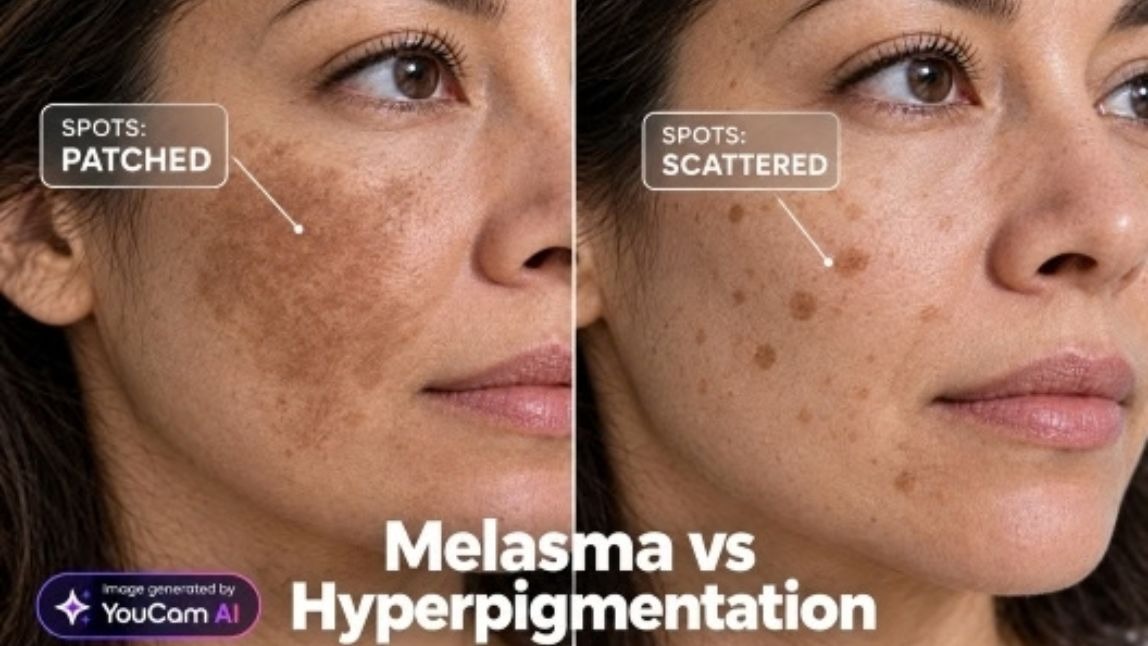
Images generated by YouCam AI
Both are brown. Both sit on the cheeks. Both get treated with the same brightening serum, and one of them frequently gets worse. Melasma is a specific kind of hyperpigmentation with its own triggers, its own treatment rules and a habit of rebounding when handled aggressively, and the thing that separates it from ordinary dark spots is not colour at all. It is pattern. This guide covers how to read that pattern, the triggers most articles leave out, why the standard pigment playbook backfires here, and how a AI skin analysis maps pigment distribution rather than just detecting that pigment exists.
What this guide covers
What Is the Difference Between Melasma and Hyperpigmentation?
Melasma is one type of hyperpigmentation, not a separate thing. Hyperpigmentation is the umbrella term for any excess melanin: sun spots, post-acne marks, freckles, melasma. What makes melasma distinct is its pattern, symmetrical patches with irregular borders on the cheeks, forehead, upper lip and jaw, and its drivers, which include hormones and heat rather than sun alone.
So the useful question is never "is it melasma or hyperpigmentation". It is "which kind of hyperpigmentation is this", and the answer comes from where it sits and what shape it makes.
What Is Hyperpigmentation, and What Types Are There?
| Type | What it looks like | Driven by |
| Solar lentigines (sun spots, age spots) | Discrete round or oval brown spots with defined edges | Cumulative UV exposure. Appear on the face, hands, chest, shoulders |
| Post-inflammatory hyperpigmentation | Marks that map exactly onto where spots, cuts or rashes were | Inflammation, then sun exposure that locks it in |
| Freckles (ephelides) | Small, light brown, scattered, darken in summer and fade in winter | Genetics plus sun |
| Melasma | Larger symmetrical patches with irregular, map-like borders | Hormones, UV, visible light and heat together |
| Drug induced pigmentation | Diffuse or patterned, sometimes grey or blue-grey | Certain medications. Worth raising with a clinician |
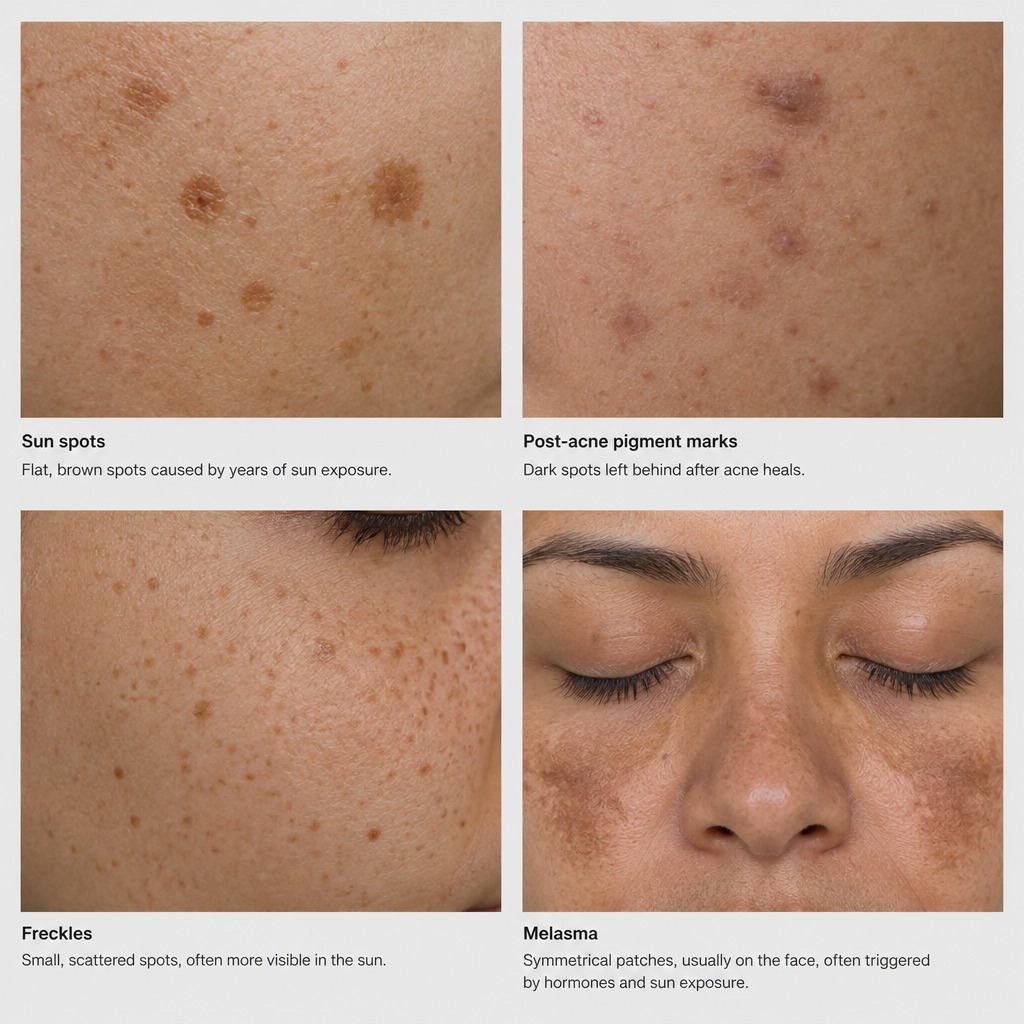
Colour is the least reliable clue on this table. All of them can be brown. Distribution is what tells them apart, which is also why a photo read for pattern beats a person squinting at a mirror.
What Is Melasma?
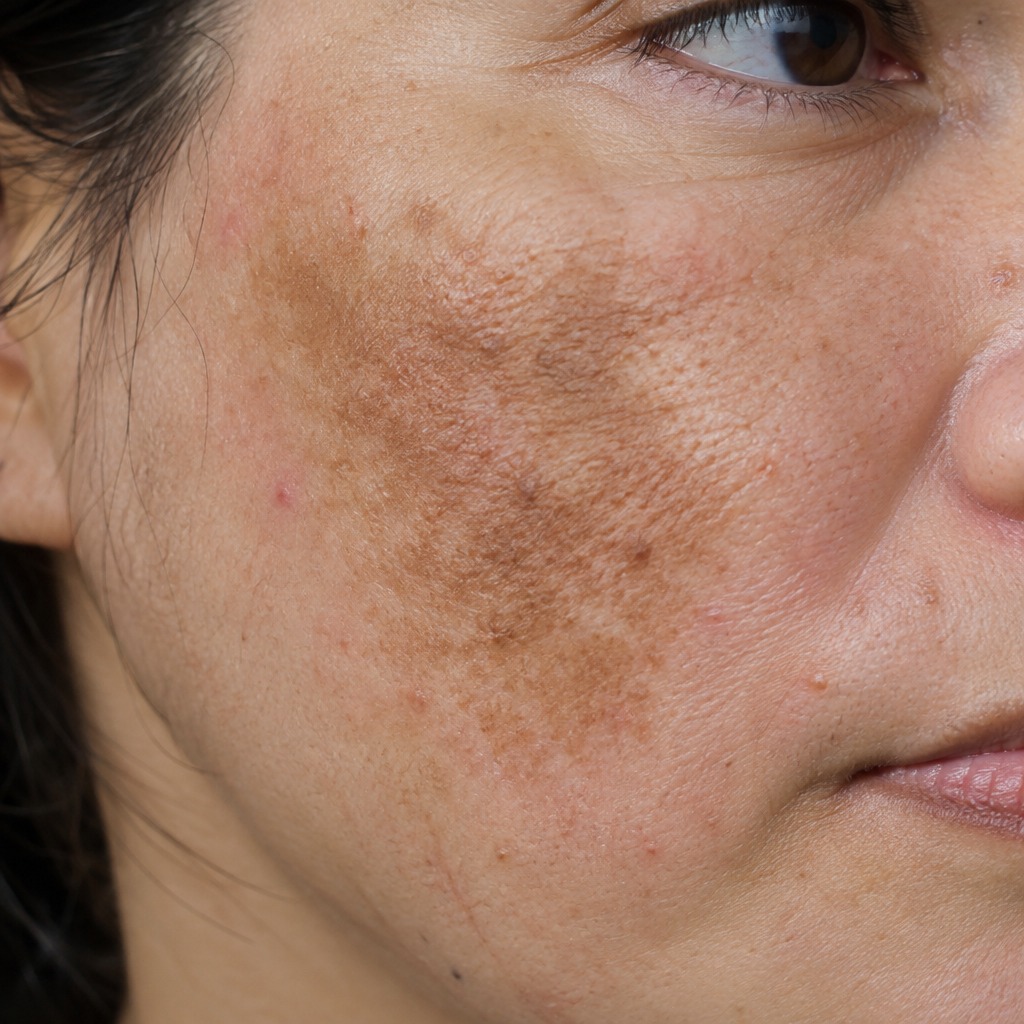
Melasma is a chronic pigmentary condition that produces symmetrical brown or greyish-brown patches, most often across the cheeks, the forehead, the bridge of the nose, the upper lip and sometimes the jawline. It affects women far more often than men, and it has a strong association with hormonal change, which is why it is commonly known as the mask of pregnancy and why it frequently appears or worsens on hormonal contraception.
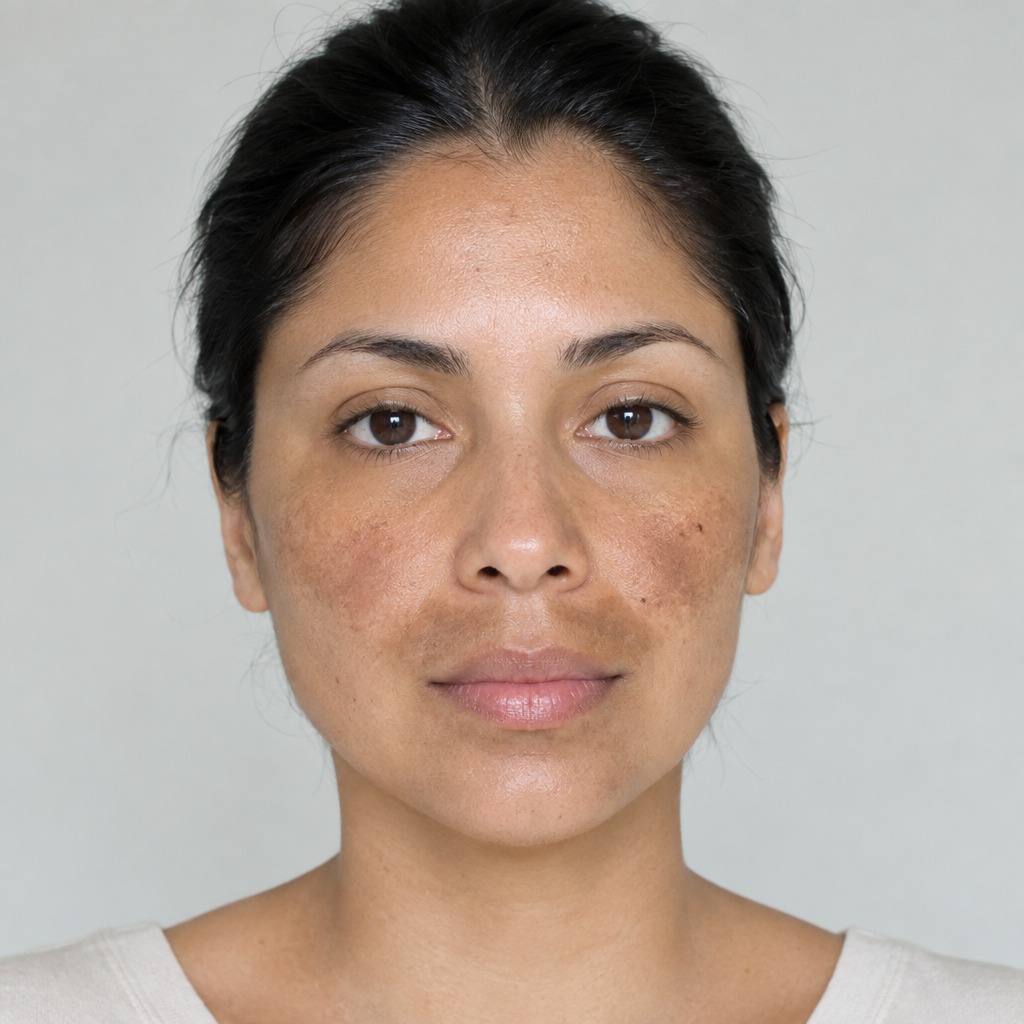
Three things make it different in practice from ordinary sun spots:
- It is symmetrical. Patches appear in broadly mirrored positions on both sides of the face.
- It recurs. Melasma is managed rather than cured, and it commonly returns after successful clearing, especially after a summer or a hormonal change.
- It is provoked by more than UV. Visible light and heat both trigger it, which most sun protection advice ignores entirely.
How Do You Tell Melasma from Other Dark Spots?
Four questions, in order of how much they settle.
| Question | Points to melasma | Points to other hyperpigmentation |
| What shape is it? | Broad patches with irregular, map-like borders | Discrete round spots with defined edges, or marks that match past breakouts |
| Is it symmetrical? | Yes, mirrored on both sides | Usually not. Sun spots follow exposure, marks follow old lesions |
| Where is it? | Cheeks, forehead, upper lip, nose bridge, jaw | Anywhere sun-exposed, including hands and chest |
| What was happening when it started? | Pregnancy, hormonal contraception, a hot climate, a summer | Years of sun, or a specific spot or injury that healed |
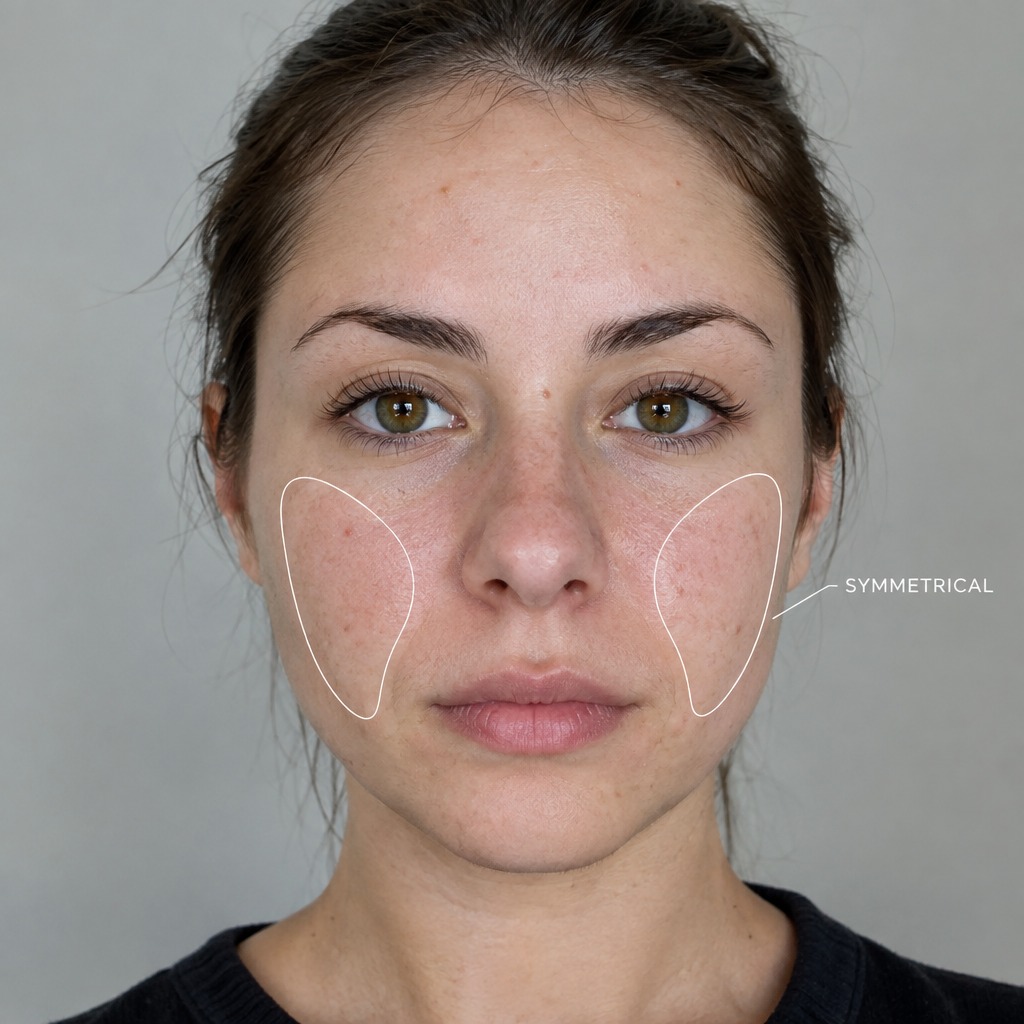
Two supporting clues. Melasma on the hands or chest is unusual, so pigment there points elsewhere. And post-acne marks can be traced back: if you can remember the spot that was in that exact position, the mark is PIH rather than melasma.
What Triggers Melasma That People Miss?
This is the section that changes outcomes, because the standard advice stops at "wear sunscreen" and melasma does not stop at UV.
| Trigger | Why it matters | What to do |
| Visible light | Melasma responds to visible light, including from screens and indoor lighting, which standard UV filters do not block | Use a tinted sunscreen containing iron oxides, which is the practical way to block visible light |
| Heat | Infrared and ambient heat can provoke it independently of light. Hot yoga, saunas, cooking over a stove, hot climates | Manage heat exposure the way you manage sun. It is a real and underrated factor |
| Hormones | Pregnancy, combined oral contraception and hormone therapy are common onset points | Worth a conversation with a clinician, particularly if onset coincided with starting something |
| Friction and irritation | Rubbing, harsh exfoliation and irritating actives can worsen patches | Gentle handling. This is not a concern you scrub |
| UV | Still the largest single driver | Broad spectrum SPF 30 or higher, daily, reapplied, all year |
The tinted sunscreen point is the single most actionable line in this article. A clear mineral or chemical sunscreen handles UV and lets visible light through, and for melasma specifically, iron oxide tint is what closes that gap.
How Does a Skin Analysis API Map Pigment Distribution?
By scoring where pigment sits, not only that it is present, which is the exact information the melasma question turns on.
The AI Skin Analysis returns 15 dermatologist verified concerns from a single selfie as separate scored values, with zone level detail. For pigment, the relevant reads are:
| Signal | What it captures | What it suggests |
| Spots, by zone | Pigmented area and its position across the face | Broad, symmetrical, cheek and forehead loading leans melasma. Scattered discrete loading leans sun damage |
| Spots alongside acne history | Pigment coinciding with lesion-prone zones | Post-inflammatory marks rather than melasma |
| Redness | Erythema, scored separately from pigment | Distinguishes red post-acne marks from brown ones, and flags inflammation that would make melasma worse |
| Fitzpatrick type | Skin tone classification | Sets the risk context. Melasma and post-inflammatory pigment are both more common and more stubborn in deeper tones |
Running Fitzpatrick classification in the same flow is not a nice-to-have for pigment work. Treatment aggressiveness has to scale down as tone deepens, because the same peel that clears a sun spot on type II can trigger fresh post-inflammatory pigment on type V. A pigment recommendation engine that ignores tone will eventually make someone's skin worse.
The usual limits apply and matter more here than elsewhere: this reads appearance, not diagnosis, and pigment scores are brutally sensitive to white balance. Compare scans taken in the same room, at the same time of day, with filters off, or you are measuring your bulbs.
How Is Melasma Treated?
Gently, consistently and with the expectation of management rather than cure.
| Approach | What it does | Notes |
| Tinted broad spectrum sunscreen | Blocks UV and, via iron oxides, visible light | The foundation. Nothing else works reliably without it |
| Tranexamic acid, topical or oral | Interrupts the pigment pathway upstream | Oral forms are prescription and need medical supervision |
| Azelaic acid | Reduces pigment and calms inflammation | Well tolerated, pregnancy friendly in many cases, worth confirming with a clinician |
| Cysteamine | Pigment inhibition | An alternative for people who cannot use hydroquinone |
| Hydroquinone | Strong pigment suppression | Effective, prescription in many markets, used in cycles under supervision |
| Niacinamide, vitamin C | Supporting roles | Useful adjuncts, rarely enough alone |
| Gentle chemical peels | Surface pigment clearing | Conservative strength only, and with caution on deeper tones |
| Lasers | Selective pigment targeting | Specialist territory. Wrong settings cause rebound worse than the original |
How Is Other Hyperpigmentation Treated?
| Type | First line | Escalation |
| Sun spots | Daily SPF, vitamin C, retinoid, alpha arbutin | Targeted laser or cryotherapy, generally straightforward |
| Post-inflammatory hyperpigmentation | SPF, azelaic acid, tranexamic acid, retinoid, plus treating the acne itself | Gentle peels, with caution on deeper tones |
| Freckles | Sun protection if you want them lighter | Usually left alone, they are not a health concern |
Notice how much more permissive this table is. Ordinary sun spots tolerate aggressive treatment. Melasma does not, and that difference is the reason misidentifying it is expensive.
Why Does Aggressive Treatment Backfire on Melasma?
Because melasma is an inflammatory-reactive condition as much as a pigmentary one. Aggressive exfoliation, high-energy laser settings and irritating actives all create inflammation, and inflammation is itself a pigment trigger. The result is the pattern every dermatologist sees: three weeks of apparent clearing, then a return that is darker and broader than the starting point.
Practical rules that follow:
- Escalate slowly and stop at the first sign of irritation.
- Treat heat and visible light as seriously as UV.
- Expect to maintain, not to finish. Stopping everything after clearing is the most common route to recurrence.
- Get a professional involved before any laser. This is the treatment most likely to make melasma worse in inexpert hands.
How Long Does Each One Take?
| Condition | First visible change | Realistic horizon |
| Sun spots | 8 to 12 weeks on topicals | 4 to 6 months, or one session of targeted treatment |
| Post-inflammatory hyperpigmentation | 6 to 12 weeks | 3 months to 2 years, tone dependent |
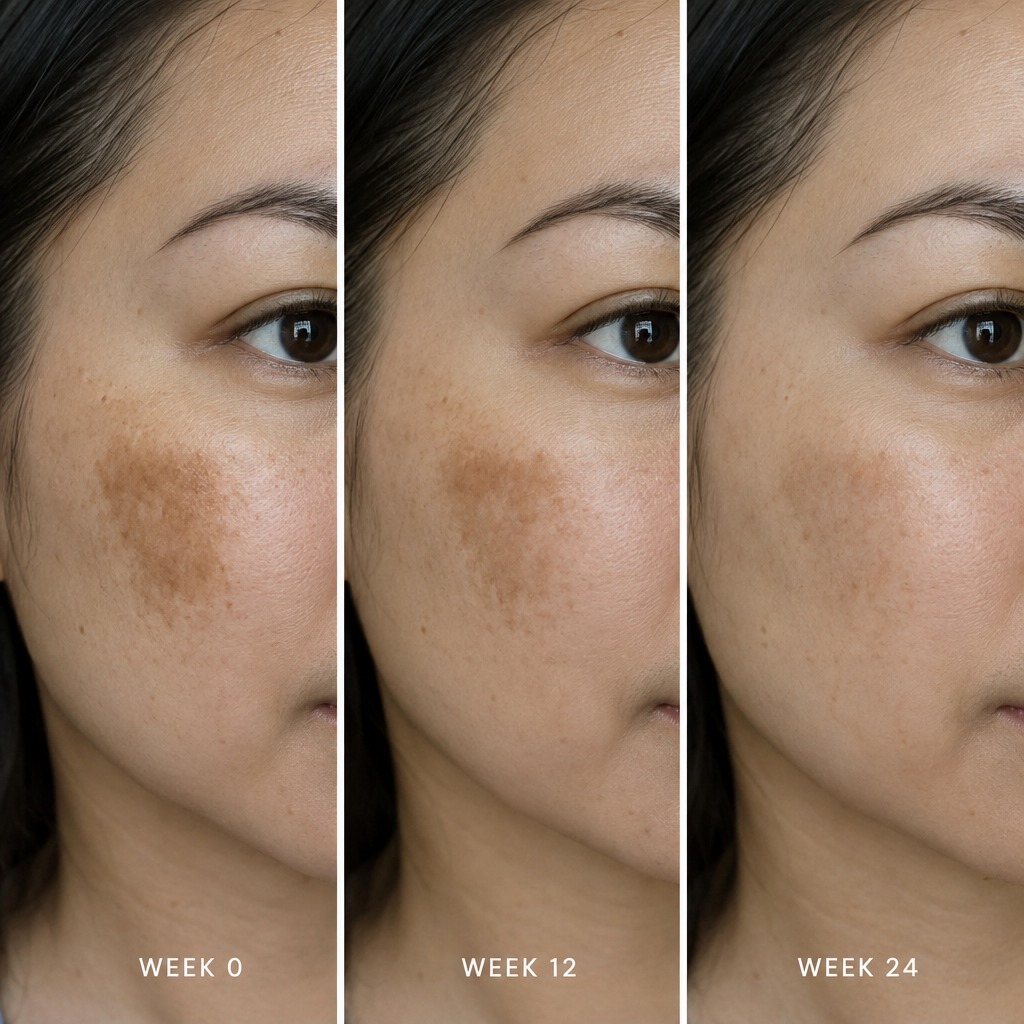
| Melasma | 8 to 12 weeks | 6 to 12 months to control, then ongoing maintenance |
| Melasma without strict photoprotection | Little to none | Recurrence is the expected outcome |
How Do Teams Build Pigment Routing with an API?
Pigment is the highest volume concern in most skincare catalogues and the one where a generic recommendation does the most damage, because the same product set is genuinely wrong for one of the subtypes.
| Spot pattern | Redness | Fitzpatrick | Route the customer to |
| Scattered, discrete, sun-exposed zones | Low | Any | Standard brightening path. Vitamin C, retinoid, SPF. Escalation is safe |
| Broad, symmetrical, cheeks and forehead | Low | Any | Melasma-aware path. Tinted SPF with iron oxides, azelaic or tranexamic acid, gentle only. Suppress strong peels |
| Coinciding with acne-prone zones | Any | Any | Post-inflammatory path. Treat the acne alongside the pigment |
| Any pigment pattern | Any | Type IV to VI | Cap treatment aggressiveness. Prioritise tolerability to avoid creating new pigment |
| Pigment plus elevated redness | High | Any | Calm first. Treating pigment on inflamed skin creates more pigment |
Two more notes for implementation. Tinted sunscreen should be surfaced automatically in the melasma branch rather than left to the customer to discover, since it is the one product that changes the outcome. And re-scan quarterly, not weekly, because pigment moves on a months-long scale and a weekly score will be dominated by lighting noise.
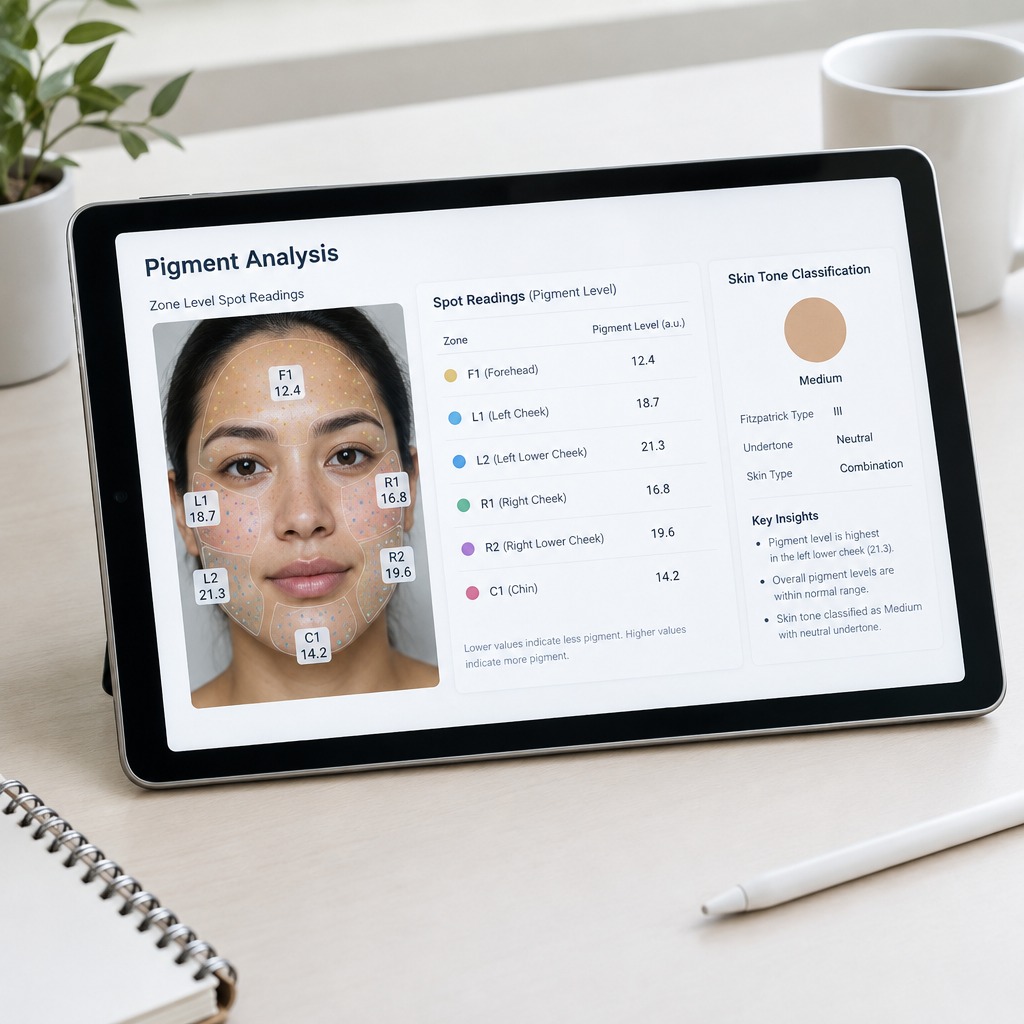
You can test the scoring against real images in the YouCam AI API Playground before writing integration code, and our guide to telling a mole from a dark spot covers the identification case that sits next to this one. Perfect Corp works with 800+ brand partners on flows of this kind.
Melasma vs Hyperpigmentation FAQ
What is the difference between melasma and hyperpigmentation?
Melasma is a type of hyperpigmentation. The umbrella term covers any excess melanin, including sun spots, post-acne marks and freckles. Melasma is distinguished by symmetrical patches with irregular borders and by triggers that include hormones, heat and visible light.
How do I know if my dark spots are melasma?
Look at shape and symmetry rather than colour. Melasma forms broad map-like patches mirrored on both sides of the face, usually on cheeks, forehead, upper lip and nose bridge. Discrete round spots with defined edges are sun spots. Marks that line up with old breakouts are post-inflammatory.
Can melasma be cured?
It is managed rather than cured. It responds to treatment and commonly recurs, particularly after sun exposure or hormonal change, so the realistic goal is control plus ongoing maintenance rather than a finish line.
Why does my melasma come back every summer?
UV, visible light and heat all provoke it, and all three peak in summer. Year round tinted sunscreen with iron oxides, plus managing heat exposure, is what shortens the seasonal swing.
Does regular sunscreen protect against melasma?
Only partly. Standard filters handle UV but let visible light through, and melasma responds to visible light too. A tinted sunscreen containing iron oxides is the practical way to cover both.
Can men get melasma?
Yes, though far less often. The presentation is the same, and the hormonal association is weaker, with sun and heat playing a larger relative role.
Why did my melasma get worse after a peel?
Because melasma reacts to inflammation, and aggressive treatment creates inflammation, which creates pigment. Rebound after over-treatment is a well known pattern, which is why conservative escalation is the rule here.
Does melasma appear on the body?
Rarely. It concentrates on the face, and occasionally the forearms and neck. Pigment on the hands and chest is much more likely to be sun damage.
Can a skin analysis API detect melasma?
It scores pigmented areas and their distribution across facial zones, which is the pattern information the distinction depends on. It should present that as a pattern that routes product advice, not as a diagnosis, and it should run alongside skin tone classification so treatment aggressiveness scales safely.
How often should I re-scan pigment?
Quarterly, in the same room at the same time of day with filters off. Pigment shifts over months, and white balance changes between two photos can easily exceed the real change in your skin.
Read the Pattern, Not the Colour
Brown tells you almost nothing. Symmetrical map-like patches on the cheeks and forehead point one way and demand gentleness, tinted protection and patience. Discrete round spots point the other way and tolerate a much more direct approach. Getting that read right before you escalate is the difference between fading pigment and manufacturing more of it. For teams building the recommendation, the same rule holds: score pigment distribution and skin tone together, branch on the pattern, and cap aggressiveness where the risk of rebound is real.
Test the skin analysis API in the YouCam AI Playground, or contact Perfect Corp for a demo to see how pigment and tone scoring fit your customer flow.



 English


