 Author:



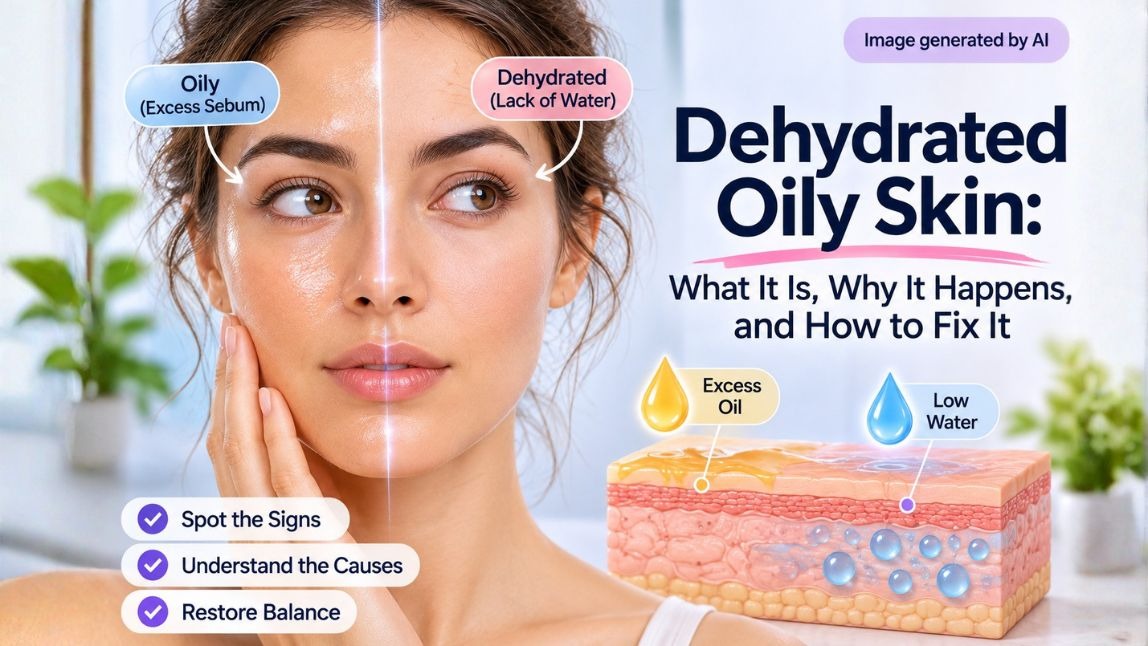
Images generated by AI
Dehydrated oily skin sounds like a contradiction, which is exactly why it goes unrecognised. Skin that produces too much oil is supposed to be the well supplied kind. Skin that is short of water is supposed to be the flaky, tight kind. Being both at once reads as impossible, so people pick whichever symptom is louder, usually the shine, and treat that. The treatment then makes the other half worse.

The resolution is simple once stated. Oil and water are separate. Sebum is produced by glands. Hydration is water held in the outer layer of the skin. A face can be awash with the first and short of the second, and when it is, every instinct about what to do next is wrong.
What Is Dehydrated Oily Skin?
Dehydrated oily skin is skin producing excess sebum while its outer layer holds too little water. It is a condition rather than a skin type, which is the most practically useful thing to know about it: types are relatively fixed, conditions are temporary and respond to what you do.
| Oiliness | Hydration | |
|---|---|---|
| What it is | Sebum, a lipid, produced by sebaceous glands | Water held in the stratum corneum |
| What governs it | Gland density, genetics, hormones, temperature | Barrier integrity, humectants, humidity, what you wash with |
| Type or condition | Largely a type. Shifts slowly with age | A condition. Shifts in days |
| How it looks | Shine, visible pores, makeup sliding | Dullness, tightness, fine surface crepiness, flaking |
| Can you have both problems? | Yes. They are measured separately because they are separate | |
If you have not yet separated these two ideas, the difference between dry and dehydrated skin is the groundwork. Dry is a type, short of oil. Dehydrated is a condition, short of water. Oily and dehydrated is the pairing that breaks most people's mental model.
How Do You Know If Your Oily Skin Is Dehydrated?
The signs are specific enough to be useful, and most of them are things people already notice without connecting them.
| Sign | Why it happens | What it rules out |
|---|---|---|
| Shiny but dull at the same time | Oil reflects light, dehydrated surface scatters it. You get gloss without glow | Simple oiliness, which usually looks bright rather than flat |
| Tight right after cleansing, oily by midday | The cleanser stripped water, the glands compensated | Dry skin, which stays tight all day |
| Fine lines that appear and vanish | Dehydrated skin creases. Rehydrated skin plumps back | Genuine wrinkles, which do not come and go overnight |
| Makeup clings to patches on an oily face | Dehydrated areas grip pigment while oily areas reject it | Plain oiliness, where base slides uniformly |
| Oil control products make it worse | Removing more oil removes more water with it | Under treatment. The problem is not that you are doing too little |
| Flaking next to shine | Barrier damage in one area, compensating oil in another | Combination skin, where the split follows the T and U zones instead |
The fifth row is the diagnostic one. If the routine designed to reduce oil is increasing it, the problem is almost never insufficient oil control. It is a barrier that has been stripped and is responding exactly as it should.

What Causes Dehydrated Oily Skin?
Most of the causes are things done to the skin rather than things the skin does.
| Cause | Mechanism | How fast it reverses |
|---|---|---|
| Foaming or stripping cleansers | Remove sebum and barrier lipids together, so water escapes faster | Days to two weeks |
| Over exfoliation | Thins the barrier, raising water loss without reducing gland output | Two to four weeks |
| Alcohol heavy toners and mattifiers | Dry the surface, prompting compensatory oil | One to two weeks |
| Skipping moisturiser because skin is oily | The single most common self inflicted cause in this category | Days |
| Low humidity, heating, air conditioning | Raises water loss from the surface regardless of routine | Managed, not reversed |
| Hot water and long showers | Strips lipids and raises water loss | Days |
| Retinoids started too fast | Barrier disruption before tolerance is built | Two to four weeks after adjusting frequency |
Row four is worth sitting with. A large share of dehydrated oily skin is created by people who skipped moisturiser on the reasonable sounding logic that oily skin does not need it. Oily skin needs water like any other skin. What it does not need is a heavy occlusive, which is a texture question rather than a whether question.
Why Does Stripping Oily Skin Make It Oilier?
Because the barrier reports water loss, and oil is part of how it responds. Remove surface lipids aggressively and the skin registers increased water loss from the outer layer, which triggers compensatory activity to slow it. The practical result is familiar: the face is squeaky clean at 8am and visibly slick by noon, and the obvious conclusion, that the cleanser is not strong enough, is backwards.
Disruption of the stratum corneum barrier initiates a repair response in which lipid synthesis is upregulated, so measures that acutely strip surface lipids can be followed by increased output rather than reduced output.Elias, P. M., Stratum corneum defensive functions: an integrated view, Journal of Investigative Dermatology
This is why the sequence matters more than the products. Hydrate and repair first, then reduce oil. Doing it the other way round means fighting a barrier that is actively working against you.
How Do You Treat Dehydrated Oily Skin?
The routine is shorter than the one most people with this condition are already running, which is usually the first thing worth saying to them.
| Step | What to use | What to avoid |
|---|---|---|
| Cleanse | A gentle, non foaming, pH balanced cleanser, lukewarm water, once or twice daily | Sulphates, scrubs, hot water, cleansing twice in the morning |
| Hydrate | Humectants on damp skin. Glycerin, hyaluronic acid, panthenol | Applying humectants to dry skin in low humidity, which can pull water the wrong way |
| Repair | Ceramides, niacinamide, fatty acids in a light fluid or gel cream | Skipping this because the skin feels oily already |
| Seal, lightly | A lightweight moisturiser. Gel cream or fluid, not a balm | Heavy occlusives on an oily T zone |
| Protect | Broad spectrum SPF in a fluid or gel finish, daily | Skipping it because it feels greasy. Change the finish, not the habit |
| Pause | Strong actives, for two to four weeks | Adding a new active to fix the problem the last one caused |
What to stop doing immediately
Three things, and they are free. Stop using a foaming cleanser twice a day. Stop exfoliating more than twice a week until the tightness is gone. Stop treating moisturiser as optional on an oily face. Most people see a difference from those three alone within two weeks, which is faster than any product will deliver.
How Long Does It Take to Rehydrate Oily Skin?
Faster than almost anything else in skincare, which is the good news in this whole article.
| Timeframe | What changes |
|---|---|
| 3 to 7 days | Tightness after cleansing settles. Fine dehydration lines soften |
| 2 weeks | Oil output starts to normalise as the barrier stops compensating |
| 4 weeks | Measurable change in both oiliness and moisture readings. The natural first checkpoint |
| 8 to 12 weeks | Barrier fully settled. Actives can be reintroduced carefully from here |
Four weeks is the interval worth building a routine around. It is long enough for real change and short enough that the person is still following the routine when the evidence arrives, which is more than can be said for pigment or firmness programmes.
How Does a Skin Analysis API Detect Dehydrated Oily Skin?
It detects it by returning oiliness and moisture as two independent values rather than inferring one from the other. That sounds trivial and is the entire mechanism. Most assessments, including every quiz that asks how your face feels after cleansing, collapse oil and hydration into a single skin type answer, and dehydrated oily skin is precisely the case that collapse destroys.
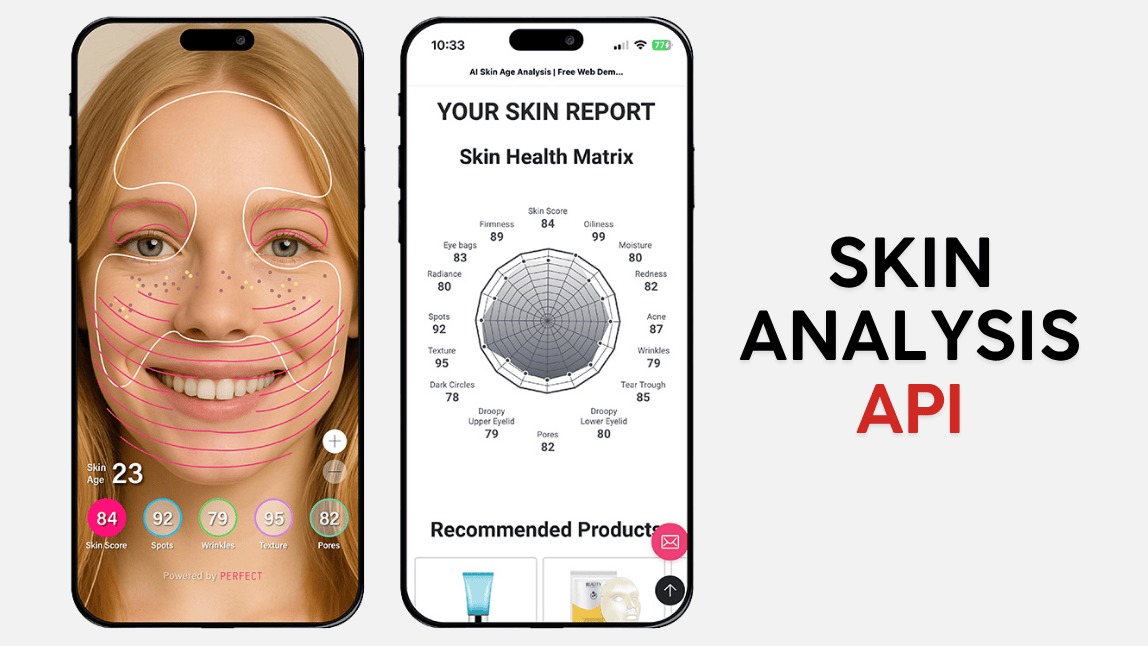
The YouCam Skin Analysis API returns both within a set of 28 diagnostics across 16 skin concerns, alongside the readings that explain what is driving them.
| Reading | What it contributes to this condition |
|---|---|
| Oiliness | Severity of surface oil, scored on its own |
| Moisture | Surface hydration, scored on its own. Low alongside low oiliness is the signature |
| Skin type, T zone and U zone | Separates this condition from ordinary combination skin |
| Redness | Flags a barrier that is irritated rather than simply dry |
| Texture | Rough surface alongside low moisture points to dehydration rather than congestion |
| Pore, by region | Confirms whether oil output is genuinely elevated or just reflecting light |
For a brand the commercial case is blunt. A customer in this state, sold a clay mask and a foaming cleanser on the strength of a shine complaint, will be worse in a month and will blame the products. The moisture reading is what turns that into a hydrating serum recommendation instead, which is both the correct advice and the one less likely to come back. The live skincare demo shows the oiliness and moisture pair in the same result.
How Do You Track Recovery?
Measure both values, at the same time of day, on a bare face. Oiliness alone will look worse before it looks better, because the barrier takes a couple of weeks to stop compensating, and a customer who only sees that number will quit at week two.
| Check | Oiliness | Moisture | Read it as |
|---|---|---|---|
| Week 2 | Flat or slightly worse | Improving | On track. Moisture moves first |
| Week 4 | Improving | Improving | Working. Hold the routine |
| Week 4 | Worse | Flat | Something in the routine is still stripping. Simplify further |
| Week 8 | Improved | Stable | Barrier settled. Reintroduce actives slowly |
Telling customers in advance that moisture improves before oiliness does is the single cheapest retention intervention available in this category. It converts the week two plateau from a reason to quit into evidence that the plan is working.
Which Ingredients Actually Help?
Short list, and the ordering matters more than the brand on the bottle. Humectants pull water in, barrier ingredients stop it leaving again, and a light occlusive holds the result in place. Miss the middle step and the first one washes out by lunchtime.
| Ingredient | Job | Why it suits an oily face |
|---|---|---|
| Glycerin | Humectant. Draws water into the outer layer | Works at low concentrations in weightless textures |
| Hyaluronic acid | Humectant. Holds water at the surface | Apply to damp skin and seal, or it can work against you in dry air |
| Panthenol | Humectant and soothing agent | Helps the redness that often travels with a stripped barrier |
| Niacinamide | Supports barrier function, moderates visible oil | The rare ingredient that addresses both halves of this condition |
| Ceramides | Replace the barrier lipids that cleansing removed | Available in gel creams, so no heavy texture required |
| Squalane | Light emollient that seals without weight | Mimics skin lipids and does not read as greasy |
Niacinamide is the one to notice. It supports barrier recovery while moderating the appearance of oil, which makes it unusually well suited to a condition defined by needing both at once.

Related Concerns Worth Checking
Dehydrated oily skin rarely arrives alone, and the concerns clustered around it change what the routine should prioritise.
| Concern | Relationship | Where to read more |
|---|---|---|
| Damaged barrier | Usually the underlying cause rather than a separate problem | Damaged skin barrier |
| Facial redness | Appears when the barrier is irritated as well as dry | Facial redness |
| Dull skin | The scatter from a dehydrated surface is what makes oily skin look flat | Dull skin |
| Rough texture | Dehydration roughens the surface without any congestion present | Skin texture |
| Enlarged pores | Look larger when surrounding skin is dehydrated and less plump | Large pores |
| Skin purging | Worth ruling out before blaming a new hydrating product for breakouts | Purging vs breakout |
When Should You See a Professional?
This condition is usually self correcting once the routine stops causing it. A few signs point elsewhere: tightness and flaking that persist after four weeks of gentle care, redness that spreads or burns rather than simply looking pink, cracking or weeping skin, and sudden changes in oil output with no change in products, climate or medication. Any of those belong with a clinician rather than with another serum.
An AI skin analysis is a cosmetic assessment intended to guide product choice and track visible change. It is not a diagnosis, and a persistent barrier problem deserves a professional opinion.
Dehydrated Oily Skin FAQ
Can oily skin really be dehydrated?
Yes. Sebum is oil produced by glands. Hydration is water held in the outer layer of skin. They are separate measurements and a face can be high on one and low on the other.
Is dehydrated oily skin the same as combination skin?
No. Combination skin is a difference between zones, usually an oily T zone and drier cheeks. Dehydrated oily skin is a shortage of water that can affect any or all zones, including an oily one. You can have both at once.
Should I still use a moisturiser if my skin is oily?
Yes, and skipping it is one of the most common causes of this condition. Choose a gel cream or fluid rather than a balm. The question is texture, not whether.
Will drinking more water fix it?
Not by itself. Surface hydration depends mostly on barrier function and on the humectants and light occlusives applied to the skin. Drinking water supports general health but does not replace barrier repair.
Why does my skin get oilier after I use a mattifying product?
Because many mattifiers are alcohol based and remove water along with oil. The barrier registers the loss and compensates. If oil control products reliably make your skin oilier, that is the signature of this condition.
Can I use salicylic acid on dehydrated oily skin?
Eventually, and sparingly. Pause it for two to four weeks while the barrier recovers, then reintroduce at a lower frequency on the areas that need it rather than across the whole face.
How is this different from dry skin?
Dry skin lacks oil. Dehydrated skin lacks water. Dry skin is a type and stays tight all day. Dehydrated oily skin is tight after cleansing and shiny by midday, which is the combination that gives it away.
Does an AI skin analysis measure hydration directly?
It estimates surface hydration from the image alongside oiliness, returning both as independent scores. It is a cosmetic assessment rather than a laboratory instrument, but the pairing is what identifies this condition, and it is repeatable enough to track recovery over weeks.
Stop Removing Oil, Start Replacing Water
Dehydrated oily skin is one of the few skincare problems where doing less is the treatment. The routine that caused it is almost always longer, harsher and more expensive than the one that fixes it, and the fix shows up in days rather than months.
Get the moisture reading alongside the oiliness reading, stop stripping, replace the water, and give the barrier four weeks. If your oil control routine has been making your skin oilier, this is why, and it is the easiest thing in skincare to reverse.