 Author:


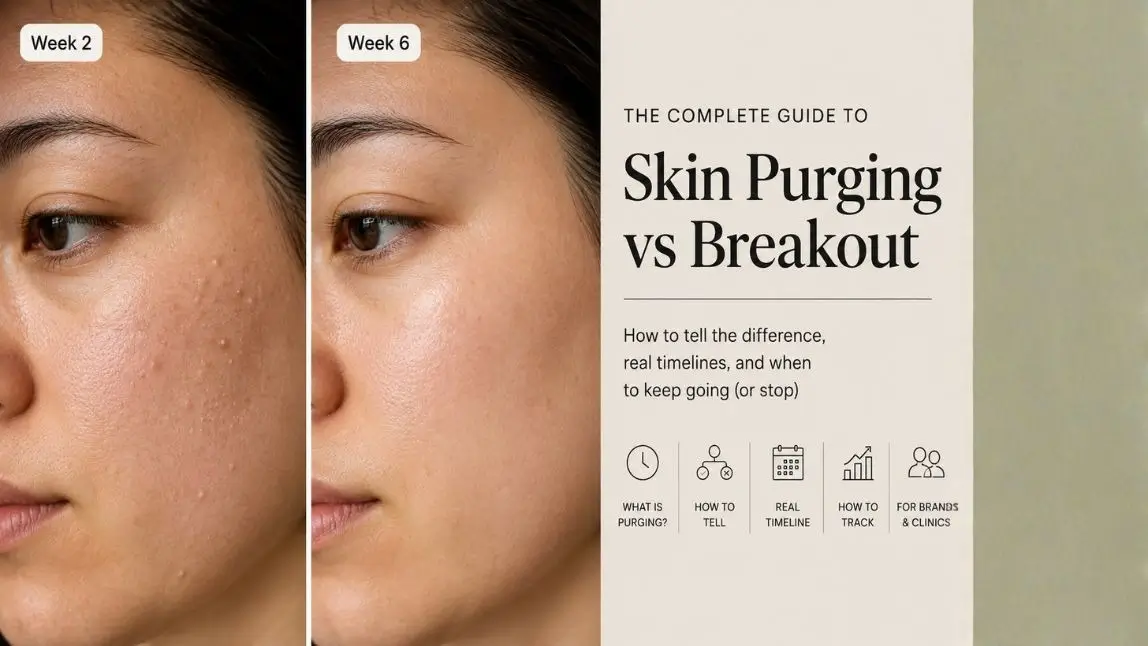
You started a new retinoid two weeks ago. Your skin looks worse than it did before you began. Now you are standing in front of the mirror trying to decide whether to push through or throw the bottle out. This is the single most common crossroads in skincare, and most people guess wrong in both directions: they quit a product that was about to work, or they persist with one that is quietly damaging their barrier. Purging and breaking out look nearly identical. They are separated by timing, location, and trajectory, not by appearance. This guide gives you a decision framework, a realistic week by week timeline, and a way to measure the difference instead of guessing at it.
Table of Contents
- What is skin purging, and why does it happen?
- How do you tell purging from a breakout?
- Which ingredients actually cause purging?
- How long does skin purging last?
- When should you stop using the product?
- How do you track it objectively?
- Why purging is a retention problem for brands
- Skin purging FAQ
What is skin purging, and why does it happen?
Skin purging is a temporary worsening of congestion caused by an ingredient that speeds up cell turnover. The plugs surfacing were already forming beneath the skin. The product did not create them. It shortened the time it took them to appear.

That distinction is the whole story. Every pore on your face is somewhere in a cycle that normally takes around 28 days. Underneath the surface right now are microcomedones you cannot see and would have met four to eight weeks from now anyway. A retinoid compresses that timeline. What would have trickled out over two months arrives over two weeks instead.
Which means purging is not detoxing, and your skin is not pushing out impurities. It is the same amount of congestion delivered faster. That framing matters, because it explains why purging has a hard ceiling. Once the existing backlog has surfaced, it is finished. A reaction has no such ceiling.
How do you tell purging from a breakout?
Four questions separate them. You need three of four pointing the same way before you commit to an answer.

| Signal | Purging | Breakout or reaction |
|---|---|---|
| Location | Areas where you already got congestion | New territory you rarely break out in |
| Timing | Starts within 1 to 3 weeks of a new active | Can start at any point, including months in |
| Lesion type | Small surface bumps and whiteheads that come to a head fast | Deeper, slower, sometimes cystic or painful |
| Trajectory | Peaks, then steadily improves | Flat or worsening over successive weeks |
| Accompanying signs | Mild dryness or flaking | Stinging, burning, itching, hives, tightness |
Trajectory is the most reliable of the five and the one people are worst at judging, because it requires comparing today against three weeks ago from memory. Location is the second most reliable and the easiest to check. If bumps have appeared along your cheekbones and you have never broken out on your cheekbones in your life, that is not a purge no matter how recently you started the product.
The signals that are not diagnostic
Severity tells you nothing. A heavy purge can look worse than a mild reaction. Redness tells you very little on its own, since both can be red. And the number of bumps is unhelpful, because purge volume scales with how congested you already were, which you could not see.
Which ingredients actually cause purging?
Only ingredients that increase cell turnover can cause a true purge. That is a short list.
- Retinoids. Tretinoin, adapalene, retinol, retinaldehyde. The most common cause by a wide margin.
- Hydroxy acids. Salicylic acid, glycolic acid, lactic acid, mandelic acid.
- Benzoyl peroxide. Less consistently, but it happens.
- Azelaic acid. Occasionally, and usually mildly.
- Certain professional treatments. Chemical peels and some laser resurfacing.

Now the useful half. If your skin got worse after starting a moisturizer, a vitamin C serum, a niacinamide product, a cleanser, or a sunscreen, that is not a purge. Those ingredients do not accelerate turnover, so there is no mechanism. Something in that formula is either clogging or irritating, and continuing in the hope that it settles is the wrong call.
This single rule resolves a large share of the confusion online. People report purging from products that are chemically incapable of causing one, then wait eight weeks for an improvement that was never going to come.
How long does skin purging last?
The commonly repeated answer is four to six weeks. That is roughly right for the purge window itself, but it undersells the full arc.
| Period | What is happening | What you see |
|---|---|---|
| Week 1 | Turnover accelerating, nothing has surfaced yet | Usually nothing. Occasionally mild dryness |
| Week 2 to 4 | Existing microcomedones reaching the surface | Peak of the purge. This is the quit point for most people |
| Week 4 to 6 | Backlog clearing faster than new congestion forms | Visible turn. Fewer new bumps each week |
| Week 6 to 12 | Prevention effect establishing | Clearer than your original baseline |
A purge that has not started improving by week eight is not a purge. That is the practical cutoff. And if you are still at week twelve with no net gain over baseline, the product is not working for you regardless of what it is doing mechanically.

One nuance that gets lost: purge severity correlates with how much congestion you had to begin with. Someone with significant closed comedones will have a dramatic purge. Someone with mostly clear skin adding a retinoid for aging will often have almost none. A heavy purge is not a sign the product is strong. It is a sign your starting point was congested.
When should you stop using the product?
Stop immediately, without waiting out any timeline, if you see any of the following:
- Burning or stinging that does not fade within minutes of application
- Hives, welts, or swelling
- Itching, which points at an allergic response or a fungal component rather than a purge
- Bumps spreading to areas that have never been congested
- Skin that feels tight, shiny, and raw, which suggests a compromised barrier rather than turnover

If none of those apply and it is week three, hold. Reduce frequency rather than stopping outright. Twice a week with a bland moisturizer buffer will get you through the same purge more slowly and far more comfortably than nightly application followed by quitting in frustration at week four.
If you are unsure whether you are dealing with a purge at all rather than a different condition entirely, our guide to telling similar skin marks apart covers the same identification-first principle applied to pigmentation.
How do you track it objectively?
Every rule above depends on comparing two points in time. Human memory is very bad at this. People consistently report their skin is worse than it was, right up until they see a photo from four weeks earlier.

Perfect Corp's AI Skin Analysis scores 15 concerns from a single photo, acne and texture among them, and it is built on a database of more than 70,000 medical-grade images spanning a range of skin tones and ages. A clinical study reported 95% test-retest reliability, which is the figure that matters for this use case. A tool that scores the same skin differently on consecutive days cannot tell you whether a trend is moving.
Three things it makes possible that a mirror does not:
- A baseline you did not have to remember. Scan on day one, before the purge starts. Most people only think to document after things go wrong, by which point there is nothing to compare against.
- Zone-level distribution. The location test is the single most reliable purge signal, and a scored facial map answers it precisely rather than impressionistically.
- A trend line rather than a snapshot. Purging peaks and falls. Reactions do not. That shape is only visible across several data points.
You can run a scan on your own skin through the free AI skin analysis demo to see what a 15-concern report looks like before committing to a routine change.
Why purging is a retention problem for brands
Week three is where retinoid customers churn. The product is doing exactly what it is supposed to, the customer sees their skin looking worse, and the return gets processed before the mechanism ever had a chance to prove itself.
The formula rarely fails here. The expectation does. A customer who is told to expect a two to four week worsening phase, and who can see week zero next to week three in objective terms, behaves completely differently from one navigating it by feel.

This is part of why more than 800 brand partners have moved AI skin assessment into the core of the customer journey rather than treating it as an acquisition gimmick. Beekman 1802 reported a 50% engagement lift after adding an AI skin experience, and Kanebo's COFFRET D'OR saw a 2.48x increase in time on page. Engagement is the leading indicator. The lagging indicator is that customers who can measure progress stay through the phase where progress is invisible.
For teams building this into an existing app or storefront, the concern scoring is available directly through the YouCam API Playground, and the enterprise deployment sits in the AI Skin Analysis product.
Skin purging FAQ
How long does skin purging last?
Typically four to six weeks from the point it starts, with the peak usually falling somewhere in weeks two to four. If it has not begun improving by week eight, treat it as something other than a purge.
Can a moisturizer cause purging?
No. Purging requires accelerated cell turnover, and moisturizers do not do that. If a moisturizer made your skin worse, it is either clogging your pores or irritating them. Both are reasons to stop rather than persist.
Does vitamin C cause purging?
Not in the true sense. Vitamin C is an antioxidant, not a turnover accelerator. Some formulations are acidic enough to irritate sensitive skin, and irritation can trigger breakouts, but that is a different mechanism with a different answer: adjust the formula or the frequency.
Should I stop using tretinoin if I am purging?
Usually not, but you can slow down. Dropping to two or three nights a week and buffering with a plain moisturizer gets you through the same adjustment with less disruption. Stop entirely only if you are seeing burning, itching, swelling, or spread into areas you have never broken out in.
Is purging worse before it gets better?
Yes, by definition. That is the shape of a purge. It is also the reason the trajectory test is the most useful one: a genuine purge has a peak and then declines, whereas a reaction stays flat or keeps climbing.
What does purging look like?
Small surface bumps and whiteheads that form and resolve faster than your usual breakouts, concentrated in the areas where you already tend to get congestion. It rarely produces deep cystic lesions. If what appeared is deep, slow, and painful, look elsewhere for the cause.
Can you purge from a chemical peel?
Yes. Peels accelerate turnover in the same way topical acids do, so the same two to six week window and the same rules apply.
Why is my purge lasting longer than six weeks?
Two common explanations. Either you were significantly more congested at baseline than you realized, which extends the backlog, or the product is doing something other than purging. The distinguishing question remains trajectory. Improving slowly is still improving. Flat is not.
The takeaway
Purging is a real, mechanically specific phenomenon, and it only applies to a short list of ingredients. Location, timing, and trajectory answer the question far more reliably than how bad your skin looks today. The reason so many people get it wrong is not that the rules are complicated. It is that applying them requires comparing your skin now against your skin a month ago, and nobody can do that from memory. Photograph it, score it, or track it. Then the decision makes itself.