 Author:



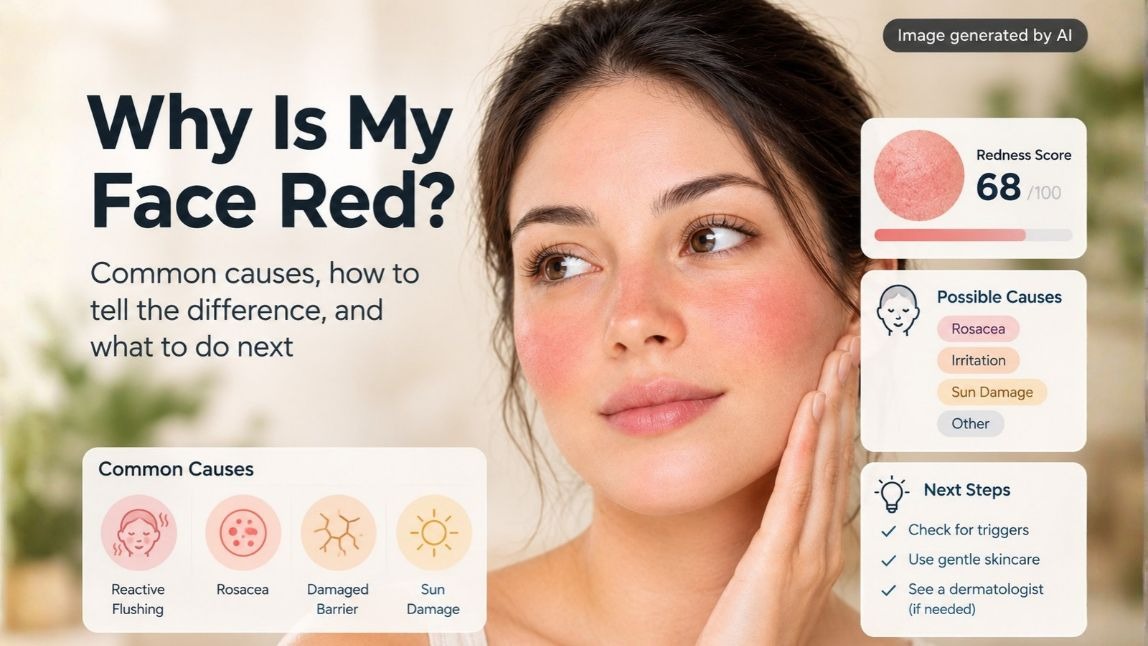
Image generated by YouCam AI
A red face is one symptom covering a dozen causes, and the useful work is narrowing it down rather than treating it. Some facial redness is a normal response that resolves in twenty minutes. Some is a chronic condition affecting roughly one adult in twenty. Some is a barrier you damaged yourself with products bought to fix it. They look similar in a mirror and need completely different responses.
This guide sorts them. You can also see how redness reads as a measurable value rather than an impression in the AI skin analysis, which scores redness independently of pigment as part of 28 skin diagnostics across 16 skin concerns, which is the distinction most of this article turns on.

What this guide covers
Why Is My Face Red?
Because blood vessels near the surface of facial skin are either dilated, inflamed, or more visible than usual. That is the mechanism behind almost every cause on this page. What differs is why the vessels are behaving that way, and the answer sits in one of four buckets: a normal temporary response, an inflammatory condition, a barrier problem, or a structural change in the vessels themselves.
The face is unusually prone to this. It has a dense superficial vascular network, thin skin over much of it, and more exposure to sun, wind and temperature swings than anywhere else on the body. A flush that would be invisible on your forearm is obvious on your cheeks.
How Do You Sort the Causes Quickly?
Three questions get you most of the way, and they take a minute.
| Question | If yes | If no |
|---|---|---|
| Does it come and go within hours? | Reactive flushing or an early vascular tendency | Persistent erythema, a condition or a barrier problem |
| Does your skin sting or burn with products you used to tolerate? | A damaged barrier is involved, whatever else is | Barrier is probably intact. Look at triggers and conditions |
| Does it blanch when you press it? | Vascular, so it is genuinely redness | Likely pigment rather than redness, despite the colour |
That third test is worth doing before anything else. Press firmly on the area for a few seconds and lift. If the colour vanishes and refills, you are dealing with blood vessels. If it stays while the skin around it blanches, you are dealing with pigment, and our guide to telling red blotchiness from brown covers that path instead.
What Are the Most Common Causes of Facial Redness?
| Cause | What it looks like | Telling detail | Timeline |
|---|---|---|---|
| Reactive flushing | Diffuse red across cheeks, nose, sometimes neck and chest | Arrives in minutes, fades in under an hour | Normal and temporary |
| Rosacea | Persistent central face redness, sometimes with bumps or visible vessels | The flush stops going away completely between triggers | Chronic, managed not cured |
| Damaged skin barrier | Patchy redness with tightness, stinging and flaking | Products that never bothered you now sting | 2 to 6 weeks to repair |
| Irritant or allergic contact reaction | Redness with a shape, often following where a product was applied | Edges match application, not anatomy | Days after removing the cause |
| Seborrhoeic dermatitis | Redness with fine greasy scale around nose, brows and hairline | Flaking rather than smooth redness | Chronic, flares and settles |
| Sunburn and cumulative sun damage | Acute burn, or background redness with visible vessels over years | Follows exposure, worse on the side you drive on | Days, or permanent |
| Post inflammatory erythema | Flat pink marks where spots used to be | Blanches on pressure, traces your breakout history | 3 to 6 months |
| Eczema or atopic dermatitis | Red, itchy, sometimes weeping or thickened patches | Itch is the dominant symptom | Chronic, flares |
| Cold and wind exposure | Mottled red and white pattern | Resolves as the skin warms | Within the hour |
| Menopause and hormonal change | Flushing episodes, often with heat | Timing lines up with other changes | Episodic |
| Medication reactions | Flushing or a rash, depending on the drug | Started after a new prescription | Discuss with the prescriber |
| Underlying medical conditions | Varies, sometimes with symptoms elsewhere | Redness plus joint pain, fatigue or a body rash | Needs assessment |
Most people reading this are in the first three rows. The last one is rare, but it is the reason the section on when to see a doctor exists.
Is It Rosacea?
Possibly, and more likely than most people assume. Rosacea is common enough that it accounts for a meaningful share of persistent facial redness in adults, particularly from the mid forties onward.
A systematic review and meta analysis pooling 32 studies across 41 populations and more than 26 million individuals estimated the prevalence of rosacea in the general population at 5.46 percent, with women at 5.41 percent and men at 3.90 percent, and most cases occurring between the ages of 45 and 60. The authors also found that prevalence depended heavily on the diagnostic method, with self reported rosacea producing higher estimates than clinical diagnosis.Gether L, Overgaard LK, Egeberg A, Thyssen JP. Incidence and prevalence of rosacea: a systematic review and meta-analysis. British Journal of Dermatology, 2018;179(2):282 to 289. doi:10.1111/bjd.16481
The practical signal that separates rosacea from ordinary flushing is persistence. Everyone flushes. What distinguishes rosacea is that the baseline shifts, so the redness no longer fully clears between episodes, and over time visible vessels, bumps or pustules may join it.
| Pattern | Ordinary flushing | Rosacea |
|---|---|---|
| Between episodes | Returns to normal colour | A background redness remains |
| Location | Cheeks, often neck and chest too | Central face, cheeks, nose, chin, forehead |
| Over years | Stable | Tends to progress without management |
| Other signs | None | Visible vessels, bumps, pustules, eye irritation |
| Sensation | Warmth | Burning or stinging is common |
If there are bumps involved, telling rosacea from acne matters because the treatments conflict, and our comparison of rosacea and acne covers that in detail. Note the meta analysis point above as well: self diagnosis over reports this condition, so a suspicion is a reason to get assessed rather than a conclusion.
What Triggers Facial Redness?
Triggers are individual, but they are not random, and the pattern across a large patient group is strikingly consistent.
In a survey of 1,066 rosacea patients, the factors most often reported as triggering symptoms were sun exposure at 81 percent, emotional stress at 79 percent, hot weather at 75 percent, wind at 57 percent, heavy exercise at 56 percent, alcohol at 52 percent and hot baths at 51 percent. Skin care products were named by 41 percent and cosmetics by 27 percent.Rosacea Triggers Survey, National Rosacea Society, based on 1,066 patients. The organisation notes that triggers vary between individuals and that the list covers only the most common ones.
Three things are worth drawing out of those numbers. Sun exposure tops the list, which makes daily sun protection the single highest value habit for anyone with a red face. Emotional stress sits second and is the one people most often dismiss. And skin care products are named by two in five, which is a reminder that the routine bought to calm redness is frequently contributing to it.

| Trigger category | Examples | What to do about it |
|---|---|---|
| Light and weather | Sun, wind, hot weather, cold weather, humidity | Daily SPF, a barrier cream before cold exposure |
| Heat | Hot baths, saunas, indoor heating, hot drinks | Lukewarm water, let drinks cool, lower the thermostat |
| Ingested | Alcohol, spicy food, hot beverages | Track rather than eliminate. Most people have one or two culprits |
| Physical | Heavy exercise | Do not stop exercising. Cool down, hydrate, train in cooler conditions |
| Emotional | Stress, embarrassment, anxiety | Underrated and difficult, but it ranks second for a reason |
| Topical | Skin care products, cosmetics, harsh cleansers | The most fixable category on this list |
The useful exercise is a two week log rather than a guess. Note what you did and how your face looked, and the two or three factors that actually matter for you will separate from the dozen that do not.
Is It a Damaged Skin Barrier Instead?
This is the most common cause among people who use a lot of skincare, and the most commonly misread, because the instinctive response makes it worse.
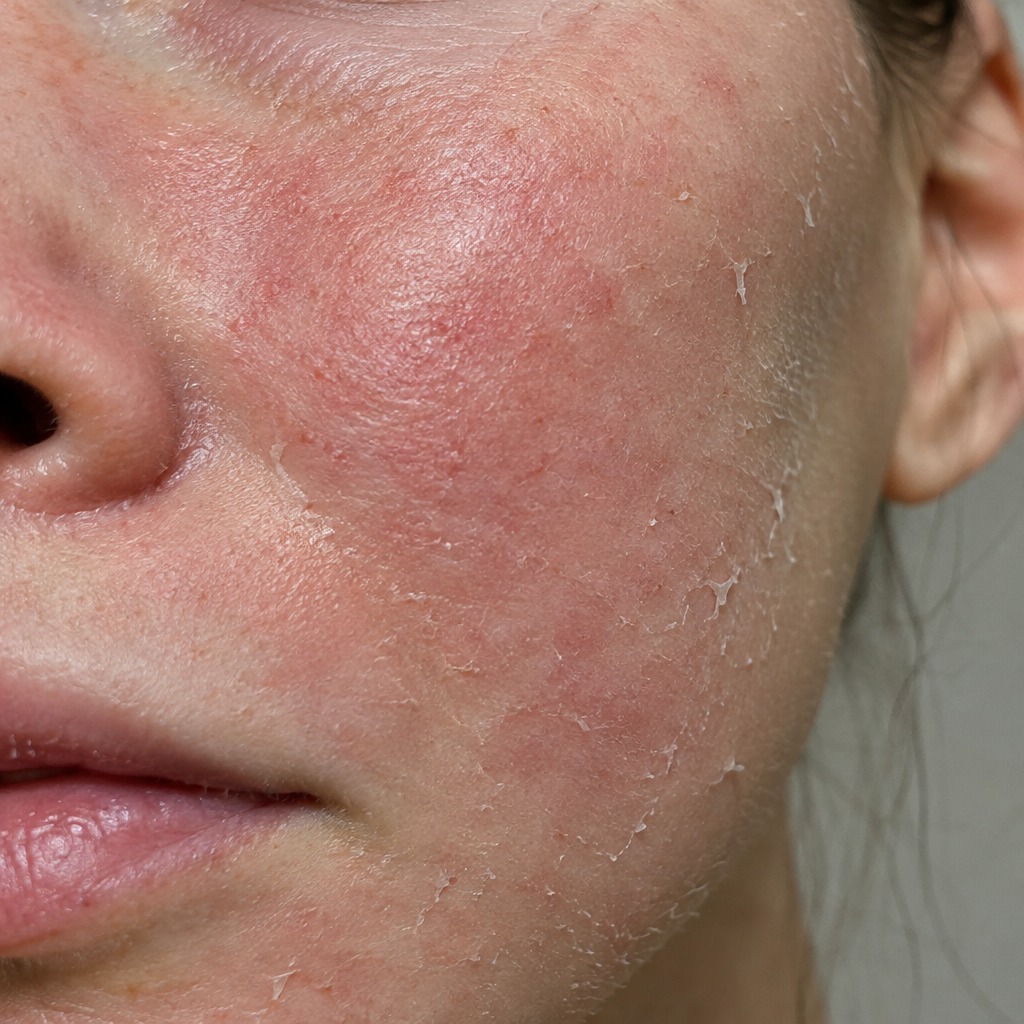
The signature is specific. Redness arrives along with tightness after cleansing, a stinging or burning sensation from products that never used to bother you, flaking that gets worse rather than better with more moisturiser, and sometimes a shiny or waxy appearance. If several of those apply, the problem is not that your skin needs more treatment. It is that it has had too much.
| What people do | What it causes | What to do instead |
|---|---|---|
| Exfoliate the flaking | Removes more of a barrier that is already thin | Stop all exfoliation until stinging has gone for a full week |
| Add a stronger active | Escalates the irritation driving the redness | Strip back to cleanser, moisturiser, sunscreen |
| Switch to a redness product | Another new ingredient on reactive skin | Change nothing except removing things, for two weeks |
| Cleanse more often | Further lipid loss | Once daily with something gentle, lukewarm water |
Our guide to a damaged skin barrier sets out the repair sequence properly. The short version is that doing less is the treatment, and it works within two to six weeks.
Does Facial Redness Look Different on Darker Skin?
Yes, and this is under discussed to the point of being a genuine clinical problem.
On deeper skin tones, erythema often does not present as pink or red at all. It can read as warmth, as a violet or dusky tone, or simply as an area that looks darker than the surrounding skin. The inflammation is identical. Its visible signature is not. The practical consequences are that redness driven conditions are under recognised on darker skin, that people are more likely to be told their concern is pigment when it is vascular, and that photographs under poor lighting make it harder still.
Research published in Science Advances, built on a curated, biopsy confirmed image set spanning Fitzpatrick I to VI, found that dermatology algorithms trained largely on lighter skin performed measurably worse on darker skin, and that the gap narrowed once models were tuned on more diverse data. The study's authors noted specifically that features such as erythema appear different on dark versus light skin, which is precisely why both clinicians and software need to be trained on the full range.Daneshjou R, Vodrahalli K, Novoa RA, Ko J, Swetter SM, Zou J, Chiou A, et al., Disparities in dermatology AI performance on a diverse, curated clinical image set, Science Advances, 2022, doi:10.1126/sciadv.abq6147
If you have deeper skin and have been told your redness is pigment, the press test in the sorting section is worth doing yourself. Blanching under pressure indicates a vascular process regardless of what colour it appears.
How Does a Skin Analysis API Score Redness?
As an independent value, which is the part that matters. Redness and pigment produce the same complaint from a customer, uneven tone, and need opposite treatments, so a system that blends them into one evenness number cannot route anyone correctly.
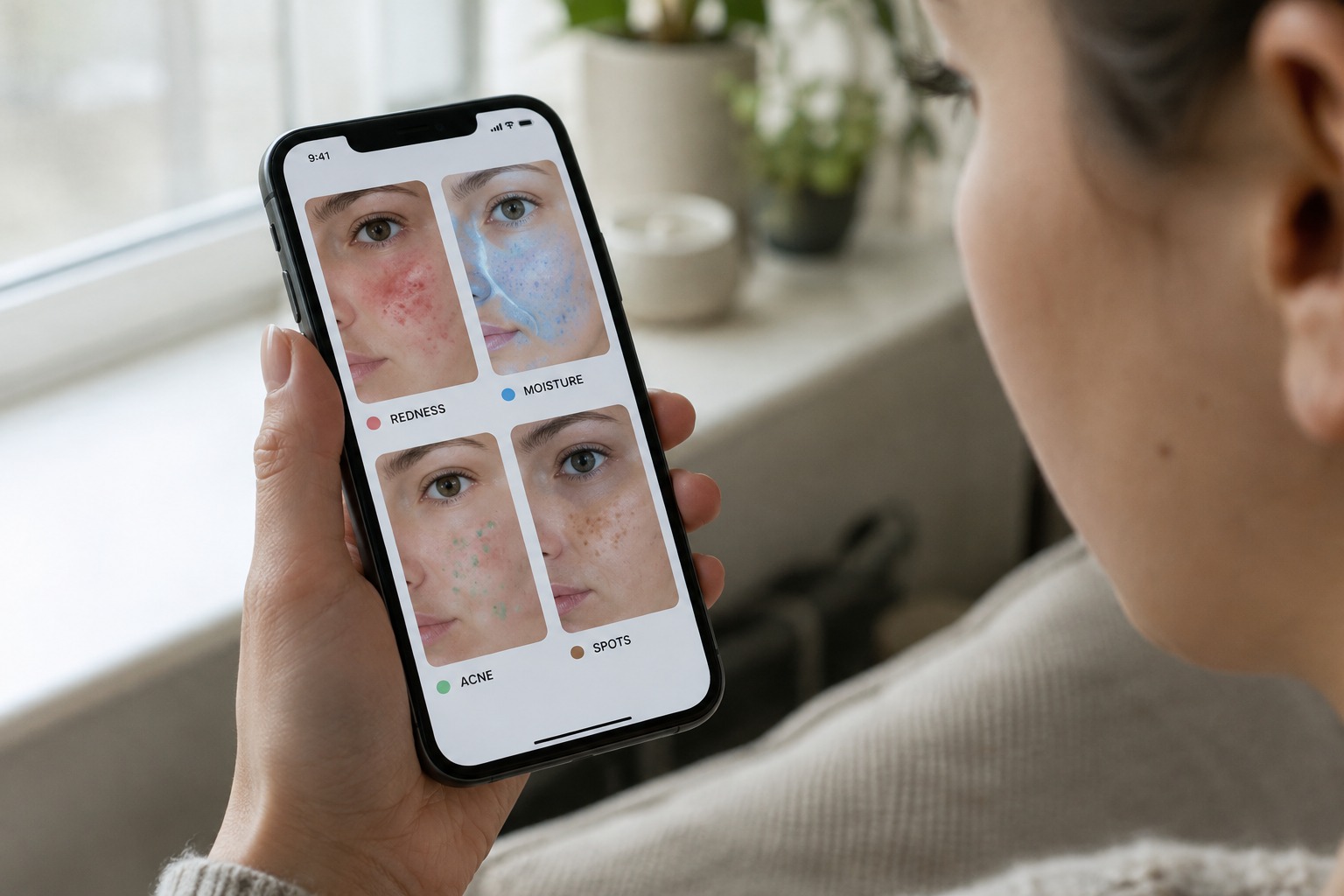
The YouCam AI Skin Analysis API returns redness as its own score alongside 28 skin diagnostics across 16 skin concerns, dermatologist verified. Read in combination with three other values, it stops describing a symptom and starts naming a cause.
| Redness | Alongside | Most likely reading |
|---|---|---|
| Elevated | Low moisture | Compromised barrier. Repair before anything else |
| Elevated | Normal moisture and texture | Trigger driven flushing or a vascular tendency |
| Elevated | High acne | Inflammatory rather than congestive. Do not escalate actives |
| Normal | High spots | Pigment, not redness, whatever it looks like |
| Elevated and persistent across scans | Matched lighting each time | The pattern worth taking to a professional |
Two honest limits. These are estimates from visible signs rather than measurements of the tissue, and redness is the most capture sensitive score on any skin report, because it genuinely changes within the hour. A reading taken after a hot shower, a workout or a glass of wine describes the last sixty minutes, not your skin.

That volatility is also what makes it useful. Redness moves faster than almost any other concern, so if you scan under consistent conditions, it is the score most likely to show you whether what you changed is working. You can see the full grouped output, including where redness sits relative to moisture and acne, in the skin analysis demo.
Why Is My Face Red Only in Certain Places?
Location is a real clue, though less mystical than face mapping charts suggest.
- Cheeks and nose, centrally. The classic rosacea distribution, and also where ordinary flushing shows most.
- Around the nose, brows and hairline, with flaking. Points toward seborrhoeic dermatitis rather than rosacea.
- Around the mouth only. Can indicate a specific type of dermatitis, often linked to topical steroid use, and is worth getting looked at.
- Where a product was applied. Edges that match application rather than anatomy indicate contact irritation.
- Where something touches your face. Straps, masks, phones and hands produce friction redness in their own shape.
- Exactly where spots used to be. Post inflammatory erythema, which fades over months and is not a new problem.
- One side more than the other. Frequently sun exposure. The driving side of the face accumulates more.
When Should You See a Doctor?
- Redness that no longer fully settles between episodes, which is the point at which rosacea is most treatable.
- Redness with pain, swelling, warmth or fever, which may indicate infection rather than a cosmetic concern.
- Any rash that is spreading, blistering, or accompanied by symptoms elsewhere such as joint pain or fatigue.
- Eye irritation, grittiness or redness alongside facial redness, which can indicate ocular involvement.
- Redness that appeared after starting a new medication.
- Anything that has not improved after six to eight weeks of gentle, consistent care.
- Visible vessels that are becoming permanent, since these respond to in clinic treatment and not to skincare.
Early assessment matters more here than in most skin concerns, because the conditions behind persistent redness tend to progress and because several of the effective treatments are prescription only.
What Should You Do Today?
If you take one thing from this page, make it the two week subtraction. Reduce your routine to a gentle cleanser, a plain moisturiser and a daily broad spectrum sunscreen. Change nothing else. Add nothing. Two weeks of that will resolve a surprising share of facial redness outright and, for everything it does not resolve, it gives you a clean baseline from which the actual cause is far easier to identify.
Alongside it, keep a short trigger log and protect against sun every day, since sun exposure tops the trigger list by a wide margin. Our companion guide covers what actually reduces facial redness, ranked by evidence, once you know which kind you are dealing with.
Run a scan in the skin analysis demo to see your redness scored separately from pigment, test the API in the YouCam AI Playground, or contact Perfect Corp if you are building redness scoring into a customer experience.

Why Is My Face Red FAQ
Why is my face red all the time?
Persistent redness that does not settle between episodes points to a chronic cause rather than ordinary flushing, most commonly rosacea, a damaged skin barrier, or seborrhoeic dermatitis. The distinguishing question is whether your skin also stings with products, which points to the barrier.
Why does my face get red for no reason?
There is usually a reason, it just is not obvious. Temperature change, emotional stress, something you ate or drank an hour earlier, and indoor heating are all common and easy to miss. A two week log of activity against appearance usually surfaces the pattern.
How do I know if my red face is rosacea?
The signal is persistence rather than intensity. Rosacea shifts your baseline, so the redness no longer fully clears between flushes, and it concentrates on the central face. Burning or stinging, visible vessels and small bumps support the suspicion. A clinician should confirm it, since self diagnosis over reports this condition.
Can skincare products cause facial redness?
Yes, and frequently. In a large patient survey, skin care products were named as a trigger by 41 percent and cosmetics by 27 percent. Over exfoliation in particular produces a damaged barrier whose main visible sign is redness.
Why does my face get red when I exercise?
Exercise raises core temperature and dilates surface blood vessels to shed heat, which is a normal and healthy response. Heavy exercise was reported as a trigger by 56 percent of patients in one large survey, but the answer is cooling down and hydrating rather than exercising less.
Why is my face red but not itchy?
Itch tends to point toward eczema or an allergic reaction, so redness without it is more likely to be vascular flushing, rosacea or barrier damage. Burning or stinging rather than itching is particularly suggestive of rosacea or a compromised barrier.
Does facial redness look different on dark skin?
Yes. On deeper skin tones inflammation often presents as warmth, a dusky or violet tone, or simply an area darker than the surrounding skin rather than as pink. This contributes to redness driven conditions being under recognised on darker skin. The press test still works, since vascular redness blanches regardless of tone.
How long does facial redness take to go away?
Reactive flushing settles within an hour. Irritation from a product resolves within days of stopping it. Barrier damage takes two to six weeks of doing less. Post inflammatory marks take three to six months. Chronic conditions are managed rather than cured.
Can a skin analysis tool measure facial redness?
It scores redness as an independent value from a photograph, separate from pigment, among 28 diagnostics across 16 concerns. It is an estimate from visible signs rather than a diagnosis, and it is the most lighting sensitive score on a report, so consistent capture conditions are essential for any comparison.
Is a red face always a problem?
No. Flushing with heat, exercise or emotion is a normal physiological response and needs no treatment. It becomes worth investigating when it stops resolving, when it comes with stinging or bumps, or when it is accompanied by symptoms elsewhere.
Narrow It Down Before You Treat It
Facial redness is one appearance with several mechanisms, and almost all of the wasted effort in treating it comes from skipping the sorting step. Press the area to confirm it is vascular. Check whether your skin stings, which tells you whether a damaged barrier is involved. Watch whether it settles between episodes, which separates ordinary flushing from something chronic. Then strip the routine back for two weeks and see what remains, because a clean baseline is worth more than any product you could add.
After that, the two things that help nearly everyone are daily sun protection and knowing your own two or three triggers. Everything else depends on which kind of red face you turned out to have.